586 posters, 8 topics, 23 sessions, 1,077 authors, 622 institutions
ePostersLive by SciGen Technologies S.A. All rights reserved.
ISQua's 40th International Conference 2024
24th - 27th September 2024 | Istanbul, Türkiye

P609
The NuRS Study – an investigation into routinely collected operational data to determine features predictive of nurse retention. A retrospective big data study on the NHS.
Poster Presenter
Authors
Affiliations
Part of Topic
Workforce, Policy, and Governance
Introduction
Nurses and midwives account for roughly a third of the NHS workforce1 and form the lifeblood of health care delivery, yet study upon study reports that a shortage is looming2,3. There are two clear paths to preventing a worker shortage, increase the supply of new staff through higher education and increase the retention of our current workforce.
Qualitative research is typically relied upon to understand, and hence maximise, staff retention. But, to what extent can the wealth of operational data Trusts collect on a daily basis inform best practices?
Aim
This study aimed to extract, aggregate and analyse routinely collected data from two Acute and two Mental Health NHS Trusts to understand what operational patterns were linked to staff retention.
Ideally the analysis can be used to inform operational decisions to ensure improved staff retention and as a method for identifying retention ‘hot spots’ (i.e. wards with an unusually low rate of turnover) to learn best practices from.
Method
Six data sets were extracted via a combination of custom-made SQL scripts, and Business Intelligence portals. The data sets were re-hosted within a custom-made data warehouse and alignment keys implemented to create a single interoperable data set.
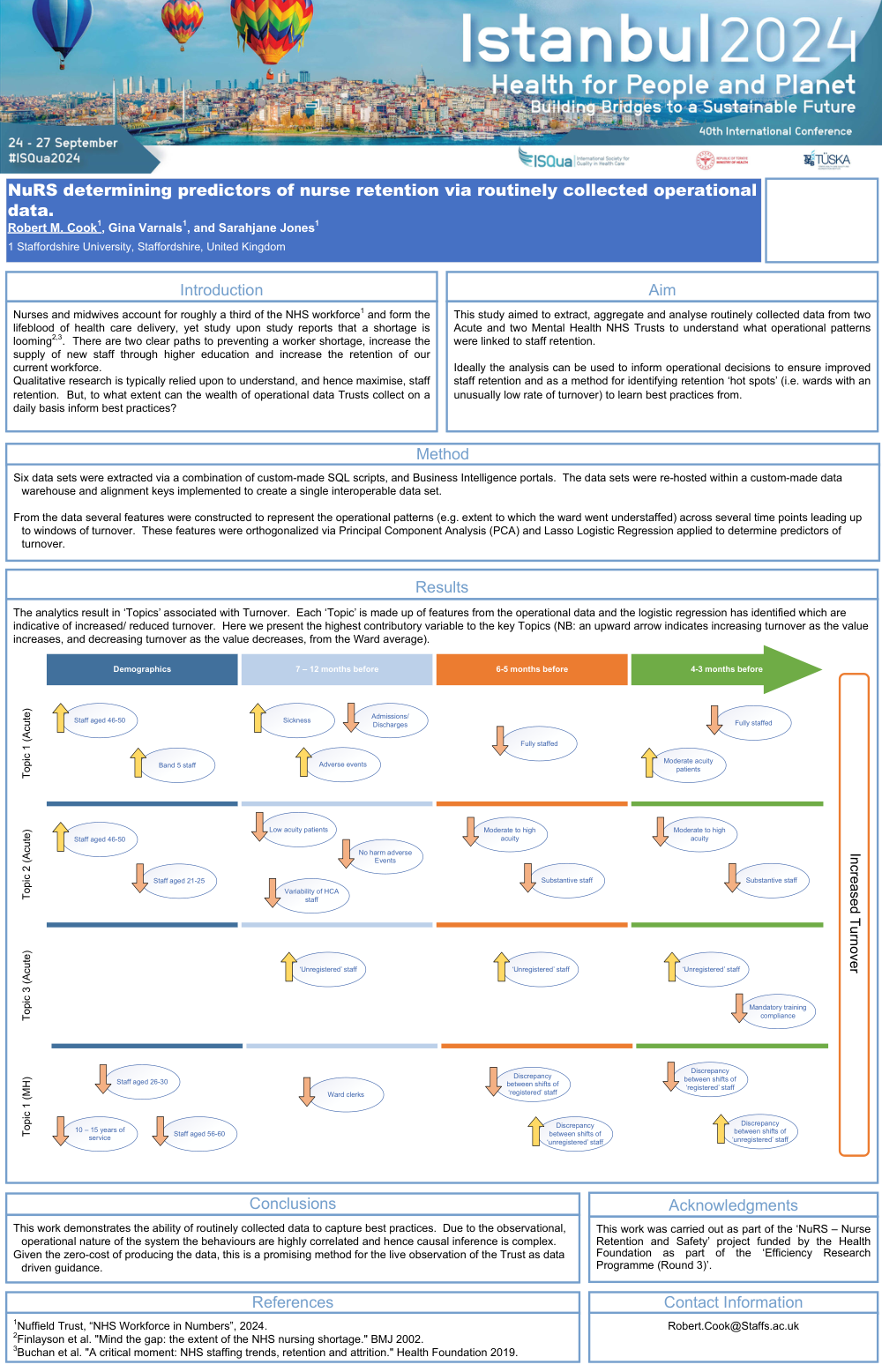
From the data several features were constructed to represent the operational patterns (e.g. extent to which the ward went understaffed) across several time points leading up to windows of turnover. These features were orthogonalized via Principal Component Analysis (PCA) and Lasso Logistic Regression applied to determine predictors of turnover.
Results
The analytics result in ‘Topics’ associated with Turnover. Each ‘Topic’ is made up of features from the operational data and the logistic regression has identified which are indicative of increased/ reduced turnover. Here we present the highest contributory variable to the key Topics (NB: an upward arrow indicates increasing turnover as the value increases, and decreasing turnover as the value decreases, from the Ward average).
Conclusions
This work demonstrates the ability of routinely collected data to capture best practices. Due to the observational, operational nature of the system the behaviours are highly correlated and hence causal inference is complex.
Given the zero-cost of producing the data, this is a promising method for the live observation of the Trust as data driven guidance.
Acknowledgments
This work was carried out as part of the ‘NuRS – Nurse Retention and Safety’ project funded by the Health Foundation as part of the ‘Efficiency Research Programme (Round 3)’.
References
1Nuffield Trust, “NHS Workforce in Numbers”, 2024.
2Finlayson et al. "Mind the gap: the extent of the NHS nursing shortage." BMJ 2002.
3Buchan et al. "A critical moment: NHS staffing trends, retention and attrition." Health Foundation 2019.