586 posters, 8 topics, 23 sessions, 1,077 authors, 622 institutions
ePostersLive by SciGen Technologies S.A. All rights reserved.
ISQua's 40th International Conference 2024
24th - 27th September 2024 | Istanbul, Türkiye

ISQUA2024-ABS-1337
Quality Improvement Capacity Building Program for the Nigerian National Clinical Mentors Program - Lessons Learnt from Implementation
Poster Presenter
Part of Topic
Workforce, Policy, and Governance
ISQUA2024-ABS-1337
Quality Improvement Capacity Building Program for the Nigerian National Clinical Mentors Program - Lessons Learnt from Implementation
Isa S. Daniel, Olaposi Olatoregun, Kehinde Balogun, Oludare Onimode, Jay Osi - Samuels, Andrew Abutu, Bruce Agins, Adebobola Bashorun.
Preferred presentation method: 15-minute oral presentation
Have you presented this abstract at an ISQua Conference before? No
I confirm that the submission has been approved by all authors: Yes
Introduction:
The Federal Ministry of Health (FMOH) in partnership with the US Centers for Disease Control and Prevention (US CDC) initiated a National Clinical Mentorship Program (NCMP) in December 2021 with Public Health Information, Surveillance, Solutions, and Systems (PHIS3) as technical partners. Considering Quality Improvement (QI) methods are proven approaches to improve clients' Quality of Care and Outcomes in healthcare settings, the FMOH identified and employed highly skilled healthcare practitioners as mentors to provide continuous education and to enhance workforce performance and engagement as such the need for QI capacity building of these individuals was vital.
Methods:
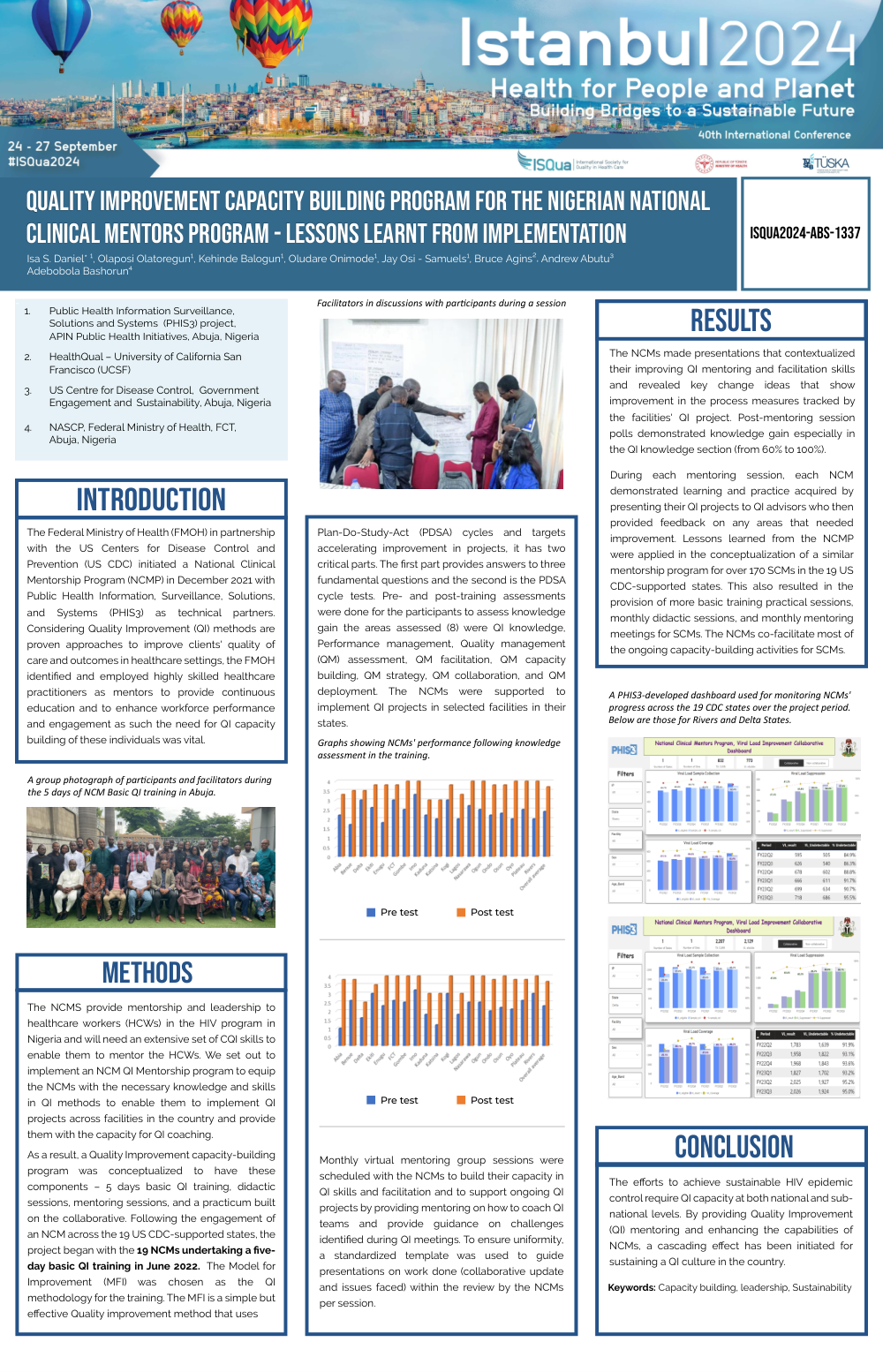
The NCMS provides mentorship and leadership to healthcare workers (HCWs) in the HIV program in Nigeria and will need an extensive set of CQI skills to enable them to mentor the HCWs. We set out to implement an NCM QI Mentorship program to equip the NCMs with the necessary knowledge and skills in QI methods to enable them to implement QI projects across facilities in the country and provide them with the capacity for QI coaching. As a result, a Quality Improvement capacity-building program was conceptualized to have these components – 5 days of basic QI training, didactic sessions, mentoring sessions, and a practicum built on the collaborative. Following the engagement of an NCM across the 19 US CDC-supported states, the project began with the 19 NCMs undertaking a five-day basic QI training in June 2022. The Model for Improvement (MFI) was chosen as the QI methodology for the training. The MFI is a simple but effective Quality improvement method that uses Plan-Do-Study-Act (PDSA) cycles and targets accelerating improvement in projects, it has two critical parts. The first part provides answers to three fundamental questions and the second is the PDSA cycle tests. Pre- and post-training assessments were done for the participants to assess the knowledge gained. The areas assessed (8) were QI knowledge, Performance management, Quality management (QM) assessment, QM facilitation, QM capacity building, QM strategy, QM collaboration, and QM deployment. The NCMs were supported to implement QI projects in selected facilities in their states. Monthly virtual mentoring group sessions were scheduled with the NCMs to build their capacity in QI skills and facilitation and to support ongoing QI projects by providing mentoring on how to coach QI teams and provide guidance on challenges identified during QI meetings. To ensure uniformity, a standardized template was used to guide presentations on work done (collaborative update and issues faced) within the review by the NCMs per session.
Results:
The NCMs made presentations that contextualized their improving QI mentoring and facilitation skills and revealed key change ideas that show improvement in the process measures tracked by the facilities' QI project. Post-mentoring session polls demonstrated knowledge gain especially in the QI knowledge section (from 60% to 100%). During each mentoring session, each NCM demonstrated learning and practice acquired by presenting their QI projects to QI advisors who then provided feedback on any areas that needed improvement. Lessons learned from the NCMP were applied in the conceptualization of a similar mentorship program for over 170 SCMs in the 19 US CDC-supported states. This also resulted in the provision of more basic training practical sessions, monthly didactic sessions, and monthly mentoring meetings for SCMs. The NCMs co-facilitate most of the ongoing capacity-building activities for SCMs.
Conclusion:
The efforts to achieve sustainable HIV epidemic control require QI capacity at both national and sub-national levels. By providing Quality Improvement (QI) mentoring and enhancing the capabilities of NCMs, a cascading effect has been initiated for sustaining a QI culture in the country.
Disclosure of Interest: None Declared
Keywords: Capacity building, leadership, Sustainability