586 posters, 8 topics, 23 sessions, 1,077 authors, 622 institutions
ePostersLive by SciGen Technologies S.A. All rights reserved.
ISQua's 40th International Conference 2024
24th - 27th September 2024 | Istanbul, Türkiye

P600
Why do acute healthcare staff behave unprofessionally towards each other and how can these behaviours be reduced? A realist review
Poster Presenter
Authors
Part of Topic
Workforce, Policy, and Governance
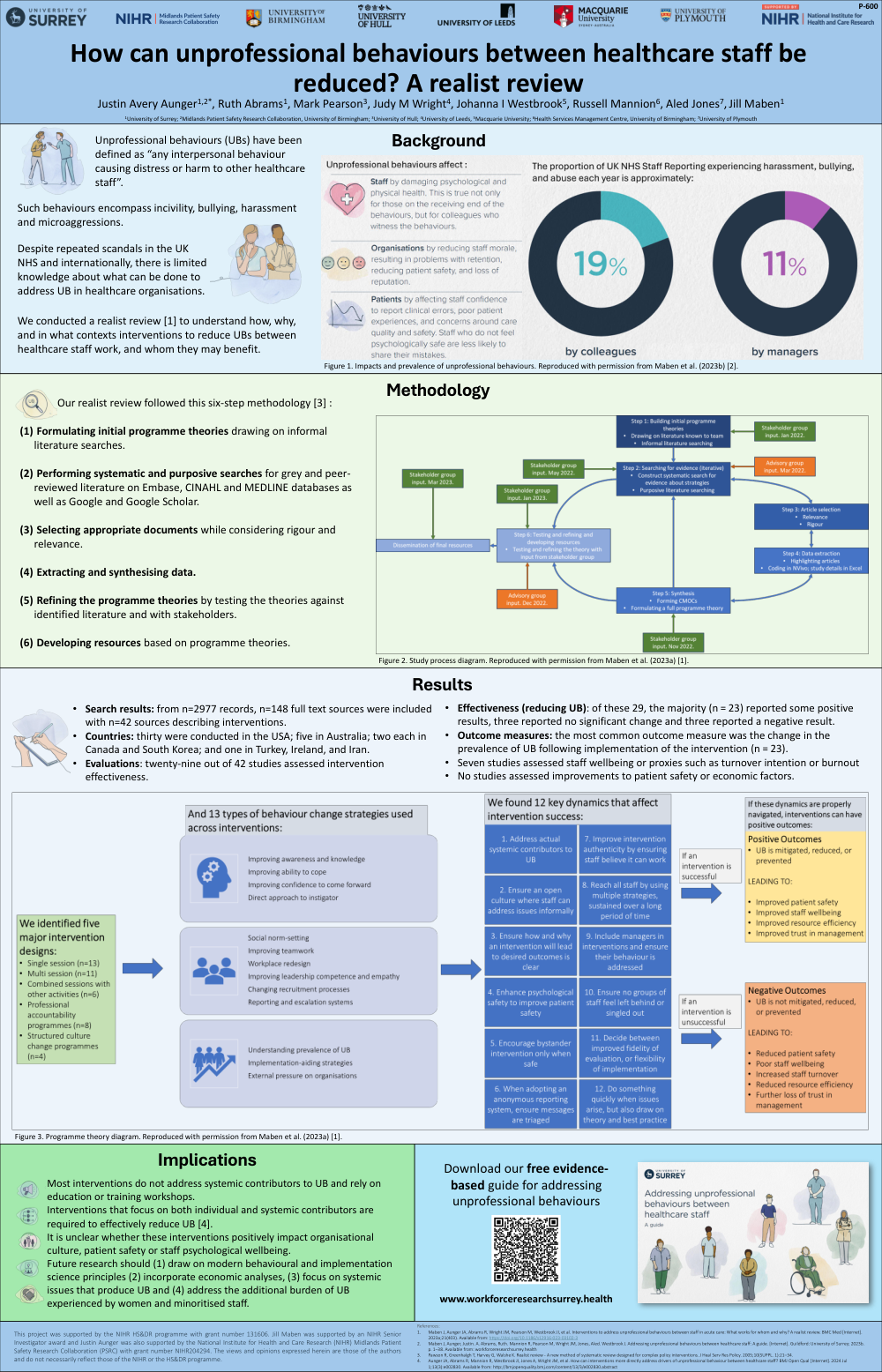
How can unprofessional behaviours between healthcare staff be reduced? A realist review
Introduction
Unprofessional behaviours (UBs) have been defined as “any interpersonal behaviour causing distress or harm to other healthcare staff”.
Such behaviours encompass incivility, bullying, harassment and microaggressions.
Despite repeated scandals in the UK NHS and internationally, there is limited knowledge about what can be done to address UB in healthcare organisations.
We conducted a realist review [1] to understand how, why, and in what contexts interventions to reduce UBs between healthcare staff work, and whom they may benefit.
Methods
Our realist review followed this six-step methodology [3]:
(1) Formulating initial programme theories drawing on informal literature searches.
(2) Performing systematic and purposive searches for grey and peer-reviewed literature on Embase, CINAHL and MEDLINE databases as well as Google and Google Scholar.
(3) Selecting appropriate documents while considering rigour and relevance.
(4) Extracting and synthesising data.
(5) Refining the programme theories by testing the theories against identified literature and with stakeholders.
(6) Developing resources based on programme theories.
Results
Most interventions do not address systemic contributors to UB and rely on education or training workshops. Interventions that focus on both individual and systemic contributors are required to effectively reduce UB [4]. It is unclear whether these interventions positively impact organisational culture, patient safety or staff psychological wellbeing. Future research should (1) draw on modern behavioural and implementation science principles (2) incorporate economic analyses, (3) focus on systemic issues that produce UB and (4) address the additional burden of UB experienced by women and minoritised staff.
References: