586 posters, 8 topics, 23 sessions, 1,077 authors, 622 institutions
ePostersLive by SciGen Technologies S.A. All rights reserved.
ISQua's 40th International Conference 2024
24th - 27th September 2024 | Istanbul, Türkiye

P689
Training allied health and non-clinical staff to decontaminate casualties in a chemical mass casualty incident – A systems perspective.
Poster Presenter
Authors
Affiliations
Part of Topic
Equity in Action: Addressing Global Healthcare Emergencies
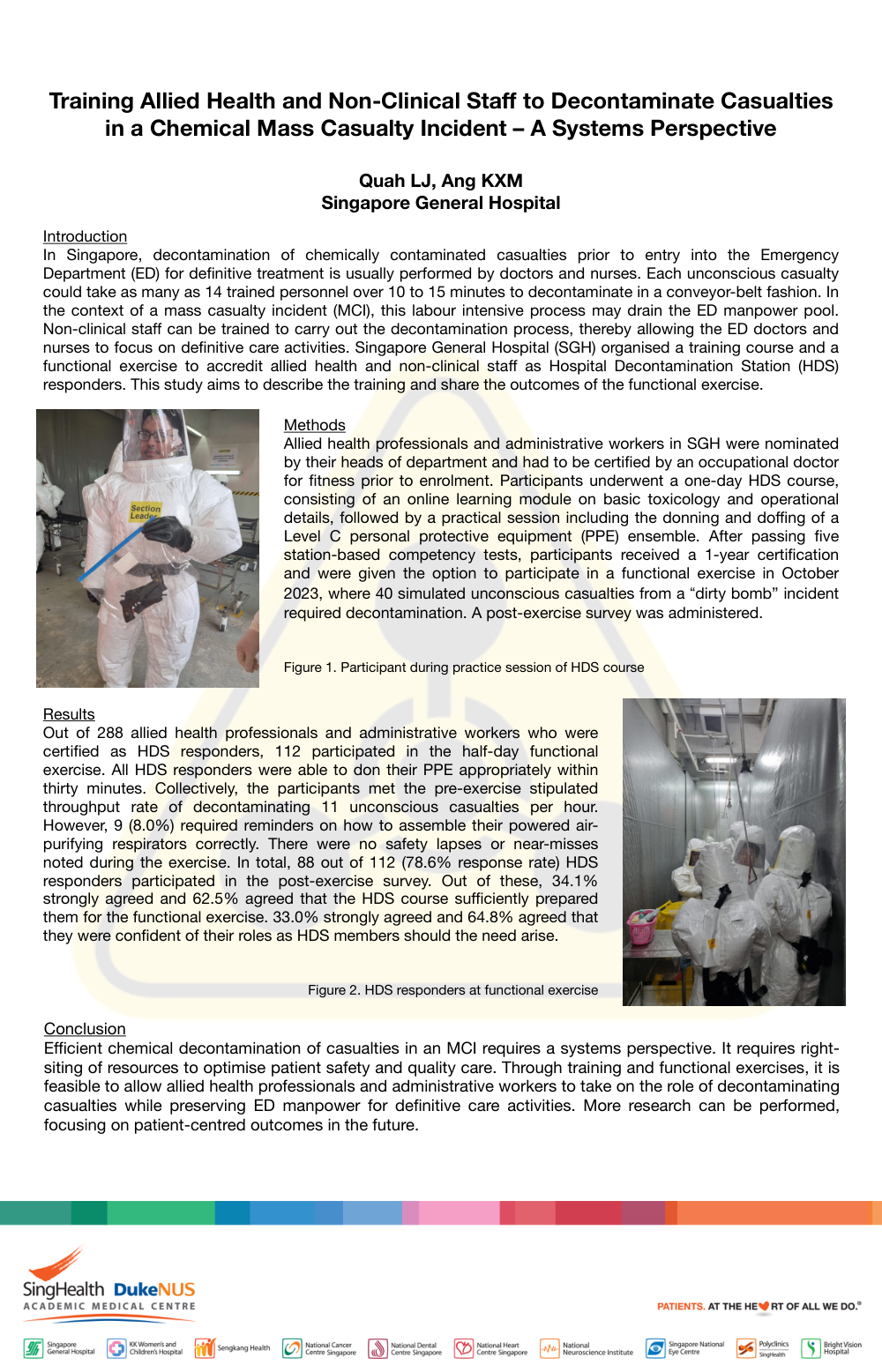
Training Allied Health and Non-Clinical Staff to Decontaminate Casualties in a Chemical Mass Casualty Incident – A Systems Perspective
Quah LJ, Ang KXM Singapore General Hospital
Introduction
In Singapore, decontamination of chemically contaminated casualties prior to entry into the Emergency Department (ED) for definitive treatment is usually performed by doctors and nurses. Each unconscious casualty could take as many as 14 trained personnel over 10 to 15 minutes to decontaminate in a conveyor-belt fashion. In the context of a mass casualty incident (MCI), this labour intensive process may drain the ED manpower pool. Non-clinical staff can be trained to carry out the decontamination process, thereby allowing the ED doctors and nurses to focus on definitive care activities. Singapore General Hospital (SGH) organised a training course and a functional exercise to accredit allied health and non-clinical staff as Hospital Decontamination Station (HDS) responders. This study aims to describe the training and share the outcomes of the functional exercise.
Methods
Allied health professionals and administrative workers in SGH were nominated by their heads of department and had to be certified by an occupational doctor for fitness prior to enrolment. Participants underwent a one-day HDS course, consisting of an online learning module on basic toxicology and operational details, followed by a practical session including the donning and doffing of a Level C personal protective equipment (PPE) ensemble. After passing five station-based competency tests, participants received a 1-year certification and were given the option to participate in a functional exercise in October 2023, where 40 simulated unconscious casualties from a !dirty bomb” incident required decontamination. A post-exercise survey was administered.
Results
Out of 288 allied health professionals and administrative workers who were certified as HDS responders, 112 participated in the half-day functional exercise. All HDS responders were able to don their PPE appropriately within thirty minutes. Collectively, the participants met the pre-exercise stipulated throughput rate of decontaminating 11 unconscious casualties per hour. However, 9 (8.0%) required reminders on how to assemble their powered air- purifying respirators correctly. There were no safety lapses or near-misses noted during the exercise. In total, 88 out of 112 (78.6% response rate) HDS responders participated in the post-exercise survey. Out of these, 34.1% strongly agreed and 62.5% agreed that the HDS course sufficiently prepared them for the functional exercise. 33.0% strongly agreed and 64.8% agreed that they were confident of their roles as HDS members should the need arise.
Conclusion
Efficient chemical decontamination of casualties in an MCI requires a systems perspective. It requires right- siting of resources to optimise patient safety and quality care. Through training and functional exercises, it is feasible to allow allied health professionals and administrative workers to take on the role of decontaminating casualties while preserving ED manpower for definitive care activities. More research can be performed, focusing on patient-centred outcomes in the future.