586 posters, 8 topics, 23 sessions, 1,077 authors, 622 institutions
ePostersLive by SciGen Technologies S.A. All rights reserved.
ISQua's 40th International Conference 2024
24th - 27th September 2024 | Istanbul, Türkiye

P607
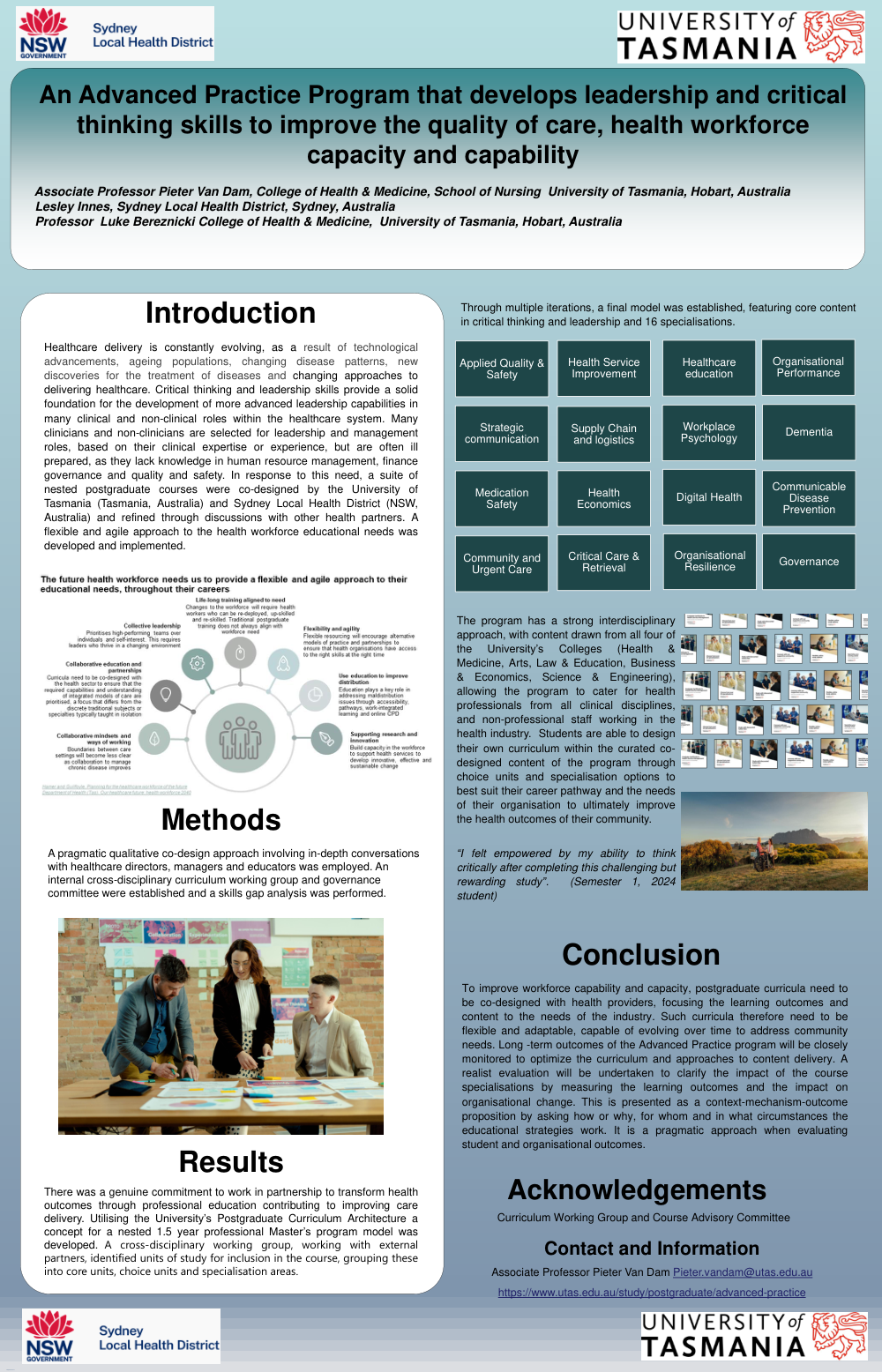
An Advanced Practice Program that develops leadership and critical thinking skills to improve the quality of care, health workforce capacity and capability
Poster Presenter
Part of Topic
Workforce, Policy, and Governance
An Advanced Practice Program that develops leadership and critical thinking skills to improve the quality of care, health workforce capacity and capability
Associate Professor Pieter Van Dam, College of Health & Medicine, School of Nursing University of Tasmania, Hobart, Australia
Lesley Innes, Sydney Local Health District, Sydney, Australia
Professor Luke Bereznicki College of Health & Medicine, University of Tasmania, Hobart, Australia
Introduction
Healthcare delivery is constantly evolving, as a result of technological advancements, ageing populations, changing disease patterns, new discoveries for the treatment of diseases and changing approaches to delivering healthcare. Critical thinking and leadership skills provide a solid foundation for the development of more advanced leadership capabilities in many clinical and non-clinical roles within the healthcare system. Many clinicians and non-clinicians are selected for leadership and management roles, based on their clinical expertise or experience, but are often ill prepared, as they lack knowledge in human resource management, finance governance and quality and safety. In response to this need, a suite of nested postgraduate courses were co-designed by the University of Tasmania (Tasmania, Australia) and Sydney Local Health District (NSW, Australia) and refined through discussions with other health partners. A flexible and agile approach to the health workforce educational needs was developed and implemented.
Methods
A pragmatic qualitative co-design approach involving in-depth conversations with healthcare directors, managers and educators was employed. An internal cross-disciplinary curriculum working group and governance committee were established and a skills gap analysis was performed.
Results
There was a genuine commitment to work in partnership to transform health outcomes through professional education contributing to improving care delivery. Utilising the University’s Postgraduate Curriculum Architecture a concept for a nested 1.5 year professional Master’s program model was developed. A cross-disciplinary working group, working with external partners, identified units of study for inclusion in the course, grouping these into core units, choice units and specialisation areas. Through multiple iterations, a final model was established, featuring core content in critical thinking and leadership and 16 specialisations.
The program has a strong interdisciplinary approach, with content drawn from all four of the University’s Colleges (Health & Medicine, Arts, Law & Education, Business & Economics, Science & Engineering), allowing the program to cater for health professionals from all clinical disciplines, and non-professional staff working in the health industry. Students are able to design their own curriculum within the curated co-designed content of the program through choice units and specialisation options to best suit their career pathway and the needs of their organisation to ultimately improve the health outcomes of their community.
“I felt empowered by my ability to think critically after completing this challenging but rewarding study”. (Semester 1, 2024 student)
Conclusion
To improve workforce capability and capacity, postgraduate curricula need to be co-designed with health providers, focusing the learning outcomes and content to the needs of the industry. Such curricula therefore need to be flexible and adaptable, capable of evolving over time to address community needs. Long -term outcomes of the Advanced Practice program will be closely monitored to optimize the curriculum and approaches to content delivery. A realist evaluation will be undertaken to clarify the impact of the course specialisations by measuring the learning outcomes and the impact on organisational change. This is presented as a context-mechanism-outcome proposition by asking how or why, for whom and in what circumstances the educational strategies work. It is a pragmatic approach when evaluating student and organisational outcomes.
Acknowledgements
Curriculum Working Group and Course Advisory Committee
Contact and Information
Associate Professor Pieter Van Dam Pieter.vandam@utas.edu.au
https://www.utas.edu.au/study/postgraduate/advanced-practice