586 posters, 8 topics, 23 sessions, 1,077 authors, 622 institutions
ePostersLive by SciGen Technologies S.A. All rights reserved.
ISQua's 40th International Conference 2024
24th - 27th September 2024 | Istanbul, Türkiye

P591
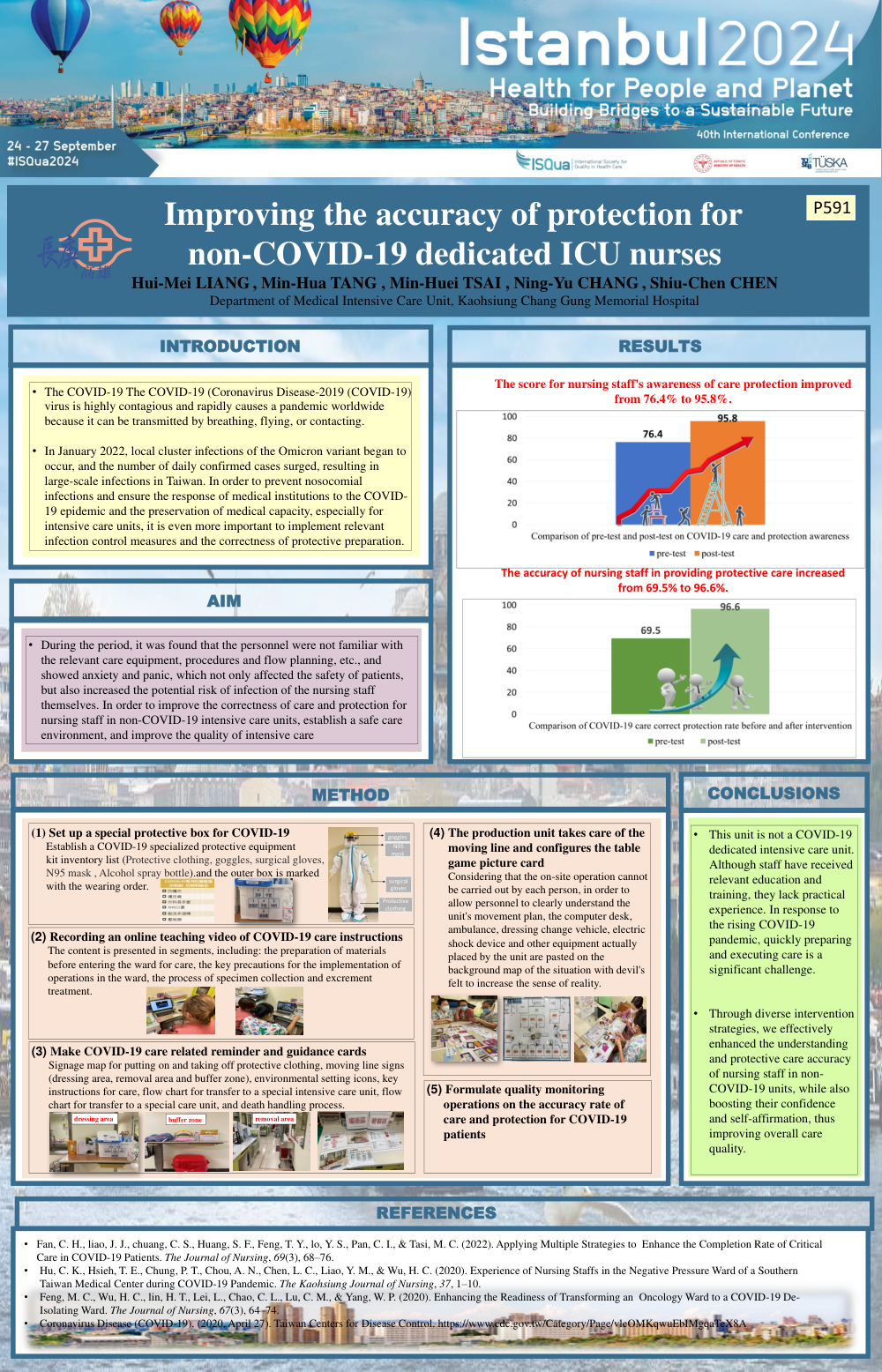
Improving the accuracy of protection for non-COVID-19 dedicated ICU nurses
Poster Presenter
Authors
Affiliations
Part of Topic
Workforce, Policy, and Governance
Improving the accuracy of protection for non-COVID-19
dedicated ICU nurses
Hui-Mei LIANG, Min-Hua TANG , Min-Huei TSAI , Ning-Yu CHANG, Shiu-Chen CHEN
Department of Medical Intensive Care Unit, Kaohsiung Chang Gung Memorial Hospital
INTRODUCTION
The COVID-19 The COVID-19 (Coronavirus Disease-2019 (COVID-19) virus is highly contagious and rapidly causes a pandemic worldwide because it can be transmitted by breathing, flying, or contacting.In January 2022, local cluster infections of the Omicron variant began to occur, and the number of daily confirmed cases surged, resulting in large-scale infections in Taiwan. In order to prevent nosocomial infections and ensure the response of medical institutions to the COVID-19 epidemic and the preservation of medical capacity, especially for intensive care units, it is even more important to implement relevant infection control measures and the correctness of protective preparation.
AIM
During the period, it was found that the personnel were not familiar with the relevant care equipment, procedures and flow planning, etc., and showed anxiety and panic, which not only affected the safety of patients, but also increased the potential risk of infection of the nursing staff themselves. In order to improve the correctness of care and protection for nursing staff in non-COVID-19 intensive care units, establish a safe care environment, and improve the quality of intensive care
METHOD
(1)Set up a special protective box for COVID-19:Establish a COVID-19 specialized protective equipment kit inventory list (Protective clothing, goggles, surgical gloves, N95 mask , Alcohol spray bottle).and the outer box is marked with the wearing order.
(2)Recording an online teaching video of COVID-19 care instructions:The content is presented in segments, including: the preparation of materials before entering the ward for care, the key precautions for the implementation of operations in the ward, the process of specimen collection and excrement treatment.
(3)Make COVID-19 care related reminder and guidance cards:Signage map for putting on and taking off protective clothing, moving line signs (dressing area, removal area and buffer zone), environmental setting icons, key instructions for care, flow chart for transfer to a special intensive care unit, flow chart for transfer to a special care unit, and death handling process.
(4)The production unit takes care of the moving line and configures the table game picture card:Considering that the on-site operation cannot be carried out by each person, in order to allow personnel to clearly understand the unit's movement plan, the computer desk, ambulance, dressing change vehicle, electric shock device and other equipment actually placed by the unit are pasted on the background map of the situation with devil's felt to increase the sense of reality.
(5)Formulate quality monitoring operations on the accuracy rate of care and protection for COVID-19 patients
RESULTS
The score for nursing staff's awareness of care protection improved from 76.4% to 95.8%.
The accuracy of nursing staff in providing protective care increased from 69.5% to 96.6%.
CONCLUSIONS
This unit is not a COVID-19 dedicated intensive care unit. Although staff have received relevant education and training, they lack practical experience. In response to the rising COVID-19 pandemic, quickly preparing and executing care is a significant challenge.Through diverse intervention strategies, we effectively enhanced the understanding and protective care accuracy of nursing staff in non-COVID-19 units, while also boosting their confidence and self-affirmation, thus improving overall care quality.