586 posters, 8 topics, 23 sessions, 1,077 authors, 622 institutions
ePostersLive by SciGen Technologies S.A. All rights reserved.
ISQua's 40th International Conference 2024
24th - 27th September 2024 | Istanbul, Türkiye

P608
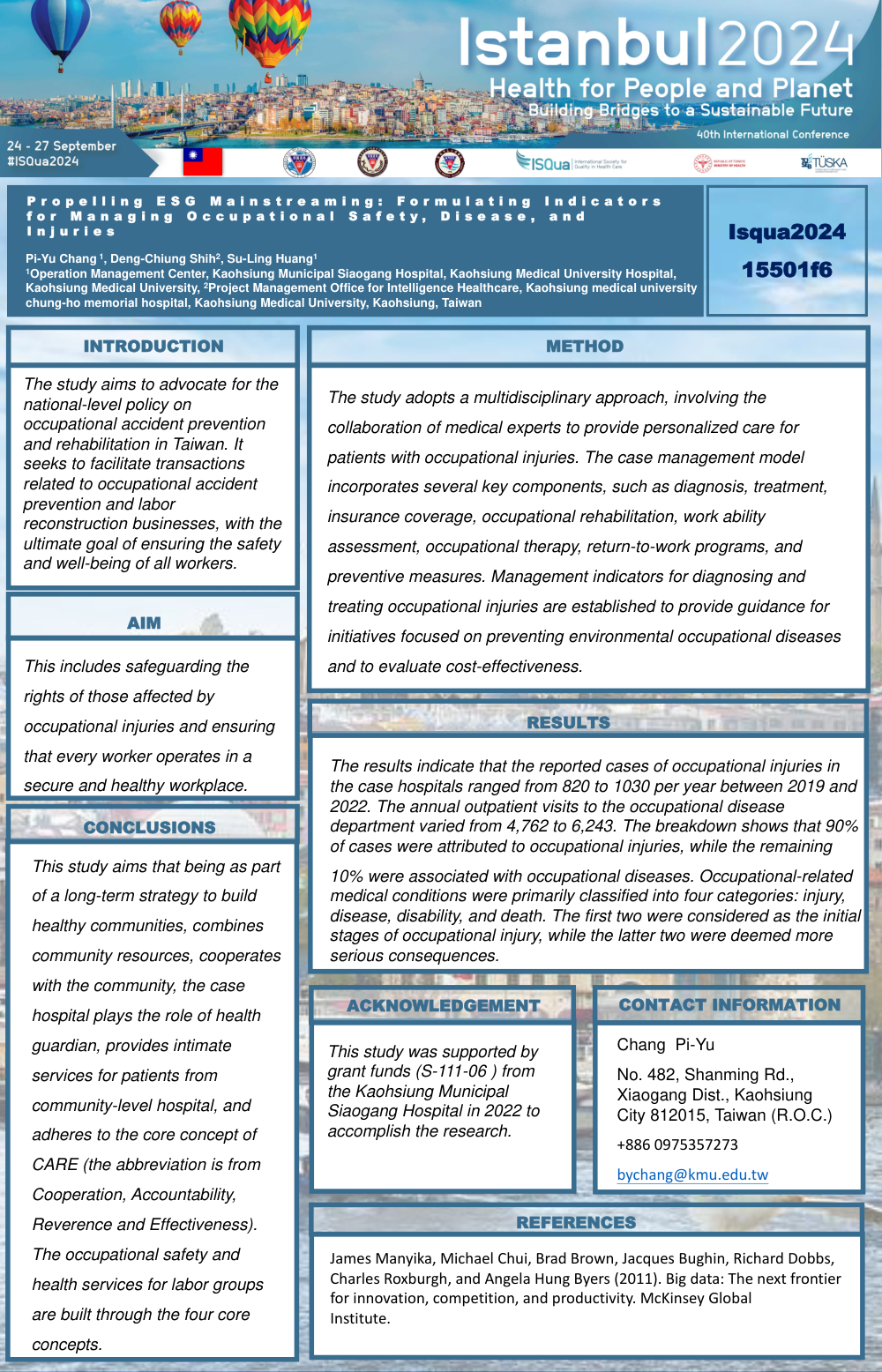
Propelling ESG Mainstreaming: Formulating Indicators for Managing Occupational Safety, Disease, and Injuries
Poster Presenter
Part of Topic
Workforce, Policy, and Governance
Introduction: The study aims to advocate for the national-level policy on occupational accident prevention and
rehabilitation in Taiwan. It seeks to facilitate transactions related to occupational accident prevention and labor
reconstruction businesses, with the ultimate goal of ensuring the safety and well-being of all workers. This includes
safeguarding the rights of those affected by occupational injuries and ensuring that every worker operates in a secure
and healthy workplace.
Methods: The study adopts a multidisciplinary approach, involving the collaboration of medical experts to provide
personalized care for patients with occupational injuries. The case management model incorporates several key
components, such as diagnosis, treatment, insurance coverage, occupational rehabilitation, work ability assessment,
occupational therapy, return-to-work programs, and preventive measures. Management indicators for diagnosing
and treating occupational injuries are established to provide guidance for initiatives focused on preventing
environmental occupational diseases and to evaluate cost-effectiveness.
Results: The results indicate that the reported cases of occupational injuries in the case hospitals ranged from 820 to
1030 per year between 2019 and 2022. The annual outpatient visits to the occupational disease department varied from
4,762 to 6,243. The breakdown shows that 90% of cases were attributed to occupational injuries, while the remaining
10% were associated with occupational diseases. Occupational-related medical conditions were primarily classified into
four categories: injury, disease, disability, and death. The first two were considered as the initial stages of occupational
injury, while the latter two were deemed more serious consequences.
Conclusion: This study aims that being as part of a long-term strategy to build healthy communities, combines
community resources, cooperates with the community, the case hospital plays the role of health guardian, provides
intimate services for patients from community-level hospital, and adheres to the core concept of CARE (the
abbreviation is from Cooperation, Accountability, Reverence and Effectiveness). The occupational safety and health
services for labor groups are built through the four core concepts.
References: 1. James Manyika, Michael Chui, Brad Brown, Jacques Bughin, Richard Dobbs, Charles Roxburgh,
and Angela Hung Byers (2011). Big data: The next frontier for innovation, competition, and productivity. McKinsey Global
Institute.