586 posters, 8 topics, 23 sessions, 1,077 authors, 622 institutions
ePostersLive by SciGen Technologies S.A. All rights reserved.
ISQua's 40th International Conference 2024
24th - 27th September 2024 | Istanbul, Türkiye

P599
Survey of Workplace Stress for Health Workers in a Teaching Hospital
Poster Presenter
Part of Topic
Workforce, Policy, and Governance
Survey of Workplace Stress for Health Workers in a Teaching Hospital
Introduction
Health workers are usually exposed to a heavy and complex environment. The highly stressful workplace not only makes them prone to psychological pressure but may also cause job burnout and mental exhaustion. Recently, a study indicated that health workers suffer from burnout syndrome, and this situation contributes to the impairment of the quality of care and patient safety2. The performance of health workers may be impacted by workplace disturbances like medical violence and disputes. The aim of the survey was to evaluate the association between job stress and workplace violence, sexual harassment, medical disputes, and gender inequality in our hospital.
Methods
The "Depression Anxiety Stress Scales-21 (DASS-21)2" (Chinese version) and the "Workplace Happiness Scale (Workplace Well-being Scale)" are adjusted and used in the research methodology. There were just 20 questions total and the questionnaire was used to measure the levels of stress, anxiety, and depression for our employees. One question of “I felt I wasn't worth much as a person” as an implicit insult meaning in Chinese culture in the original DASS-21 was excluded from our survey.
Results
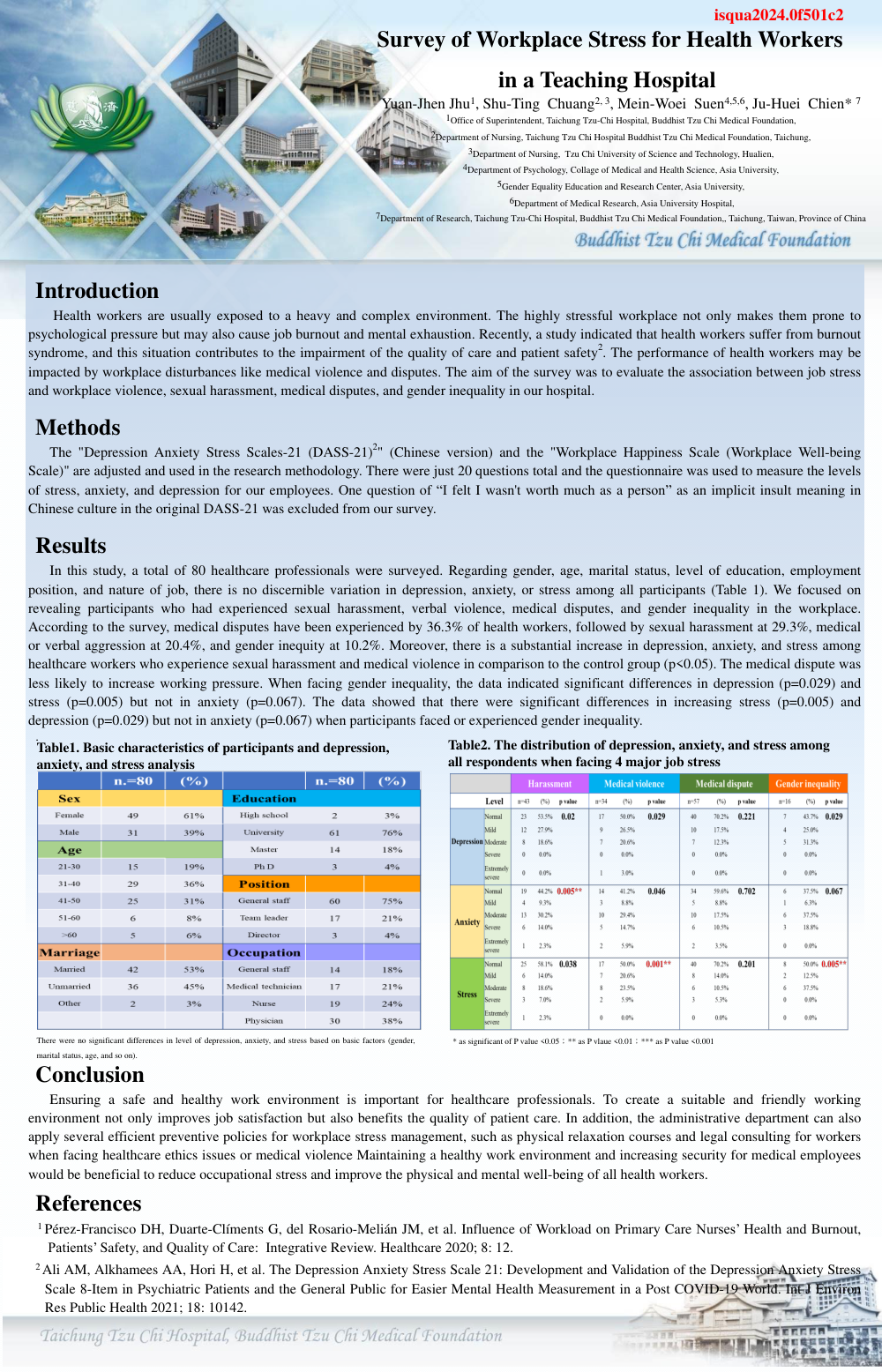
In this study, a total of 80 healthcare professionals were surveyed. Regarding gender, age, marital status, level of education, employment position, and nature of job, there is no discernible variation in depression, anxiety, or stress among all participants (Table 1). We focused on revealing participants who had experienced sexual harassment, verbal violence, medical disputes, and gender inequality in the workplace. According to the survey, medical disputes have been experienced by 36.3% of health workers, followed by sexual harassment at 29.3%, medical or verbal aggression at 20.4%, and gender inequity at 10.2%. Moreover, there is a substantial increase in depression, anxiety, and stress among healthcare workers who experience sexual harassment and medical violence in comparison to the control group (p<0.05). The medical dispute was less likely to increase working pressure. When facing gender inequality, the data indicated significant differences in depression (p=0.029) and stress (p=0.005) but not in anxiety (p=0.067). The data showed that there were significant differences in increasing stress (p=0.005) and depression (p=0.029) but not in anxiety (p=0.067) when participants faced or experienced gender inequality.
Conclusion
Ensuring a safe and healthy work environment is important for healthcare professionals. To create a suitable and friendly working environment not only improves job satisfaction but also benefits the quality of patient care. In addition, the administrative department can also apply several efficient preventive policies for workplace stress management, such as physical relaxation courses and legal consulting for workers when facing healthcare ethics issues or medical violence Maintaining a healthy work environment and increasing security for medical employees would be beneficial to reduce occupational stress and improve the physical and mental well-being of all health workers.