586 posters, 8 topics, 23 sessions, 1,077 authors, 622 institutions
ePostersLive by SciGen Technologies S.A. All rights reserved.
ISQua's 40th International Conference 2024
24th - 27th September 2024 | Istanbul, Türkiye

ISQUA2024-ABS-3534
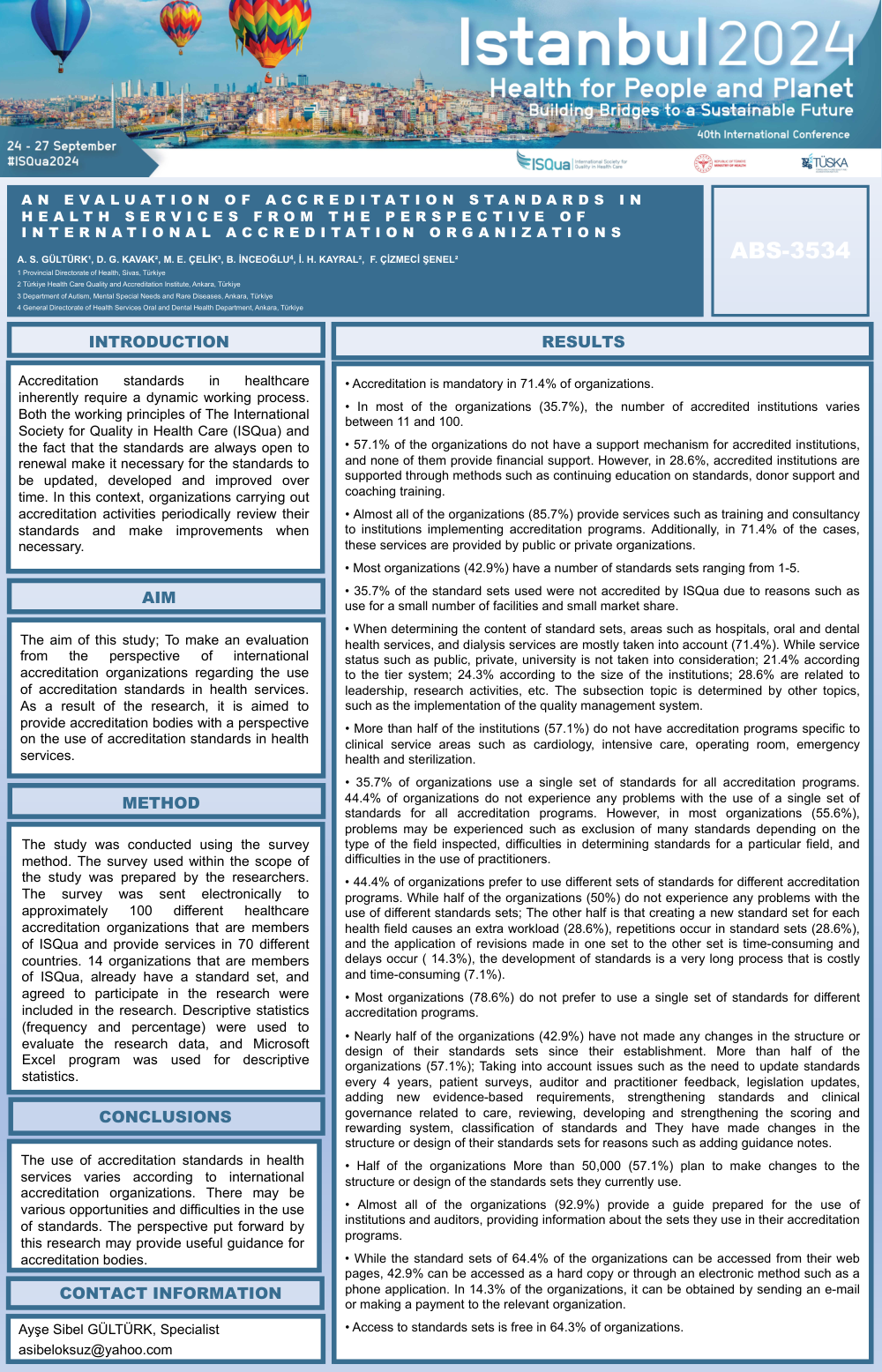
AN EVALUATION OF ACCREDITATION STANDARDS IN HEALTH SERVICES FROM THE PERSPECTIVE OF INTERNATIONAL ACCREDITATION ORGANIZATIONS
Poster Presenter
Part of Topic
Workforce, Policy, and Governance
Introduction
Accreditation standards in healthcare inherently require a dynamic working process. Both the working principles of The International Society for Quality in Health Care (ISQua) and the fact that the standards are always open to renewal make it necessary for the standards to be updated, developed and improved over time. In this context, organizations carrying out accreditation activities periodically review their standards and make improvements when necessary. The purpose of this study; To make an evaluation from the perspective of international accreditation organizations regarding the use of accreditation standards in health services. As a result of the research, it is aimed to provide accreditation bodies with a perspective on the use of accreditation standards in health services.
Method
The study was conducted using the survey method. The survey used within the scope of the study was prepared by the researchers. The survey was sent electronically to approximately 100 different healthcare accreditation organizations that are members of ISQua and provide services in 70 different countries. 14 organizations that are members of ISQua, already have a standard set, and agreed to participate in the research were included in the research. Descriptive statistics (frequency and percentage) were used to evaluate the research data, and Microsoft Excel program was used for descriptive statistics.
Results
• Accreditation is mandatory in 71.4% of organizations.
• In most of the organizations (35.7%), the number of accredited institutions varies between 11 and 100.
• 57.1% of the organizations do not have a support mechanism for accredited institutions, and none of them provide financial support. However, in 28.6%, accredited institutions are supported through methods such as continuing education on standards, donor support and coaching training.
• Almost all of the organizations (85.7%) provide services such as training and consultancy to institutions implementing accreditation programs. Additionally, in 71.4% of the cases, these services are provided by public or private organizations.
• Most organizations (42.9%) have a number of standards sets ranging from 1-5.
• 35.7% of the standard sets used were not accredited by ISQua due to reasons such as use for a small number of facilities and small market share.
• When determining the content of standard sets, areas such as hospitals, oral and dental health services, and dialysis services are mostly taken into account (71.4%). While service status such as public, private, university is not taken into consideration; 21.4% according to the tier system; 24.3% according to the size of the institutions; 28.6% are related to leadership, research activities, etc. The subsection topic is determined by other topics, such as the implementation of the quality management system.
• More than half of the institutions (57.1%) do not have accreditation programs specific to clinical service areas such as cardiology, intensive care, operating room, emergency health and sterilization.
• 35.7% of organizations use a single set of standards for all accreditation programs. 44.4% of organizations do not experience any problems with the use of a single set of standards for all accreditation programs. However, in most organizations (55.6%), problems may be experienced such as exclusion of many standards depending on the type of the field inspected, difficulties in determining standards for a particular field, and difficulties in the use of practitioners.
• 44.4% of organizations prefer to use different sets of standards for different accreditation programs. While half of the organizations (50%) do not experience any problems with the use of different standards sets; The other half is that creating a new standard set for each health field causes an extra workload (28.6%), repetitions occur in standard sets (28.6%), and the application of revisions made in one set to the other set is time-consuming and delays occur ( 14.3%), the development of standards is a very long process that is costly and time-consuming (7.1%).
• Most organizations (78.6%) do not prefer to use a single set of standards for different accreditation programs.
• Nearly half of the organizations (42.9%) have not made any changes in the structure or design of their standards sets since their establishment. More than half of the organizations (57.1%); Taking into account issues such as the need to update standards every 4 years, patient surveys, auditor and practitioner feedback, legislation updates, adding new evidence-based requirements, strengthening standards and clinical governance related to care, reviewing, developing and strengthening the scoring and rewarding system, classification of standards and They have made changes in the structure or design of their standards sets for reasons such as adding guidance notes.
• Half of the organizations More than 50,000 (57.1%) plan to make changes to the structure or design of the standards sets they currently use.
• Almost all of the organizations (92.9%) provide a guide prepared for the use of institutions and auditors, providing information about the sets they use in their accreditation programs.
• While the standard sets of 64.4% of the organizations can be accessed from their web pages, 42.9% can be accessed as a hard copy or through an electronic method such as a phone application. In 14.3% of the organizations, it can be obtained by sending an e-mail or making a payment to the relevant organization.
• Access to standards sets is free in 64.3% of organizations.
Conclusion
The use of accreditation standards in health services varies according to international accreditation organizations. There may be various opportunities and difficulties in the use of standards. The perspective put forward by this research may provide useful guidance for accreditation bodies.