586 posters, 8 topics, 23 sessions, 1,077 authors, 622 institutions
ePostersLive by SciGen Technologies S.A. All rights reserved.
ISQua's 40th International Conference 2024
24th - 27th September 2024 | Istanbul, Türkiye

ISQUA2024-ABS-2974
Implementing genomics in Primary Care
Poster Presenter
Authors
Affiliations
Part of Topic
Workforce, Policy, and Governance
Implementing genomics in Primary Care
Janet C. Long* 1, Stephanie Best1, 2, 3, Zoe Fehlberg1, 3, Jeffrey Braithwaite1
1Australian Institute of Health Innovation, Macquarie University, Sydney, 2School of Health Sciences, University of
Melbourne, 3Australian Genomics, Murdoch Children's Research Institute, Melbourne, Australia
Introduction: Genomic testing is becoming more widely available across all health care settings in Australia, including
primary health. The evidence-base of clinical utility and cost effectiveness of many genomic applications is now well
established and growing, and consumer attitudes are becoming more positive to testing. Recent additions of genomic
tests onto the Australian universal insurance scheme, Medicare, have made tests such as genetic carrier screening for
couples planning a family, and testing for actionable genetic diseases such as familial hypercholesterolaemia, more
feasible in primary practice. However, many general practitioners (GPs) [family physicians], have limited experience in
genetic testing. There are also concerns over the capacity of specialist genomic services to handle any increases in
referrals. The aim of this study is to define the challenges of implementing genomics into primary care, and strategies and
resources being used to address them. This has very important consequences for the quality of care and the
sustainability of health systems.
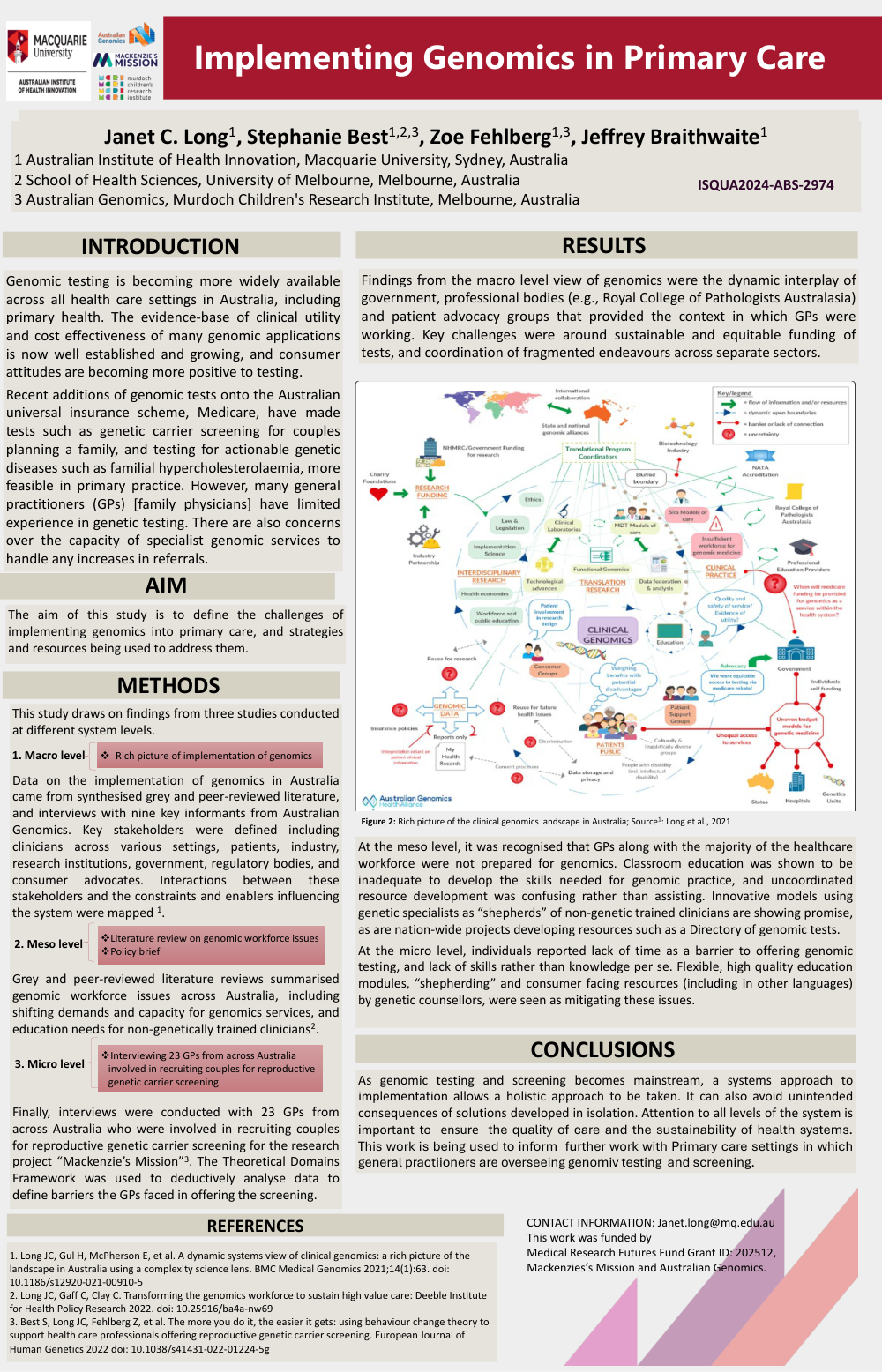
Methods: This study draws on findings from three studies conducted at different system levels. (1) At the macro level of
the system, we developed a holistic view of clinical genomics across Australia1. Data came from synthesised grey and
peer-reviewed literature, and interviews with nine key informants from Australian Genomics. Key stakeholders were
defined including clinicians across various settings, patients, industry, research institutions, government, regulatory
bodies, and consumer advocates. Interactions between these stakeholders and the constraints and enablers influencing
the system were mapped. (2) At the meso level, grey and peer-reviewed literature reviews summarised genomic
workforce issues across Australia, including shifting demands and capacity for genomics services, and education needs
for non-genetically trained clinicians2. (3) At the micro level, interviews were conducted with 23 GPs from across Australia
who were involved in recruiting couples for reproductive genetic carrier screening for the research project “Mackenzie’s
Mission”3. The Theoretical Domains Framework was used to deductively analyse data to define barriers the GPs faced in
offering the screening. Ethics approval was granted by Royal Childrens’ Hospital Melbourne Research Ethics Committee
(HREC/53433/RCHM-2019).
Results: Findings from the systems level view of genomics were the dynamic interplay of government, professional
bodies (e.g., Royal College of Pathologists Australasia) and patient advocacy groups that provided the context in which
GPs were working. Key challenges were around sustainable and equitable funding of tests, and coordination of
fragmented endeavours across separate sectors. At the meso level, it was recognised that GPs along with the majority of
the healthcare workforce were not prepared for genomics. Classroom education was shown to be inadequate to develop
the skills needed for genomic practice, and uncoordinated resource development was confusing rather than assisting.
Innovative models using genetic specialists as “shepherds” of non-genetic trained clinicians are showing promise, as are
nation-wide projects developing resources such as a Directory of genomic tests. At the micro level, individuals reported
lack of time as a barrier to offering genomic testing, and lack of skills rather than knowledge per se. Flexible, high quality
education modules, “shepherding” by genetic counsellors, and consumer facing resources (including in other languages)
were seen as mitigating these issues.
Conclusion: As genomic testing becomes mainstream, a systems approach to implementation allows a holistic approach
to be taken. It can also avoid unintended consequences of solutions developed in isolation.
References: 1. Long JC, Gul H, McPherson E, et al. A dynamic systems view of clinical genomics: a rich picture of
the landscape in Australia using a complexity science lens. BMC Medical Genomics 2021;14(1):63. doi: 10.1186/s12920-
021-00910-5
2. Long JC, Gaff C, Clay C. Transforming the genomics workforce to sustain high value care: Deeble Institute for
Health Policy Research 2022. doi: 10.25916/ba4a-nw69
3. Best S, Long JC, Fehlberg Z, et al. The more you do it, the easier it gets: using behaviour change theory to
support health care professionals offering reproductive genetic carrier screening. European Journal of Human Genetics
2022 doi: 10.1038/s41431-022-01224-5
Disclosure of Interest: None Declared
Keywords: genomics, Implementation Science, primary care services