586 posters, 8 topics, 23 sessions, 1,077 authors, 622 institutions
ePostersLive by SciGen Technologies S.A. All rights reserved.
ISQua's 40th International Conference 2024
24th - 27th September 2024 | Istanbul, Türkiye

ISQUA2024-ABS-2921
Student Nurse Retention – identifying risks and best practices for retention via retrospective data analysis
Poster Presenter
Authors
Affiliations
Part of Topic
Workforce, Policy, and Governance
Introduction
Nurses and midwives account for roughly a third of the NHS workforce1 and form the lifeblood of health care delivery, yet study upon study reports that a shortage is looming2,3. There are two clear paths to preventing a worker shortage, increase the supply of new staff through higher education and increase the retention of our current workforce.
Attrition for pre-registration student nurses in the UK is approximately 25% and continues to rise4; and there are numerous examples of attrition to learn from. Universities already collect vast lakes of operational data to inform strategic planning, and so any new use comes at a minimal additional resource cost.
Aim
This study set out to analyse the university’s routinely collected student data for any added benefit in the areas of:
- Identifying students who were at risk of attrition in their first 3 years of study
- Identify any current best practices for student retention.
This work pulled together student demographics, attainment, intermittence, and nursing specialty.
Method
Following consultation with stakeholders, 3 operational endpoints were identified to reflect a full student journey, for analysis:
1. Likelihood for a student to leave a nursing course within a year of enrolling at the university
2. Likelihood for a student to leave a nursing course within a year of enrolling at the university, given they have not left in their first year of study
3. Likelihood a student fails to complete a nursing course given they have not left in their first two years of study
Analysis was performed via bi-directional stepwise binary logistic regression, using an offset-only model as both initial and lower bound to model scope, and the main effects model as the upper bound to model scope. Model quality was measured using both training and validation data sets via the ROC-AUC method
Results
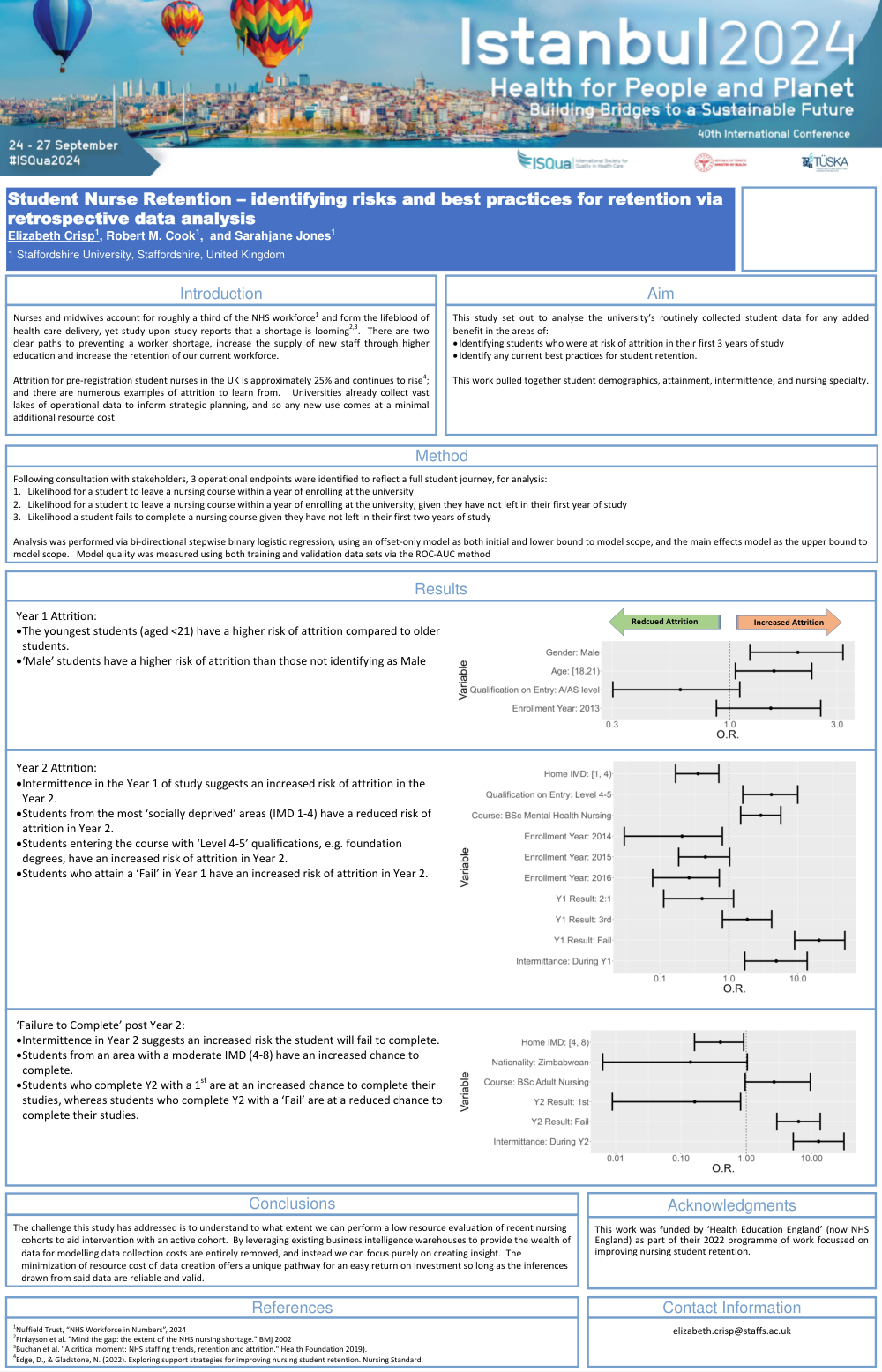
Year 1 Attrition:
- The youngest students (aged <21) have a higher risk of attrition compared to older students.
- ‘Male’ students have a higher risk of attrition than those not identifying as Male
Year 2 Attrition:
- Intermittence in the Year 1 of study suggests an increased risk of attrition in the Year 2.
- Students from the most ‘socially deprived’ areas (IMD 1-4) have a reduced risk of attrition in Year 2.
- Students entering the course with ‘Level 4-5’ qualifications, e.g. foundation degrees, have an increased risk of attrition in Year 2.
- Students who attain a ‘Fail’ in Year 1 have an increased risk of attrition in Year 2.
‘Failure to Complete’ post Year 2:
- Intermittence in Year 2 suggests an increased risk the student will fail to complete.
- Students from an area with a moderate IMD (4-8) have an increased chance to complete.
- Students who complete Y2 with a 1st are at an increased chance to complete their studies, whereas students who complete Y2 with a ‘Fail’ are at a reduced chance to complete their studies.
Conclusions
The challenge this study has addressed is to understand to what extent we can perform a low resource evaluation of recent nursing cohorts to aid intervention with an active cohort. By leveraging existing business intelligence warehouses to provide the wealth of data for modelling data collection costs are entirely removed, and instead we can focus purely on creating insight. The minimization of resource cost of data creation offers a unique pathway for an easy return on investment so long as the inferences drawn from said data are reliable and valid.
Acknowledgments
This work was funded by ‘Health Education England’ (now NHS England) as part of their 2022 programme of work focussed on improving nursing student retention.
References
1 Nuffield Trust, “NHS Workforce in Numbers”, , 2024
2Finlayson et al. "Mind the gap: the extent of the NHS nursing shortage." BMj 2002
3Buchan et al. "A critical moment: NHS staffing trends, retention and attrition." Health Foundation 2019).
4Edge, D., & Gladstone, N. (2022). Exploring support strategies for improving nursing student retention. Nursing Standard.