586 posters, 8 topics, 23 sessions, 1,077 authors, 622 institutions
ePostersLive by SciGen Technologies S.A. All rights reserved.
ISQua's 40th International Conference 2024
24th - 27th September 2024 | Istanbul, Türkiye

ISQUA2024-ABS-2716
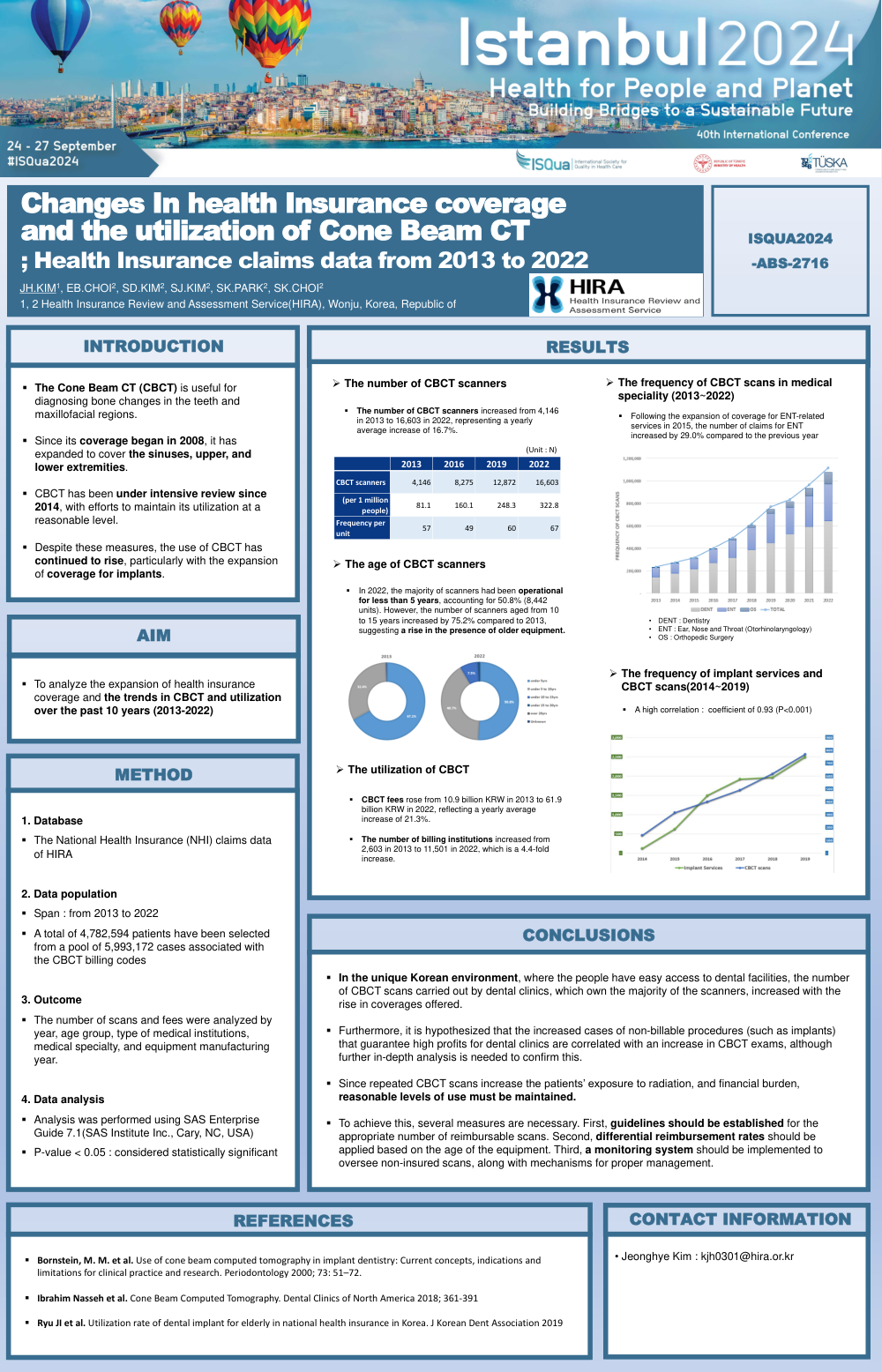
Changes in health Insurance coverage and the utilization of Cone Beam CT ; Health insurance claims data from 2013 to 2022
Poster Presenter
Authors
Part of Topic
Workforce, Policy, and Governance
ISQUA2024
JH.KIM1, EB.CHOI2, SD.KIM2, SJ.KIM2, SK.PARK2, SK.CHOI2
1, 2 Health Insurance Review and Assessment Service(HIRA), Wonju, Korea, Republic of
Changes In health Insurance coverage
and the utilization of Cone Beam CT
; Health Insurance claims data from 2013 to 2022
The Cone Beam CT (CBCT) is useful for
diagnosing bone changes in the teeth and
maxillofacial regions.
Since its coverage began in 2008, it has
expanded to cover the sinuses, upper, and
lower extremities.
CBCT has been under intensive review since
2014, with efforts to maintain its utilization at a
reasonable level.
Despite these measures, the use of CBCT has
continued to rise, particularly with the expansion
of coverage for implants.
To analyze the expansion of health insurance
coverage and the trends in CBCT and utilization
over the past 10 years (2013-2022)
• Jeonghye Kim : kjh0301@hira.or.kr
INTRODUCTION
AIM
METHOD
RESULTS
CONTACT INFORMATION
REFERENCES
CONCLUSIONS
In the unique Korean environment, where the people have easy access to dental facilities, the number
of CBCT scans carried out by dental clinics, which own the majority of the scanners, increased with the
rise in coverages offered.
Furthermore, it is hypothesized that the increased cases of non-billable procedures (such as implants)
that guarantee high profits for dental clinics are correlated with an increase in CBCT exams, although
further in-depth analysis is needed to confirm this.
Since repeated CBCT scans increase the patients’ exposure to radiation, and financial burden,
reasonable levels of use must be maintained.
To achieve this, several measures are necessary. First, guidelines should be established for the
appropriate number of reimbursable scans. Second, differential reimbursement rates should be
applied based on the age of the equipment. Third, a monitoring system should be implemented to
oversee non-insured scans, along with mechanisms for proper management.
1. Database
The National Health Insurance (NHI) claims data
of HIRA
2. Data population
Span : from 2013 to 2022
A total of 4,782,594 patients have been selected
from a pool of 5,993,172 cases associated with
the CBCT billing codes
3. Outcome
The number of scans and fees were analyzed by
year, age group, type of medical institutions,
medical specialty, and equipment manufacturing
year.
4. Data analysis
Analysis was performed using SAS Enterprise
Guide 7.1(SAS Institute Inc., Cary, NC, USA)
P-value < 0.05 : considered statistically significant
The number of CBCT scanners
2013 2016 2019 2022
CBCT scanners 4,146 8,275 12,872 16,603
(per 1 million
people) 81.1 160.1 248.3 322.8
Frequency per
unit 57 49 60 67
(Unit : N)
The frequency of implant services and
CBCT scans(2014~2019)
A high correlation : coefficient of 0.93 (P<0.001)
• DENT : Dentistry
• ENT : Ear, Nose and Throat (Otorhinolaryngology)
• OS : Orthopedic Surgery
The age of CBCT scanners
The number of CBCT scanners increased from 4,146
in 2013 to 16,603 in 2022, representing a yearly
average increase of 16.7%.
In 2022, the majority of scanners had been operational
for less than 5 years, accounting for 50.8% (8,442
units). However, the number of scanners aged from 10
to 15 years increased by 75.2% compared to 2013,
suggesting a rise in the presence of older equipment.
The utilization of CBCT
CBCT fees rose from 10.9 billion KRW in 2013 to 61.9
billion KRW in 2022, reflecting a yearly average
increase of 21.3%.
The number of billing institutions increased from
2,603 in 2013 to 11,501 in 2022, which is a 4.4-fold
increase.
The frequency of CBCT scans in medical
speciality (2013~2022)
Following the expansion of coverage for ENT-related
services in 2015, the number of claims for ENT
increased by 29.0% compared to the previous year