301 posters, 50 videos, 13 topics, 13 sessions, 739 authors, 192 institutions
ePostersLive by SciGen Technologies S.A. All rights reserved.
ISMICS 2026 Annual Meeting
10 - 13 June, 2026 | Miami, Florida

P95
Periareolar Incision: A Minimally Invasive Endoscopic Approach To Congenital Cardiac Surgery In Pediatric And Adult Patients
Poster Presenter
Authors
Part of Topic
Pediatric - Cardiac, Cardiovascular & Thoracic
BACKGROUND:Minimally invasive and endoscopic techniques are now well established in adult cardiac surgery; however, their adoption in pediatric and congenital
heart disease (CHD) surgery remains limited. The periareolar incision represents a novel surgical access that combines excellent cosmetic outcomes with adequate
exposure for minimally invasive and endoscopic congenital cardiac procedures. We report our institutional experience using this approach in both pediatric and adult
CHD patients, demonstrating favorable outcomes without incision-related complications to date.
METHODS:We performed a retrospective, single-center analysis of patients who underwent endoscopic congenital cardiac surgery via a periareolar minimally invasive
approach between September 2021 and the present. More than 500 endoscopic cardiac procedures performed during this period, pediatric and congenital cases were
identified for analysis. Collected data included patient demographics, operative details, perioperative variables, postoperative outcomes, and follow-up information.
RESULTS:A total of 111 consecutive congenital cardiac cases were included, consisting of 56 adult CHD patients and 55 pediatric patients (<16 years). Patient age
ranged from 4 to 57 years, with body weight between 14 and 145 kg. Cardiopulmonary bypass times ranged from 70 to 234 minutes (mean 139 minutes), and aortic
cross-clamp times ranged from 55 to 207 minutes (mean 96 minutes). Intensive care unit stay ranged from 12 hours to 4 days, while total hospital stay ranged from 3
to 12 days. The overall transfusion rate was 35%, decreasing to 18% in pediatric patients. There was no operative or in-hospital mortality. All procedures were
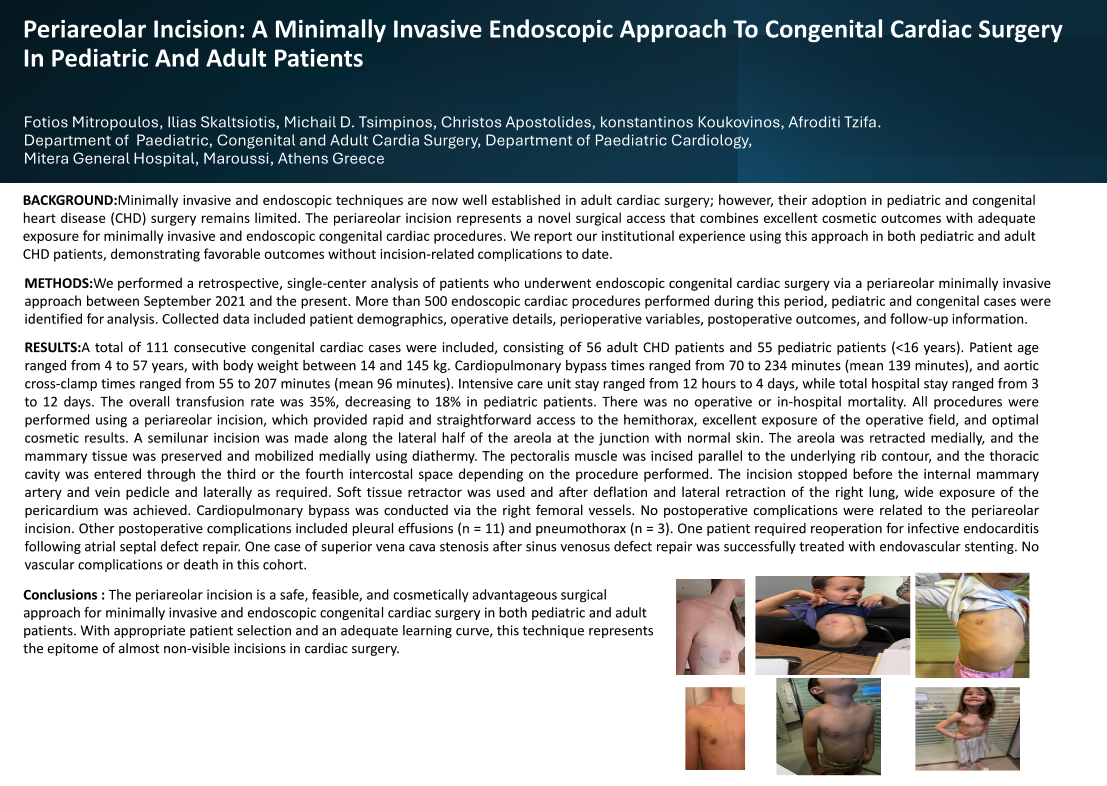
performed using a periareolar incision, which provided rapid and straightforward access to the hemithorax, excellent exposure of the operative field, and optimal
cosmetic results. A semilunar incision was made along the lateral half of the areola at the junction with normal skin. The areola was retracted medially, and the
mammary tissue was preserved and mobilized medially using diathermy. The pectoralis muscle was incised parallel to the underlying rib contour, and the thoracic
cavity was entered through the third or the fourth intercostal space depending on the procedure performed. The incision stopped before the internal mammary
artery and vein pedicle and laterally as required. Soft tissue retractor was used and after deflation and lateral retraction of the right lung, wide exposure of the
pericardium was achieved. Cardiopulmonary bypass was conducted via the right femoral vessels. No postoperative complications were related to the periareolar
incision. Other postoperative complications included pleural effusions (n = 11) and pneumothorax (n = 3). One patient required reoperation for infective endocarditis
following atrial septal defect repair. One case of superior vena cava stenosis after sinus venosus defect repair was successfully treated with endovascular stenting. No
vascular complications or death in this cohort.
Conclusions : The periareolar incision is a safe, feasible, and cosmetically advantageous surgical approach for minimally invasive and endoscopic congenital cardiac
surgery in both pediatric and adult patients. With appropriate patient selection and an adequate learning curve, this technique represents the epitome of almost
non-visible incisions in cardiac surgery.