301 posters, 50 videos, 13 topics, 13 sessions, 739 authors, 192 institutions
ePostersLive by SciGen Technologies S.A. All rights reserved.
ISMICS 2026 Annual Meeting
10 - 13 June, 2026 | Miami, Florida

P47
Transit Time Flow Measurement During Robotic And Sternotomy Coronary Artery Bypass Grafting: A Propensity Matched Study
Poster Presenter
Part of Topic
Coronary Revascularization
Transit Time Flow Measurement During Robotic and Sternotomy Coronary Artery Bypass Grafting: A Propensity Matched Study
Massimo Baudo1, Amanda Yakobitis2, Dana Foley2, Courtney Murray2, Gianluca Torregrossa1,2
Background
Robotic-assisted coronary artery bypass grafting (RACAB) and sternotomy CABG are two revascularization strategies performed in different technical ways. Operative times for RACAB, initially lengthy, have significantly shortened over two decades.
Renewed adoption is driven by improved robotic technology, structured training, and reaffirmed advantages of CABG over PCI. Adoption remains limited due to high technical demands, substantial training requirements, and significant infrastructure costs: only a small number of dedicated programs maintain high-volume activity.
This study compared perioperative outcomes and hospital course between propensity-matched cohorts undergoing RACAB or sternotomy CABG.
Methods
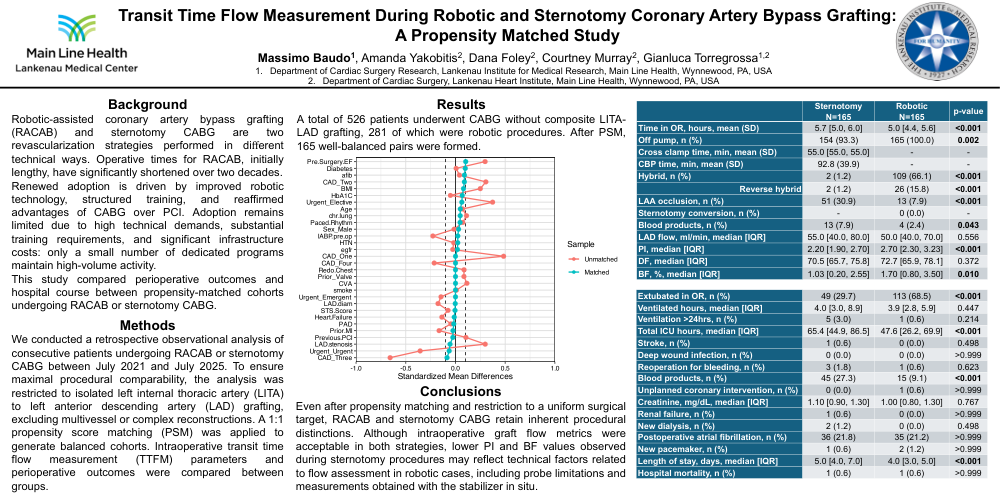
We conducted a retrospective observational analysis of consecutive patients undergoing RACAB or sternotomy CABG between July 2021 and July 2025. To ensure maximal procedural comparability, the analysis was restricted to isolated left internal thoracic artery (LITA) to left anterior descending artery (LAD) grafting, excluding multivessel or complex reconstructions. A 1:1 propensity score matching (PSM) was applied to generate balanced cohorts. Intraoperative transit time flow measurement (TTFM) parameters and perioperative outcomes were compared between groups.
Results
A total of 526 patients underwent CABG without composite LITA-LAD grafting, 281 of which were robotic procedures. After PSM, 165 well-balanced pairs were formed.
Conclusions
Even after propensity matching and restriction to a uniform surgical target, RACAB and sternotomy CABG retain inherent procedural distinctions. Although intraoperative graft flow metrics were acceptable in both strategies, lower PI and BF values observed during sternotomy procedures may reflect technical factors related to flow assessment in robotic cases, including probe limitations and measurements obtained with the stabilizer in situ.