301 posters, 50 videos, 13 topics, 13 sessions, 739 authors, 192 institutions
ePostersLive by SciGen Technologies S.A. All rights reserved.
ISMICS 2026 Annual Meeting
10 - 13 June, 2026 | Miami, Florida

P37
Robot-assisted Midcab With The Da Vinci Single-port System: First In Human Experience
Poster Presenter
Part of Topic
Coronary Revascularization
Video
Objectives
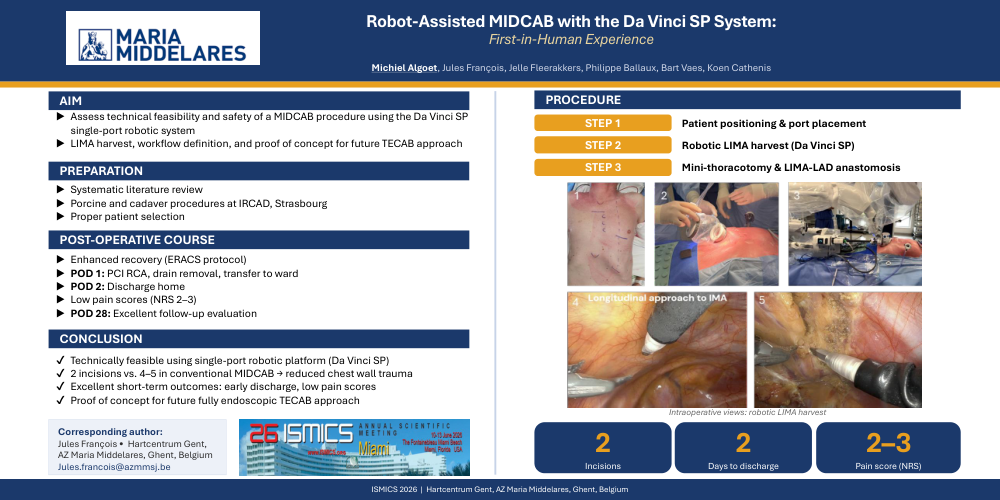
This study aimed to evaluate the feasibility and early clinical outcomes of the first-in-human robot-assisted minimally invasive direct coronary artery bypass (MIDCAB) procedure performed with the da Vinci single-port (SP) surgical system.
Background
Minimally invasive coronary artery bypass techniques are increasingly adopted to reduce surgical trauma, accelerate recovery, and minimize postoperative pain compared with conventional sternotomy. The da Vinci SP robotic platform, designed for single-port access and flexible instrument maneuverability, has not previously been reported for MIDCAB. Assessing its technical performance, safety, and perioperative outcomes is critical before broader clinical application.
Methods
A 63-year-old male with stable angina and angiographically documented proximal stenosis of the left anterior descending (LAD) artery and right coronary artery underwent a planned hybrid procedure. The left internal mammary artery (LIMA) was harvested robotically via a subcostal approach using the da Vinci SP system. Access included a four-centimeter subcostal incision and a six-centimeter thoracotomy. The LIMA-to-LAD anastomosis was performed off-pump. Standard enhanced recovery after surgery (ERAS) protocols were applied.
Results
Robotic dissection of the LIMA was successfully achieved using the flexible SP instruments, despite the absence of a small clip applier. The LIMA-to-LAD anastomosis was completed with satisfactory intraoperative stability. The patient was extubated on-table, transferred to the intensive care unit overnight, and discharged on postoperative day two following staged percutaneous coronary intervention (PCI) of the right coronary artery. Follow-up at one month demonstrated excellent clinical recovery.
Conclusions
This first-in-human experience demonstrates the technical feasibility of performing a robot-assisted MIDCAB procedure with the da Vinci SP platform. Advantages included reduced number of incisions, absence of intercostal trocars, and simplified access for myocardial stabilization. Limitations identified were the longitudinal approach required for LIMA harvesting and lack of a small clip applier. These findings suggest promising potential for further application of the da Vinci SP system in totally endoscopic coronary artery bypass (TECAB) procedures, pending additional clinical validation.