301 posters, 50 videos, 13 topics, 13 sessions, 739 authors, 192 institutions
ePostersLive by SciGen Technologies S.A. All rights reserved.
ISMICS 2026 Annual Meeting
10 - 13 June, 2026 | Miami, Florida

P33
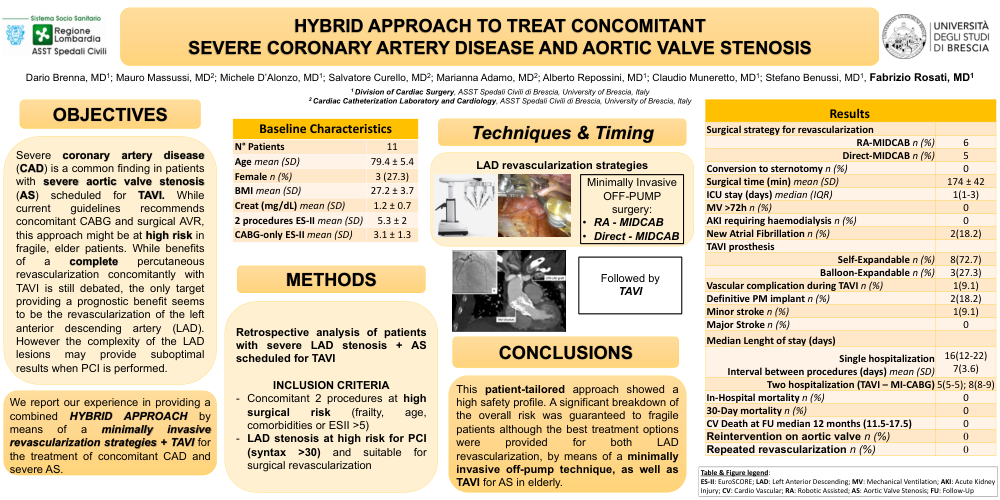
Hybrid Approach To Treat Concomitant Severe Coronary Artery Disease And Aortic Valve Stenosis
Poster Presenter
Authors
Dario Brenna, Mauro Massussi, Michele D'Alonzo, Salvatore Curello, Marianna Adamo, Alberto Repossini, Claudio Muneretto, Stefano Benussi, Fabrizio Rosati
Affiliations
Division of Cardiac Surgery, ASST Spedali Civili di Brescia, University of Brescia, Italy, Cardiac Catheterization Laboratory and Cardiology, ASST Spedali Civili di Brescia, University of Brescia, Italy
Part of Topic
Coronary Revascularization
OBJECTIVES
Severe coronary artery disease (CAD) is a common finding in patients with severe aortic valve stenosis (AS) scheduled for TAVI. While current guidelines recommends concomitant CABG and surgical AVR, this approach might be at high risk in fragile, elder patients. While benefits of a complete percutaneous revascularization concomitantly with TAVI is still debated, the only target providing a prognostic benefit seems to be the revascularization of the left anterior descending artery (LAD). However the complexity of the LAD lesions may provide suboptimal results when PCI is performed.
We report our experience in providing a combined HYBRID APPROACH by means of a minimally invasive revascularization strategies + TAVI for the treatment of concomitant CAD and severe AS.
METHODS
Retrospective analysis of patients with severe LAD stenosis + AS scheduled for TAVI
Inclusion criteria:
-Concomitant 2 procedures at high surgical risk (frailty, age, comorbidities or ESII >5)
CONCLUSIONS
This patient-tailored approach showed a high safety profile. A significant breakdown of the overall risk was guaranteed to fragile patients although the best treatment options were provided for both LAD revascularization, by means of a minimally invasive off-pump technique, as well as TAVI for AS in elderly.