301 posters, 50 videos, 13 topics, 13 sessions, 739 authors, 192 institutions
ePostersLive by SciGen Technologies S.A. All rights reserved.
ISMICS 2026 Annual Meeting
10 - 13 June, 2026 | Miami, Florida

D146
Quality Of Life After Minimally Invasive Versus Sternotomy Valve Surgery: A Contemporary Evidence Synthesis
Poster Presenter
Authors
Andra-Denis Marinescu, Stefan Andrei Oprea, Victor Sebastian Costache
Affiliations
Titu Maiorescu University, Faculty of Medicine, Department of Doctoral Studies, Bucharest, Romania, Titu Maiorescu University, Faculty of Medicine, Department of Doctoral Studies, Bucharest, Romania; Sanador Clinical Hospital, Department of Cardiovascular Surgery, Bucharest, Romania, Titu Maiorescu University, Faculty of Medicine, Department of Cardiovascular Surgery, Bucharest, Romania; Sanador Clinical Hospital, Department of Cardiovascular Surgery, Bucharest, Romania
Part of Topic
Valve � Surgical Valves
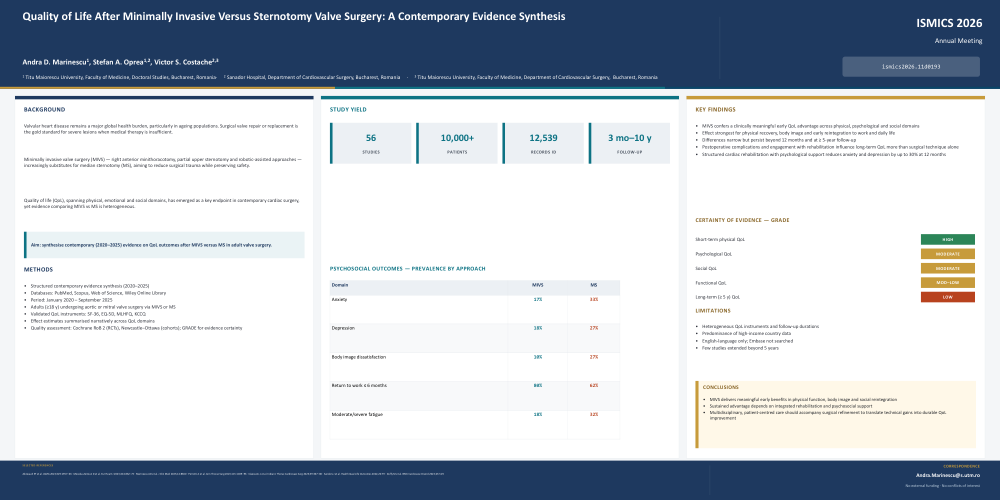
Background:
Valvular heart disease remains a major global health burden, particularly in ageing populations. Surgical valve repair or replacement is the gold standard for severe lesions when medical therapy is insufficient.
Minimally invasive valve surgery (MIVS) — right anterior minithoracotomy, partial upper sternotomy and robotic-assisted approaches — increasingly substitutes for median sternotomy (MS), aiming to reduce surgical trauma while preserving safety.
Quality of life (QoL), spanning physical, emotional and social domains, has emerged as a key endpoint in contemporary cardiac surgery, yet evidence comparing MIVS vs MS is heterogeneous.
Aim: synthesise contemporary (2020–2025) evidence on QoL outcomes after MIVS versus MS in adult valve surgery.
Methods:
Key findings
Limitations