301 posters, 50 videos, 13 topics, 13 sessions, 734 authors, 193 institutions
ePostersLive by SciGen Technologies S.A. All rights reserved.
ISMICS 2026 Annual Meeting
10 - 13 June, 2026 | Miami, Florida

D145
The Quest For Standardisation: Current Strategies Aimed At Standardizing The Transcatheter Aortic Valve Insertion (tavi) Procedure
Poster Presenter
Part of Topic
Valve - Transcatheter Therapies
SCOPING REVIEW
The Quest For Standardisation Current Strategies Aimed At Standardizing Transcatheter Aortic Valve Insertion (TAVI) Procedure
Wilson MK¹, Agiasotis S², Wilson H³, Carney T³, Puvanendran A², Preda VA²
¹SurgicalXR, Macquarie University Hospital ²Macquarie University Faculty of Medicine ³SurgicalXR, Sydney, Australia
ISMICS 2026 Annual Scientific Meeting | Miami, FL | June 10–13, 2026
The Challenge
Considerable heterogeneity exists in procedural planning, execution, and follow-up. No comprehensive mapping of where standardisation efforts currently exist nor where critical gaps remain has been conducted.
Research Question
What is the current landscape of standardisation strategies across the full TAVI care pathway (pre-, peri-, and post-procedural)?
JBI Scoping Review Methodology | PRISMA-ScR Guidelines
Medline Embase Scopus CINAHL Cochrane
Timeframe 2015 – April 2025
Inclusion Empirical articles and consensus documents examining pre-, peri-, or post-procedural TAVI interventions
Categorisation Studies grouped by procedural phase (pre-, peri-, post-, cross-phase) and thematic domains
Data Extraction Joanna Briggs Institute methodology with systematic study selection
KEY FINDINGS — Critical Gaps Identified
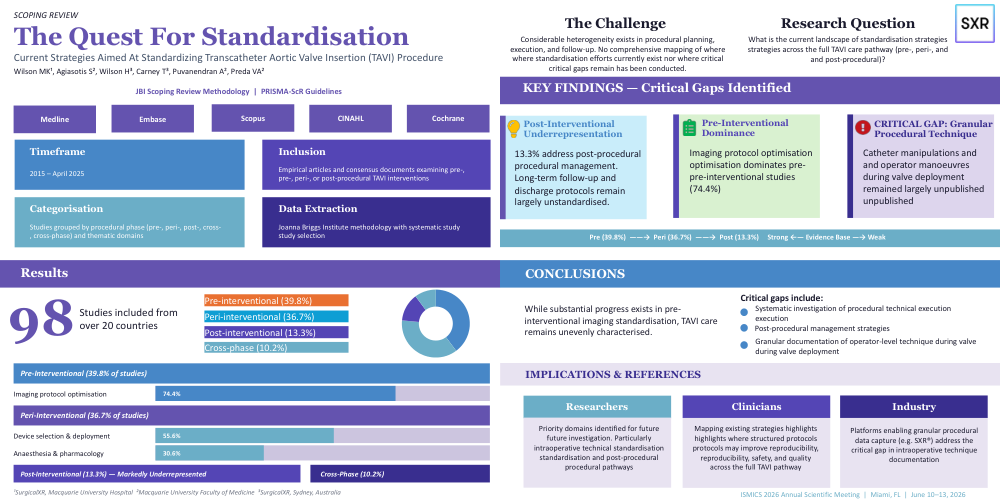
CRITICAL GAP: Granular Procedural Technique Catheter manipulations and operator manoeuvres during valve deployment remained largely unpublished
Post-Interventional Underrepresentation 13.3% address post-procedural management. Long-term follow-up and discharge protocols remain largely unstandardised.
Pre-Interventional Dominance Imaging protocol optimisation dominates pre-interventional studies (74.4%)
Pre (39.8%) ——→ Peri (36.7%) ——→ Post (13.3%) Strong ←— Evidence Base —→ Weak
98 Studies included from over 20 countries
Evidence Distribution by Phase
Pre-Interventional (39.8% of studies) Imaging protocol optimisation 74.4%
Peri-Interventional (36.7% of studies) Device selection & deployment 55.6% Anaesthesia & pharmacology 30.6%
Post-Interventional (13.3%) — Markedly Underrepresented
Cross-Phase (10.2%)
Results
Pre-interventional (39.8%) Peri-interventional (36.7%) Post-interventional (13.3%) Cross-phase (10.2%)
CONCLUSIONS
While substantial progress exists in pre-interventional imaging standardisation, TAVI care remains unevenly characterised.
Critical gaps include: Systematic investigation of procedural technical execution Post-procedural management strategies Granular documentation of operator-level technique during valve deployment
IMPLICATIONS & REFERENCES
Researchers Priority domains identified for future investigation. Particularly intraoperative technical standardisation and post-procedural pathways
Clinicians Mapping existing strategies highlights where structured protocols may improve reproducibility, safety, and quality across the full TAVI pathway
Industry Platforms enabling granular procedural data capture (e.g. SXR®) address the critical gap in intraoperative technique documentation