301 posters, 50 videos, 13 topics, 13 sessions, 739 authors, 192 institutions
ePostersLive by SciGen Technologies S.A. All rights reserved.
ISMICS 2026 Annual Meeting
10 - 13 June, 2026 | Miami, Florida

D131
Aortic Root Enlargement Via Upper Hemisternotomy Using The A. Kocher Technique
Part of Topic
Valve � Surgical Valves
Video
Objective
Aortic root enlargement (ARE) is an established strategy to avoid prosthesis-patient mismatch (PPM) during surgical aortic valve replacement (SAVR). Its use in minimally invasive settings remains limited due to concerns about exposure and technical complexity.
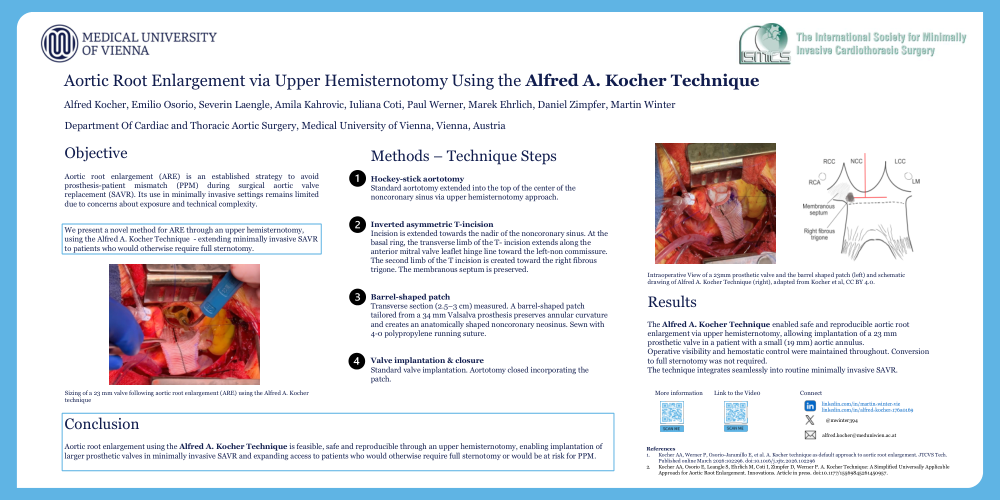
We present a novel method for ARE through an upper hemisternotomy, using the Alfred A. Kocher Technique – extending minimally invasive SAVR to patients who would otherwise require full sternotomy.
Methods – Technique Steps
- Hockey-stick aortotomy - Standard aortotomy extended into the top of the center of the noncoronary sinus via upper hemisternotomy approach.
- Inverted asymmetric T-incision - Incision is extended towards the nadir of the noncoronary sinus. At the basal ring, the transverse limb of the T-incision extends along the anterior mitral valve leaflet hinge line toward the left-non commissure. The second limb of the T incision is created toward the right fibrous trigone. The membranous septum is preserved.
- Barrel-shaped patch - Transverse section (2.5–3 cm) measured. A barrel-shaped patch tailored from a 34 mm Valsalva prosthesis preserves annular curvature and creates an anatomically shaped noncoronary neosinus. Sewn with 4-0 polypropylene running suture.
- Valve implantation & closure - Standard valve implantation. Aortotomy closed incorporating the patch.
Conclusion
Aortic root enlargement using the Alfred A. Kocher Technique is feasible, safe and reproducible through an upper hemisternotomy, enabling implantation of larger prosthetic valves in minimally invasive SAVR and expanding access to patients who would otherwise require full sternotomy or would be at risk for PPM.