301 posters, 50 videos, 13 topics, 13 sessions, 739 authors, 192 institutions
ePostersLive by SciGen Technologies S.A. All rights reserved.
ISMICS 2026 Annual Meeting
10 - 13 June, 2026 | Miami, Florida

P26
Automated Performance Metrics (apms) In Robotic Totally Endoscopic Coronary Artery Bypass (tecab): A Pilot Study
Part of Topic
Coronary Revascularization
Objective
Automated performance metrics (APMs), recorded by the surgical robot and accessible via a smartphone app, provide objective intraoperative insights in robotic surgery. This is the first study evaluating APMs in robotic totally endoscopic coronary artery bypass (TECAB) procedures, comparing performance across patient groups and procedural variations.
Methods
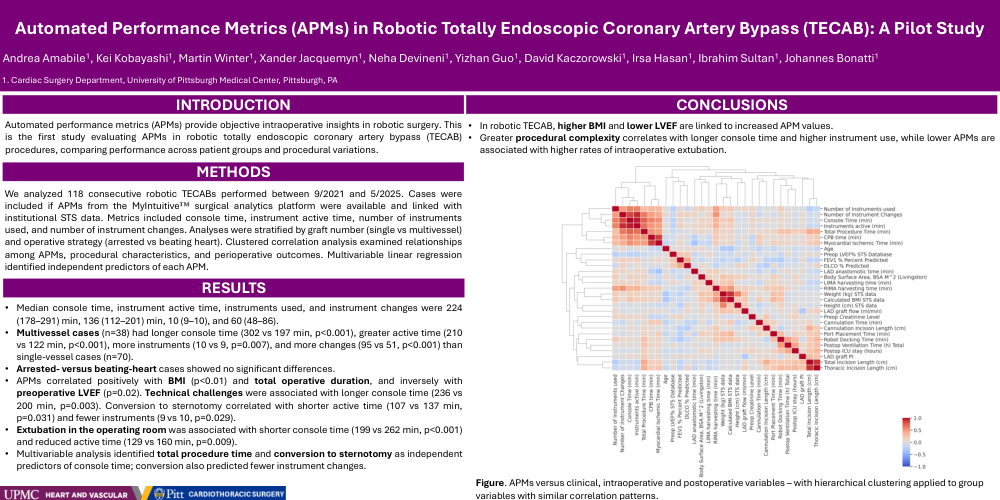
We analyzed 118 consecutive robotic TECABs performed between 9/2021 and 5/2025. Cases were included if APMs from the MyIntuitive™ surgical analytics platform were available and linked with institutional STS data. Metrics included console time, instrument active time, number of instruments used, and number of instrument changes. Analyses were stratified by graft number (single vs multivessel) and operative strategy (arrested vs beating heart). Clustered correlation analysis examined relationships among APMs, procedural characteristics, and perioperative outcomes. Multivariable linear regression identified independent predictors of each APM.
Results
Median console time, instrument active time, instruments used, and instrument changes were 224 (178–291) min, 136 (112–201) min, 10 (9–10), and 60 (48–86). Multivessel cases (n=38) had longer console time (302 vs 197 min, p<0.001), greater active time (210 vs 122 min, p<0.001), more instruments (10 vs 9, p=0.007), and more changes (95 vs 51, p<0.001) than single-vessel cases (n=70). Arrested- versus beating-heart cases showed no significant differences. APMs correlated positively with BMI (p<0.01) and total operative duration, and inversely with preoperative LVEF (p=0.02). Technical challenges were associated with longer console time (236 vs 200 min, p=0.003). Conversion to sternotomy correlated with shorter active time (107 vs 137 min, p=0.031) and fewer instruments (9 vs 10, p=0.029). Extubation in the operating room was associated with shorter console time (199 vs 262 min, p<0.001) and reduced active time (129 vs 160 min, p=0.009). Multivariable analysis identified total procedure time and conversion to sternotomy as independent predictors of console time; conversion also predicted fewer instrument changes.
Conclusions
In robotic TECAB, higher BMI and lower LVEF are linked to increased APM values. Greater procedural complexity correlates with longer console time and higher instrument use, while lower APMs are associated with higher rates of intraoperative extubation.