301 posters, 50 videos, 13 topics, 13 sessions, 739 authors, 192 institutions
ePostersLive by SciGen Technologies S.A. All rights reserved.
ISMICS 2026 Annual Meeting
10 - 13 June, 2026 | Miami, Florida

D129
Impact Of Routine Placement Of Two Chest Tubes On Pneumothorax And Subcutaneous Emphysema After Robotic Mitral Valve Surgery
Poster Presenter
Authors
Martin Winter, Zehavit Kirshenboim, Robert Liotta, Joan Lacomis, Manuel Giraldo-Grueso, Andrea Amabile, Kei Kobayashi, Yizhan Guo, Ariana Jackson, Irsa Hasan, David Kaczorowski, Ibrahim Sultan, Johannes Bonatti
Affiliations
Department of Cardiothoracic Surgery, University of Pittsburgh Medical Center, Radiology Department, University of Pittsburgh Medical Center, Pittsburgh, PA
Part of Topic
Valve � Surgical Valves
Introduction
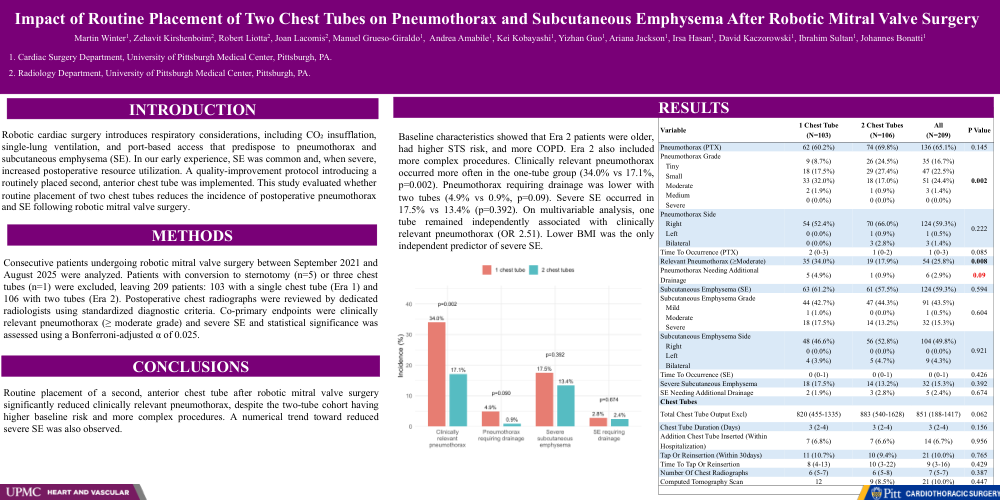
Robotic cardiac surgery introduces respiratory considerations, including CO₂ insufflation, single-lung ventilation, and port-based access that predispose to pneumothorax and subcutaneous emphysema (SE). In our early experience, SE was common and, when severe, increased postoperative resource utilization. A quality-improvement protocol introducing a routinely placed second, anterior chest tube was implemented. This study evaluated whether routine placement of two chest tubes reduces the incidence of postoperative pneumothorax and SE following robotic mitral valve surgery.
Methods
Consecutive patients undergoing robotic mitral valve surgery between September 2021 and August 2025 were analyzed. Patients with conversion to sternotomy (n=5) or three chest tubes (n=1) were excluded, leaving 209 patients: 103 with a single chest tube (Era 1) and 106 with two tubes (Era 2). Postoperative chest radiographs were reviewed by dedicated radiologists using standardized diagnostic criteria. Co-primary endpoints were clinically relevant pneumothorax (≥ moderate grade) and severe SE and statistical significance was assessed using a Bonferroni-adjusted α of 0.025.
Results
Baseline characteristics showed that Era 2 patients were older, had higher STS risk, and more COPD. Era 2 also included more complex procedures. Clinically relevant pneumothorax occurred more often in the one-tube group (34.0% vs 17.1%, p=0.002). Pneumothorax requiring drainage was lower with two tubes (4.9% vs 0.9%, p=0.09). Severe SE occurred in 17.5% vs 13.4% (p=0.392). On multivariable analysis, one tube remained independently associated with clinically relevant pneumothorax (OR 2.51). Lower BMI was the only independent predictor of severe SE.
Conclusion
Routine placement of a second, anterior chest tube after robotic mitral valve surgery significantly reduced clinically relevant pneumothorax, despite the two-tube cohort having higher baseline risk and more complex procedures. A numerical trend toward reduced severe SE was also observed.