301 posters, 50 videos, 13 topics, 13 sessions, 739 authors, 192 institutions
ePostersLive by SciGen Technologies S.A. All rights reserved.
ISMICS 2026 Annual Meeting
10 - 13 June, 2026 | Miami, Florida

P25
A Stepwise Educational Strategy For Training Surgeons In Minimally Invasive Coronary Artery Bypass Grafting
Part of Topic
Coronary Revascularization
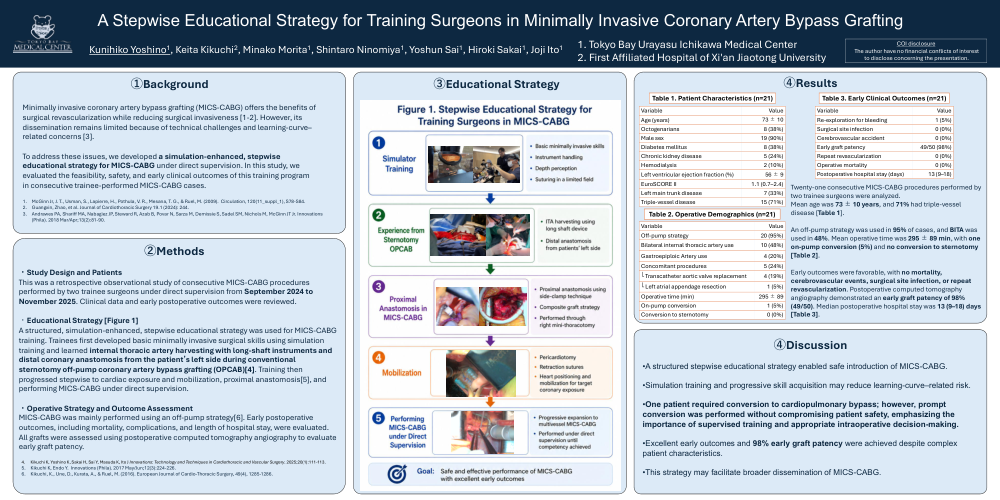
We developed a simulation-enhanced, stepwise educational strategy for MICS-CABG under direct supervision. In this study, we evaluated the feasibility, safety, and early clinical outcomes of this training program in consecutive trainee-performed MICS-CABG cases.
A structured, simulation-enhanced, stepwise educational strategy was used for MICS-CABG training. Trainees first developed basic minimally invasive surgical skills using simulation training and learned internal thoracic artery harvesting with long-shaft instruments and distal coronary anastomosis from the patient’s left side during conventional sternotomy off-pump coronary artery bypass grafting (OPCAB)[4]. Training then progressed stepwise to cardiac exposure and mobilization, proximal anastomosis[5], and performing MICS-CABG under direct supervision.
Twenty-one consecutive MICS-CABG procedures performed by two trainee surgeons were analyzed.
Mean age was 73 ± 10 years, and 71% had triple-vessel disease [Table 1].
An off-pump strategy was used in 95% of cases, and BITA was used in 48%. Mean operative time was 295 ± 89 min, with one on-pump conversion (5%) and no conversion to sternotomy [Table 2].
Early outcomes were favorable, with no mortality, cerebrovascular events, surgical site infection, or repeat revascularization. Postoperative computed tomography angiography demonstrated an early graft patency of 98% (49/50). Median postoperative hospital stay was 13 (9–18) days [Table 3].