301 posters, 50 videos, 13 topics, 13 sessions, 739 authors, 192 institutions
ePostersLive by SciGen Technologies S.A. All rights reserved.
ISMICS 2026 Annual Meeting
10 - 13 June, 2026 | Miami, Florida

D120
Comparison Between Surgical Approaches In Sutureless Avr - Mid Term Results Of Multicentric Prospective Mantra Registry
Poster Presenter
Authors
Part of Topic
Valve � Surgical Valves
Introduction:
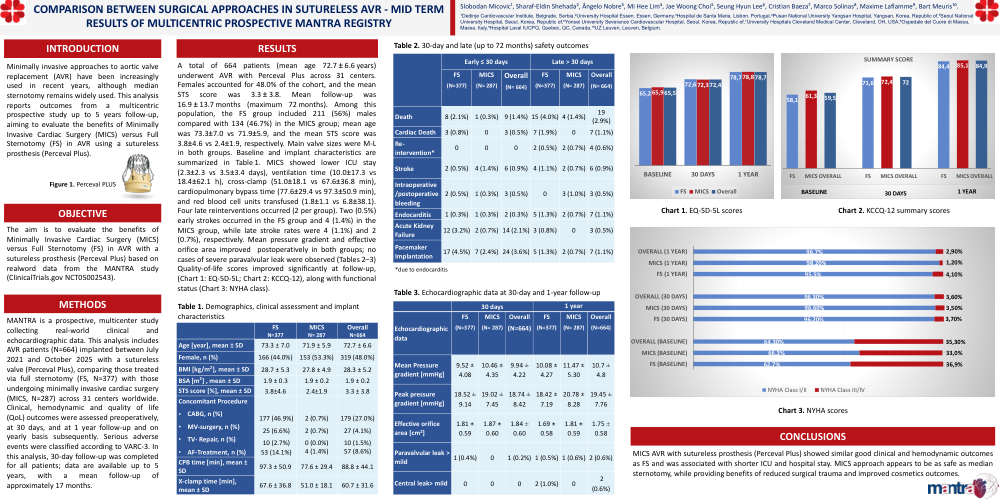
Minimally invasive approaches to aortic valve replacement (AVR) have been increasingly used in recent years, although median sternotomy remains widely used. This analysis reports outcomes from a multicentric prospective study up to 5 years follow-up, aiming to evaluate the benefits of Minimally Invasive Cardiac Surgery (MICS) versus Full Sternotomy (FS) in AVR using a sutureless prosthesis (Perceval Plus).
Objective:
The aim is to evaluate the benefits of Minimally Invasive Cardiac Surgery (MICS) versus Full Sternotomy (FS) in AVR with a sutureless prosthesis (Perceval Plus) based on realword data from the MANTRA study (ClinicalTrials.gov NCT05002543).
Methods:
MANTRA is a prospective, multicenter study collecting real-world clinical and echocardiographic data. This analysis includes AVR patients (N=664) implanted between July 2021 and October 2025 with a sutureless valve (Perceval Plus), comparing those treated via full sternotomy (FS, N=377) with those undergoing minimally invasive cardiac surgery (MICS, N=287) across 31 centers worldwide. Clinical, hemodynamic and quality of life (QoL) outcomes were assessed preoperatively, at 30 days, and at 1 year follow-up and on yearly basis subsequently. Serious adverse events were classified according to VARC-3. In this analysis, 30-day follow-up was completed for all patients; data are available up to 5 years, with a mean follow-up of approximately 17 months.
Results:
A total of 664 patients (mean age 72.7 ± 6.6 years) underwent AVR with Perceval Plus across 31 centers. Females accounted for 48.0% of the cohort, and the mean STS score was 3.3 ± 3.8. Mean follow‑up was 16.9 ± 13.7 months (maximum 72 months). Among this population, the FS group included 211 (56%) males compared with 134 (46.7%) in the MICS group; mean age was 73.3±7.0 vs 71.9±5.9, and the mean STS score was 3.8±4.6 vs 2.4±1.9, respectively. Main valve sizes were M-L in both groups. Baseline and implant characteristics are summarized in Table 1. MICS showed lower ICU stay (2.3±2.3 vs 3.5±3.4 days), ventilation time (10.0±17.3 vs 18.4±62.1 h), cross-clamp (51.0±18.1 vs 67.6±36.8 min), cardiopulmonary bypass time (77.6±29.4 vs 97.3±50.9 min), and red blood cell units transfused (1.8±1.1 vs 6.8±38.1). Four late reinterventions occurred (2 per group). Two (0.5%) early strokes occurred in the FS group and 4 (1.4%) in the MICS group, while late stroke rates were 4 (1.1%) and 2 (0.7%), respectively. Mean pressure gradient and effective orifice area improved postoperatively in both groups; no cases of severe paravalvular leak were observed (Tables 2–3) Quality‑of‑life scores improved significantly at follow‑up, (Chart 1: EQ-5D-5L; Chart 2: KCCQ-12), along with functional status (Chart 3: NYHA class).
Conclusions:
MICS AVR with sutureless prosthesis (Perceval Plus) showed similar good clinical and hemodynamic outcomes as FS and was associated with shorter ICU and hospital stay. MICS approach appears to be as safe as median sternotomy, while providing benefits of reduced surgical trauma and improved cosmetics outcomes.