301 posters, 50 videos, 13 topics, 13 sessions, 739 authors, 192 institutions
ePostersLive by SciGen Technologies S.A. All rights reserved.
ISMICS 2026 Annual Meeting
10 - 13 June, 2026 | Miami, Florida

D107
Robotic Versus Conventional Sternotomy For Primary Mitral Valve Surgery: Operative Outcomes And Survival
Poster Presenter
Authors
Feras Khaliel, Alanoud Almuhaysin, Ebtisam Alhuwaider, Feras Khaliel, Ali Alenazi, Mohammed Alamri, Zain Khalpey, Shahid Khan, Hani Alsergani
Affiliations
Adult Cardiac Surgery, Heart Centre, King Faisal Specialist Hospital & Research Centre, Riyadh, Saudi Arabia, Adult Echocardiography Section, Department of Cardiology, Heart Center, King Faisal Specialist Hospital & Research Center, Riyadh, Saudi Arabia, Division of Cardiothoracic Surgery, Arizona State University, Scottsdale, Arizona, Adult Cardiology, Heart Centre, King Faisal Specialist Hospital & Research Centre, Riyadh, Saudi Arabia
Part of Topic
Valve � Surgical Valves
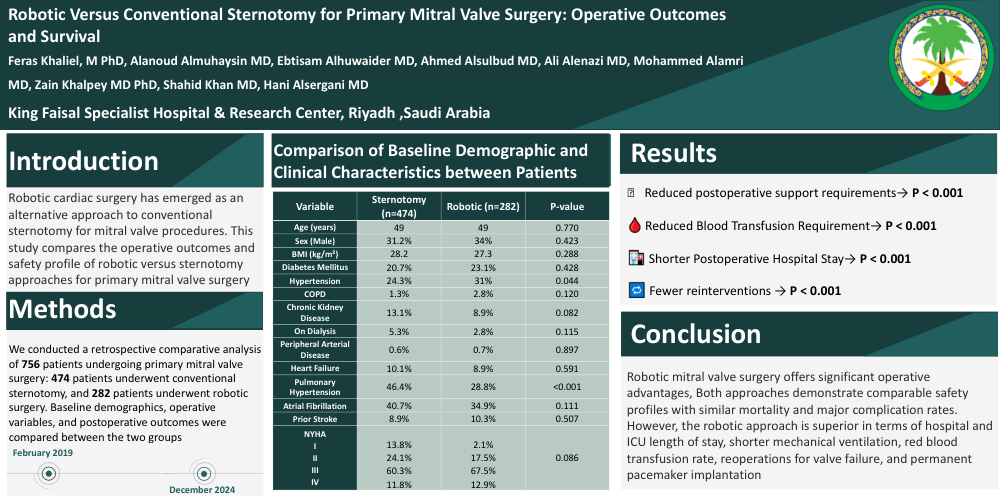
Background: Robotic cardiac surgery has emerged as an alternative approach to conventional sternotomy for mitral valve procedures. This study compares the operative outcomes and safety profile of robotic versus sternotomy approaches for primary mitral valve surgery.
Methods: We conducted a retrospective comparative analysis of 756 patients undergoing primary mitral valve surgery: 474 patients underwent conventional sternotomy and 282 patients underwent robotic surgery. Baseline demographics, operative variables, and postoperative outcomes were compared between the two groups.
Results: The groups were well-matched for age (median 49 years in both groups), sex, BMI, and left ventricular ejection fraction. The robotic group had lower preoperative risk scores (STS score: 1.1 vs. 1.6, p=0.004) and a lower prevalence of pulmonary hypertension (28.8% vs. 46.4%, p<0.001). The robotic approach was associated with significantly shorter mechanical ventilation times (median 10 vs. 18 hours, p<0.001), reduced hospital length of stay (median 7 vs. 9 days, p=0.001), and fewer red blood cell transfusions (median 1 vs. 2 units, p<0.001). Notably, the robotic group had significantly fewer reoperations for valve failure (1.4% vs. 8.4%, p<0.001) and a lower incidence of permanent pacemaker implantation (0.4% vs. 3.6%, p=0.005). Mortality rates were similar between groups (2.9% vs. 3.2%, p=0.813), as were rates of acute kidney injury, new-onset atrial fibrillation, and new stroke. No difference in survival was observed (log-rank p= 0.855).
Conclusion: Robotic mitral valve surgery offers significant operative advantages, including shorter operative times, reduced blood transfusion requirements, and lower rates of valve failure requiring reoperation. The robotic approach also demonstrates a lower incidence of permanent pacemaker implantation. Both approaches demonstrate comparable safety profiles with similar mortality and major complication rates. However robotic approach is superior in terms of hospital and ICU length of stay, shorter mechanical ventilation, red blood transfusion rate, reoperations for valve failure, and permanent pacemaker implantation.