301 posters, 50 videos, 13 topics, 13 sessions, 739 authors, 192 institutions
ePostersLive by SciGen Technologies S.A. All rights reserved.
ISMICS 2026 Annual Meeting
10 - 13 June, 2026 | Miami, Florida

D91
Minimally Invasive Direct-vision Radial Artery Harvest Through A Single Short Incision: A Resource-limited Setting Solution
Poster Presenter
Authors
Affiliations
Part of Topic
Coronary Revascularization
Objective
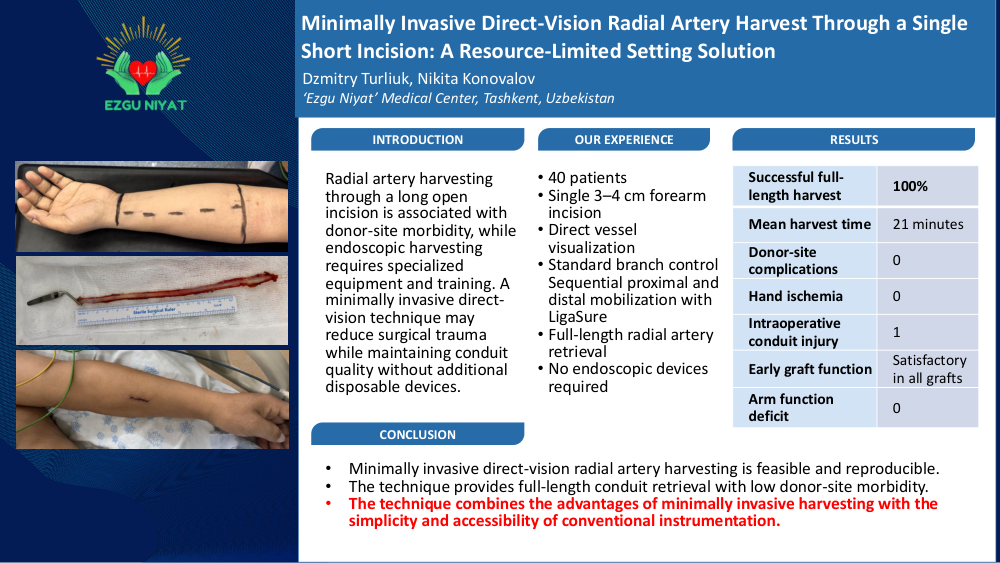
Open radial artery harvesting is associated with donor-site morbidity, while endoscopic harvesting requires specialized equipment. We evaluated the feasibility, safety, and early outcomes of a minimally invasive direct-vision radial artery harvesting technique through a single short incision, suitable for resource-limited settings.
Methods
Forty consecutive patients undergoing coronary artery bypass surgery had the radial artery harvested via a 3–4 cm forearm incision using direct visualization, limited dissection, and standard branch control. Full-length grafts were obtained without endoscopic devices. Donor-site outcomes included morbidity and functional assessment. Arm function was evaluated clinically, including wrist and forearm strength. The primary endpoint was donor-site morbidity within 30 days. Secondary endpoints included harvest time, intraoperative conduit injury, early graft function, and arm function.
Results
All procedures achieved full-length radial artery harvest. Mean harvest time was 21 minutes. No donor-site complications or hand ischemia occurred. Intraoperative conduit injury occurred in one patient. Early graft function, assessed intraoperatively or by early imaging in patients undergoing hybrid revascularization, was satisfactory in all cases. Arm function was preserved in all patients, with no measurable deficits in wrist or forearm strength. The technique required no specialized equipment and allowed clear visualization of the conduit along its length.
Conclusions
Minimally invasive direct-vision radial artery harvesting through a single short incision is feasible, reproducible, and associated with low donor-site morbidity. This technique offers a practical, cost-conscious alternative to long open incisions and endoscopic harvesting, suitable for resource-limited settings. Arm function is preserved, and the approach has a short learning curve. Prospective studies with long-term graft patency are warranted.