301 posters, 50 videos, 13 topics, 13 sessions, 739 authors, 192 institutions
ePostersLive by SciGen Technologies S.A. All rights reserved.
ISMICS 2026 Annual Meeting
10 - 13 June, 2026 | Miami, Florida

D65
Evolution Of Femoral Cannulation Techniques In Minimally Invasive Valve Repair A 10-year Experience
Part of Topic
Valve � Surgical Valves
Introduction
Minimallyinvasivemitralvalvesurgery(MIMVS)viaarightmini-thoracotomyhasevolvedintoawell-establishedalternativetoconventionalmediansternotomy,significantlyimprovingpatientsatisfactionandacceleratingfunctionalrecoverybyminimizingsurgicaltrauma.Acriticalandtechnicallydemandingcornerstoneofthisapproachremainstheestablishmentofsafeperipheralfemoro-femoralaccesstoinitiatecardiopulmonarybypass(CPB).
Historically,accesstothefemoralarteryandveinwasroutinelyestablishedthroughanopensurgicalcut-down.[1]Althoughthistraditionalmethodoffersdirectvisualcontrolofvessels,surgicaldissectionwithinthesensitiveinguinallymphatictrianglecarriesarelevantriskofaccess-sitemorbidity.Thisincludespostoperativelymphfistulas,seromas,andwoundhealingdisorders,whichcancomplicatetheclinicalcourseandprolonghospitallengthofstay.Drivenbytheadvancementoflarge-boretranscatheterinterventions,ultrasound-guidedpercutaneousfemoralpuncturehasemergedasalessinvasivealternativeforcardiacsurgeons.Combiningreal-timeultrasoundguidancewithspecializedequipment—suchassmartvenouscannulasforoptimizeddrainageandplug-basedvascularclosuredevices(e.g.,theMANTAsystem)—allowsforacompletelypercutaneousworkflowthatminimizeslocaltissuedisruptioninthegroin.[2]
StudyObjective:Thisstudyevaluatesour10-yearinstitutionaltransitionfromroutineopenfemoralcut-downtostandardized,ultrasound-guidedpercutaneouscannulationinpatientsundergoingMIMVS.Weaimedtoanalyzehowthisproceduralevolutioninfluencedworkflowefficiency,resourceutilization,andaccess-sitesafetyoverafulldecadeofclinicalprogramdevelopment.[6]
Methods
•
Study Period:January 2014 –August 2025
•
Cohort:575 patients (Cut-down: 393; Percutaneous: 182).
•
Technique:Ultrasound-guided puncture vs. open preparation.
•
Analysis:Retrospective study with Propensity Score Matching (PSM) for 72 matched pairs adjusted forAge, sex, obesity(BMI > 30 kg/m²), EuroSCOREII, NYHA class, COPD, chronicdialysis, and priorcardiacsurgery. UnmatchedCohortTests (N=575): Mann-Whitney U testforcontinuousparameters; Fisher'sexacttestorChi-squaretestforcategoricaldifferences. Matched CohortTests (72 pairs): Wilcoxon signed-rank testforcontinuousoutcomes; McNemar'stestforbinary/categoricalendpointstoaccountforwithin-pair correlation.
Results & Efficiency
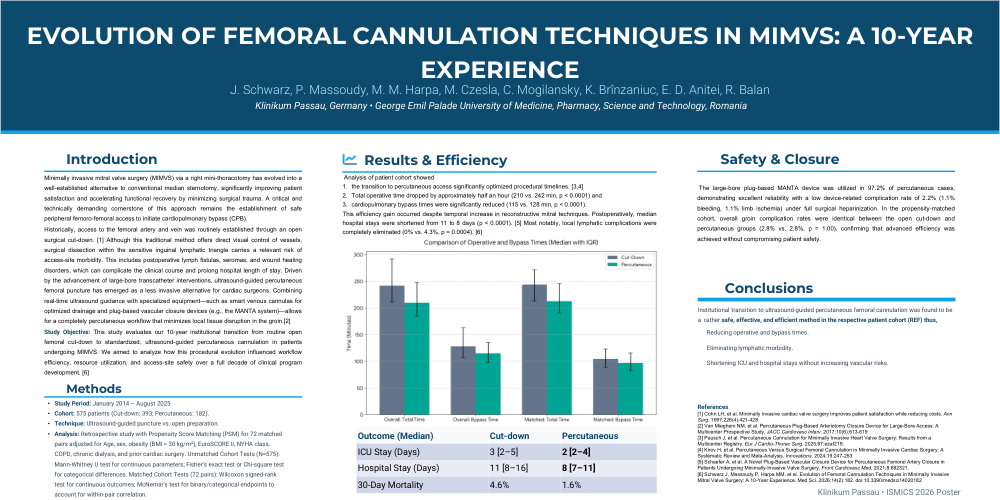
Analysisofpatientcohortshowed
1.
thetransitiontopercutaneousaccesssignificantlyoptimizedproceduraltimelines.[3,4]
2.
Totaloperativetimedroppedbyapproximatelyhalfanhour(210vs.242min,p<0.0001)and
3.
cardiopulmonarybypasstimesweresignificantlyreduced(115vs.128min,p<0.0001).
Thisefficiencygainoccurreddespitetemporalincreaseinreconstructivemitraltechniques.Postoperatively,medianhospitalstayswereshortenedfrom11to8days(p<0.0001).[5]Mostnotably,locallymphaticcomplicationswerecompletelyeliminated(0%vs.4.3%,p=0.0004).[6]
Safety & Closure
Thelarge-boreplug-basedMANTAdevicewasutilizedin97.2%ofpercutaneouscases,demonstratingexcellentreliabilitywithalowdevice-relatedcomplicationrateof2.2%(1.1%bleeding,1.1%limbischemia)underfullsurgicalheparinization.Inthepropensity-matchedcohort,overallgroincomplicationrateswereidenticalbetweentheopencut-downandpercutaneousgroups(2.8%vs.2.8%,p=1.00),confirmingthatadvancedefficiencywasachievedwithoutcompromisingpatientsafety.
Conclusions
Institutional transition to ultrasound-guided percutaneous femoral cannulation was found to be a rather safe, effective, and efficient method in the respective patient cohort (REF) thus,
Eliminating lymphatic morbidity.
Reducing operative and bypass times.
Shortening ICU and hospital stays without increasing vascular risks.
References
[1] Cohn LH, et al. Minimallyinvasive cardiacvalvesurgeryimprovespatientsatisfactionwhilereducingcosts. Ann Surg. 1997;226(4):421-428
[2] Van MieghemNM, et al. PercutaneousPlug-BasedArteriotomyClosureDevice forLarge-Bore Access: A Multicenter ProspectiveStudy. JACC CardiovascInterv. 2017;10(6):613-619
[3] PauschJ, et al. PercutaneousCannulationforMinimallyInvasive Heart Valve Surgery: Resultsfroma Multicenter Registry. EurJ Cardio-ThoracSurg. 2025;67:ezaf219.
[4] Kirov H, et al. PercutaneousVersus SurgicalFemoral Cannulationin MinimallyInvasive CardiacSurgery: A SystematicReview and Meta-Analysis. Innovations. 2024;19:247-253
[5] Schaefer A, et al. A NovelPlug-BasedVascularClosureDevice forPercutaneousFemoral ArteryClosurein PatientsUndergoingMinimally-Invasive Valve Surgery. Front CardiovascMed. 2021;8:682321.
[6] Schwarz J, MassoudyP, Harpa MM, et al. Evolution ofFemoral CannulationTechniquesin MinimallyInvasive Mitral Valve Surgery: A 10-Year Experience. Med Sci. 2026;14(2):182. doi:10.3390/medsci14020182