301 posters, 50 videos, 13 topics, 13 sessions, 739 authors, 192 institutions
ePostersLive by SciGen Technologies S.A. All rights reserved.
ISMICS 2026 Annual Meeting
10 - 13 June, 2026 | Miami, Florida

P1
A Dual-phase Ai And Machine Learning Approach To Predict Operative Mortality In Aortic Surgery
Part of Topic
Aortic and Endovascular Therapies
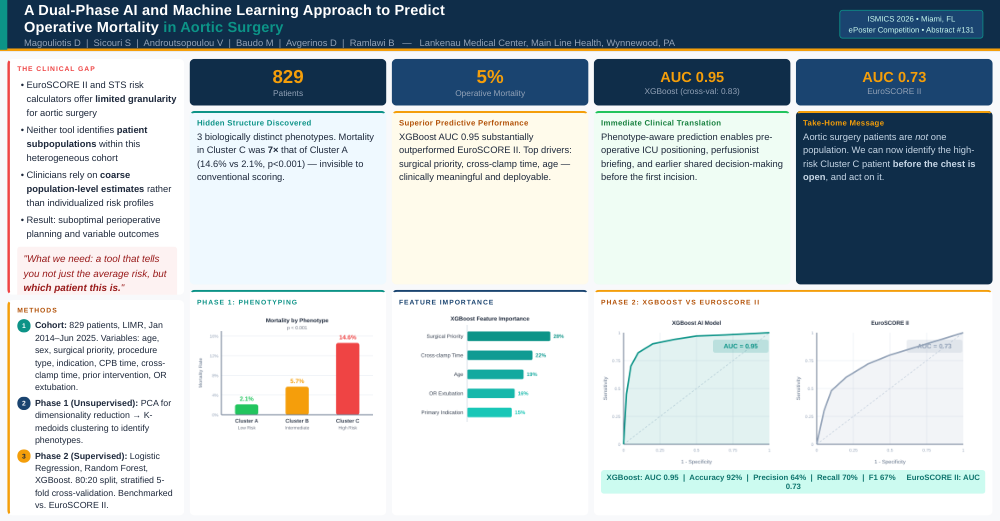
Background: Patients undergoing aortic surgery present complex risk profiles, making accurate risk stratification crucial for improving outcomes. Conventional scoring systems such as EuroSCORE II offer limited granularity, while the STS risk calculator assesses only a limited cohort of patients. This study aimed to harness both unsupervised and supervised machine learning techniques to identify distinct clinical phenotypes among patients undergoing aortic surgery and to develop an accurate prediction model for operative mortality using routinely collected variables.
Methods: We retrospectively analyzed data from 829 patients who underwent aortic surgery between January 2014 and June 2025 at Lankenau Medical Center. Variables included age, sex, surgical priority, procedure type, primary indication, cardiopulmonary bypass time, cross-clamp time, prior cardiac intervention, and OR extubation. An unsupervised clustering approach employed principal component analysis for dimensionality reduction followed by k-medoids clustering. Supervised learning models including logistic regression, random forest, and XGBoost were trained to predict operative mortality using an 80:20 train/test split with stratified 5-fold cross-validation.
Results: Median age was 66 years (IQR 58-73), 35% were female, 61% had aneurysmal disease, and overall operative mortality was 5%. Unsupervised clustering revealed three phenotypes: Cluster A (low-risk, 2.1% mortality), Cluster B (intermediate-risk, 5.7%), and Cluster C (high-risk, 14.6%), p<0.001. XGBoost demonstrated an AUC of 0.95 (cross-validated AUC 0.83), outperforming EuroSCORE II (AUC 0.73). Accuracy was 92%, precision 64%, recall 70%, and F1-score 67%. Key predictive features included surgical priority, cross-clamp time, age, OR extubation, and primary indication.
Conclusions: Integrating unsupervised phenotyping with supervised prediction modeling identified distinct patient subgroups and developed a robust AI-powered tool for operative mortality prediction in aortic surgery. This dual-phase approach may inform tailored perioperative strategies, optimize resource allocation, and enhance shared decision-making in this high-risk surgical domain.
Keywords: aortic surgery, machine learning, XGBoost, operative mortality, risk stratification, phenotyping, unsupervised learning, EuroSCORE, artificial intelligence, cardiac surgery.