301 posters, 50 videos, 13 topics, 13 sessions, 739 authors, 192 institutions
ePostersLive by SciGen Technologies S.A. All rights reserved.
ISMICS 2026 Annual Meeting
10 - 13 June, 2026 | Miami, Florida

P18
Concommitant Aortic Valve Replacement And Atrial Fibrillation Surgery Combining Right Mini-thoractomy And Thoracoscopy, A Novel Approach
Part of Topic
Arrhythmia Surgery & Interventions
Video
Objective:
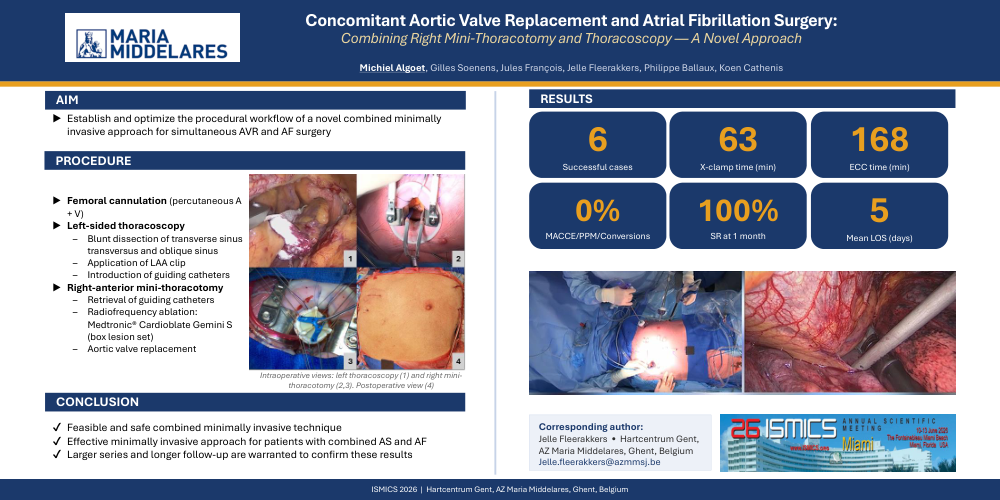
To assess the feasibility, safety, and early outcomes of a novel combined minimally invasive approach integrating right mini-thoracotomy aortic valve replacement (AVR) with a left thoracoscopic mini-MAZE procedure in patients with aortic valve disease and atrial fibrillation (AF). While minimally invasive AVR and thoracoscopic ablation are well established individually, their simultaneous application through bilateral minimal access has not been widely described.
Methods:
Six patients underwent combined AVR and thoracoscopic mini-MAZE at our institution. Cardiopulmonary bypass was established via percutaneous femoral cannulation, and the aorta was cross-clamped using a Chitwood clamp. A standard mini-MAZE ablation lesion set was created using bipolar radiofrequent energy. Operative and postoperative outcomes were prospectively recorded, including cross-clamp and bypass times, rhythm status, complications, and length of stay.
Results:
All procedures were completed via the planned minimally invasive approach with no conversions to sternotomy. Mean cross-clamp and bypass times were 63 ± 28 minutes and 168 ± 45 minutes, respectively. There were no in-hospital mortalities. At 30-day follow-up, 100% remained free of AF. The mean postoperative stay was 5 days. No MACCE, PPM nor conversions were registered.
Conclusions:
This dual-access technique combining right mini-thoracotomy AVR with left thoracoscopic mini-MAZE is technically feasible, reproducible, and safe in selected patients. It allows comprehensive treatment of aortic valve disease and atrial fibrillation while maintaining the benefits of a minimally invasive approach. Further experience and longer-term follow-up are warranted to assess durability and rhythm outcomes.