301 posters, 50 videos, 13 topics, 13 sessions, 739 authors, 192 institutions
ePostersLive by SciGen Technologies S.A. All rights reserved.
ISMICS 2026 Annual Meeting
10 - 13 June, 2026 | Miami, Florida

D74
Modified Thoracoscopic Ablation Procedure For The Treatment Of Af
Poster Presenter
Authors
Part of Topic
Arrhythmia Surgery & Interventions
Modified thoracoscopic ablation procedure for the treatment of AF
Amiran Sh. Revishvili , Vadim A. Popov , Egor S. Malyshenko, Maksim M. Anishchenko, Natalia V. Popova, Sirarpi S. Petrosyan
A.V. Vishnevsky National Medical Research Center of Surgery Moscow, Russian Federation
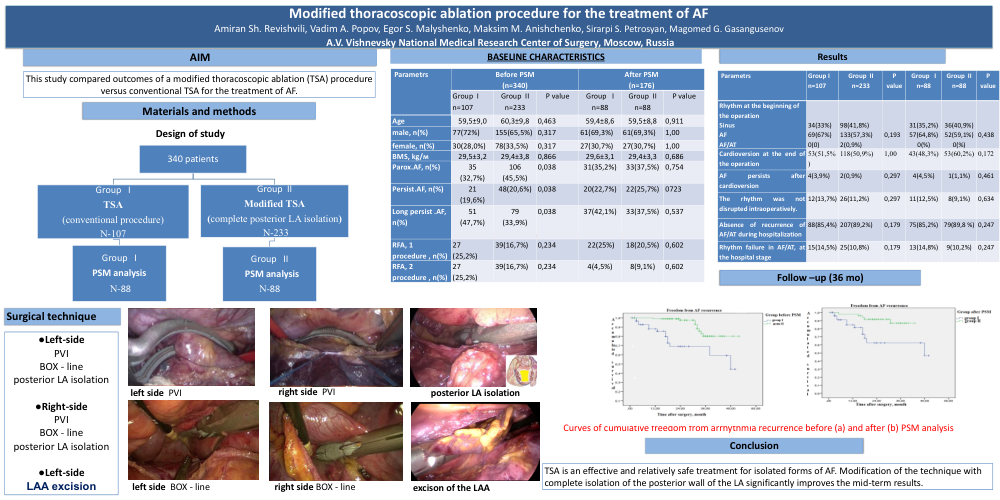
Objective. This study compared outcomes of a modified thoracoscopic ablation (TSA) procedure versus conventional TSA for the treatment of AF.
Material and methods. The propensity score match (PSM) analwas conducted in 340 patients after TSA. 1st group (n=107) underwent conventional procedure , while 2nd group (n=233) received a modified procedure with complete posterior LA isolation. After PSM analysis 88 pairs of patient were obtained. The primary endpoint was the freedom from AF/AT/PT at discharge and during mid-term follow-up (up to 36 mo). Secondary endpoints included the rate of conversion to sternotomy and the rate of permanent pacemaker implantation (PPI).
Results. After PSM analysis there was no in-hospital mortality in either group. The rate of sinus rhythm at discharge was significantly higher in 2nd group compared to 1st group (95.4% vs. 86.4%, p=0.035). In 1st group I, there were 2 (2.3%) complication requiring sternotomy, while in 2nd group II there were no conversions (p = 0.497).In 1st case in 2nd group (1.1%) required patient PPI during hospitalization. Cumulative freedom from AF/AT/PT recurrence was significantly higher in Group II compared to Group I: 98% vs 84.9% (at 12 mo); 91% vs 62% (at 24 mo); and 84.6% vs 62% (at 36 mo), p = 0.004. There were no cases of PPI during mid-term follow-up.
Conclusions. TA is an effective and relatively safe treatment for isolated forms of AF. Modification of the technique with complete isolation of the posterior wall of the LA significantly improves the mid-term results.