301 posters, 50 videos, 13 topics, 13 sessions, 739 authors, 192 institutions
ePostersLive by SciGen Technologies S.A. All rights reserved.
ISMICS 2026 Annual Meeting
10 - 13 June, 2026 | Miami, Florida

D43
Introducing The Biaxillary Access: Cabg With Concomitant Valve Surgery Using Novel Technology
Poster Presenter
Authors
Part of Topic
Coronary Revascularization
Objective:
To evaluate the anatomical feasibility and procedural workflow of a minimally invasive biaxillary access strategy for concomitant coronary artery bypass grafting and valve surgery in a human cadaver model.
This study was performed in nine Thiel/ethanol-fixed human cadavers. Concomitant coronary artery bypass grafting and valve procedures were carried out using a minimally invasive biaxillary access strategy.
The assessment focused on:
•anatomical exposure
•internal thoracic artery conduit length
•graft harvesting
•anastomosis times
•valve implantation positioning
Postprocedural evaluation was performed by direct macroscopic inspection and three-dimensional computed tomography imaging.
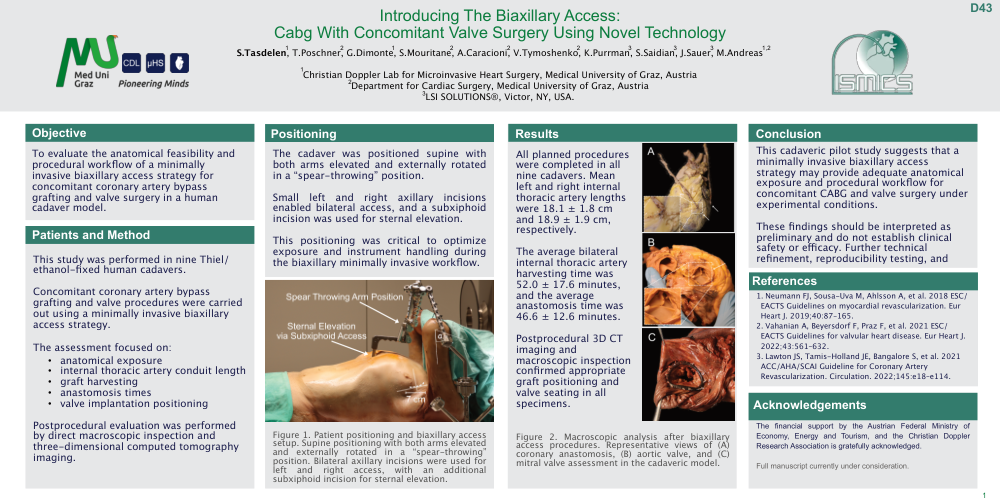
All planned procedures were completed in all nine cadavers. Mean left and right internal thoracic artery lengths were 18.1 ± 1.8 cm and 18.9 ± 1.9 cm, respectively.
The average bilateral internal thoracic artery harvesting time was 52.0 ± 17.6 minutes, and the average anastomosis time was 46.6 ± 12.6 minutes. Postprocedural 3D CT imaging and macroscopic inspection confirmed appropriate graft positioning and valve seating in all specimens.
Conclusion:
This cadaveric pilot study suggests that a minimally invasive biaxillary access strategy may provide adequate anatomical exposure and procedural workflow for concomitant CABG and valve surgery under experimental conditions. These findings should be interpreted as preliminary and do not establish clinical safety or efficacy. Further technical refinement, reproducibility testing, and clinical validation are required.
1.Neumann FJ, Sousa-Uva M, Ahlsson A, et al. 2018 ESC/EACTS Guidelines on myocardial revascularization. Eur Heart J. 2019;40:87–165.
2.Vahanian A, Beyersdorf F, Praz F, et al. 2021 ESC/EACTS Guidelines for valvular heart disease. Eur Heart J. 2022;43:561–632.
3.Lawton JS, Tamis-Holland JE, Bangalore S, et al. 2021 ACC/AHA/SCAI Guideline for Coronary Artery Revascularization. Circulation. 2022;145:e18–e114.
Acknowledgements:
The financial support by the Austrian Federal Ministry of Economy, Energy and Tourism, and the Christian Doppler Research Association is gratefully acknowledged.
Full manuscript currently under consideration.