301 posters, 50 videos, 13 topics, 13 sessions, 739 authors, 192 institutions
ePostersLive by SciGen Technologies S.A. All rights reserved.
ISMICS 2026 Annual Meeting
10 - 13 June, 2026 | Miami, Florida

D30
Benchmarking Cabg Quality Through Textbook Outcome In The Modern Era
Poster Presenter
Part of Topic
Coronary Revascularization
Benchmarking CABG Quality Through Textbook Outcome in the Modern Era
Massimo Baudo1, Amanda Yakobitis2, Dana Foley2, Courtney Murray2, Gianluca Torregrossa1,2
Background
Textbook outcome (TO) is a composite measure of surgical quality reflecting the absence of major perioperative adverse events. Originally developed to benchmark surgical performance beyond single-endpoint metrics, it provides a holistic assessment of the "ideal" postoperative course. However, its definition remains heterogeneous and inconsistently applied across studies, limiting comparability between institutions. This study evaluated the rate of TO following surgical coronary revascularization (CABG) using a comprehensive, clinically relevant composite of events.
Methods
All consecutive patients undergoing CABG between July 2021 and July 2025 were retrospectively included. TO was defined as the absence of perioperative transfusion, sternotomy conversion, prolonged mechanical ventilation (>24h), stroke, deep sternal wound infection, reoperation for bleeding, unplanned coronary revascularization, renal failure or dialysis, new postoperative atrial fibrillation, pacemaker implantation, in-hospital mortality, and 30-day readmission. TO was treated as a binary endpoint and considered achieved only when all criteria were met. Logistic regression analysis was performed to identify factors independently associated with TO.
Results
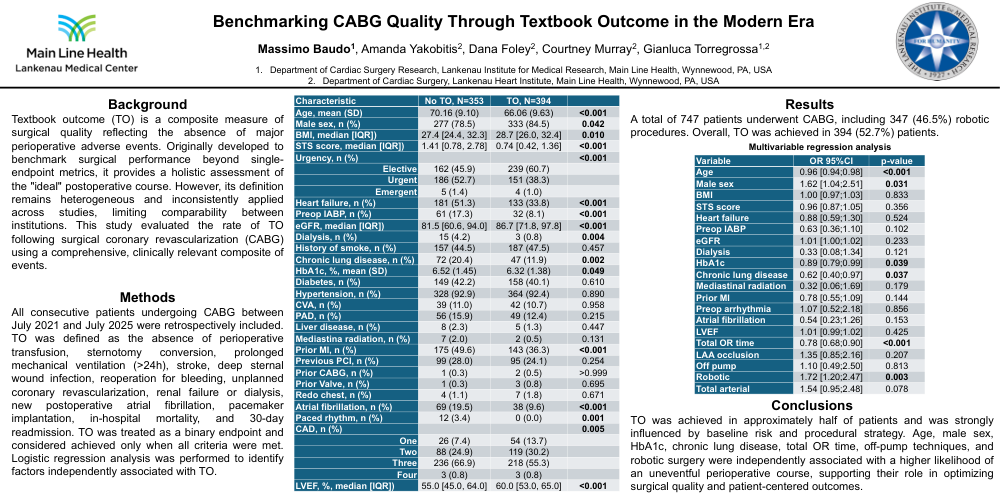
A total of 747 patients underwent CABG, including 347 (46.5%) robotic procedures. Overall, TO was achieved in 394 (52.7%) patients.
Conclusions
TO was achieved in approximately half of patients and was strongly influenced by baseline risk and procedural strategy. Age, male sex, HbA1c, chronic lung disease, total OR time, off-pump techniques, and robotic surgery were independently associated with a higher likelihood of an uneventful perioperative course, supporting their role in optimizing surgical quality and patient-centered outcomes.