301 posters, 50 videos, 13 topics, 13 sessions, 739 authors, 192 institutions
ePostersLive by SciGen Technologies S.A. All rights reserved.
ISMICS 2026 Annual Meeting
10 - 13 June, 2026 | Miami, Florida

D26
Robotic Versus Conventional Sternotomy For Redo Mitral Valve Replacement: A Comparative Analysis Of Operative Outcomes
Poster Presenter
Authors
Feras Khaliel, Ebtisam Alhuwaider, Alanoud Almuhaysin, Ahmed Alsulbud, Ulhaq Irfan, Domenico Galzerano, Dania Mohty, Adel Aly, Hani Alsergani
Affiliations
Adult Cardiac Surgery Department, Heart Center of Excellence, King Faisal Specialist Hospital & Research Center, Riyadh, Saudi Arabia, Adult Echocardiography Section, Heart Center, King Faisal Specialist Hospital & Research Center, Riyadh, Saudi Arabia, Cardiac Anesthesia, Anesthesia Department, King Faisal Specialist Hospital & Research Centre, Riyadh, Saudi Arabia, Adult Cardiology Department, Heart Center of Excellence, King Faisal Specialist Hospital & Research Center, Riyadh, Saudi Arabia
Part of Topic
Valve � Surgical Valves
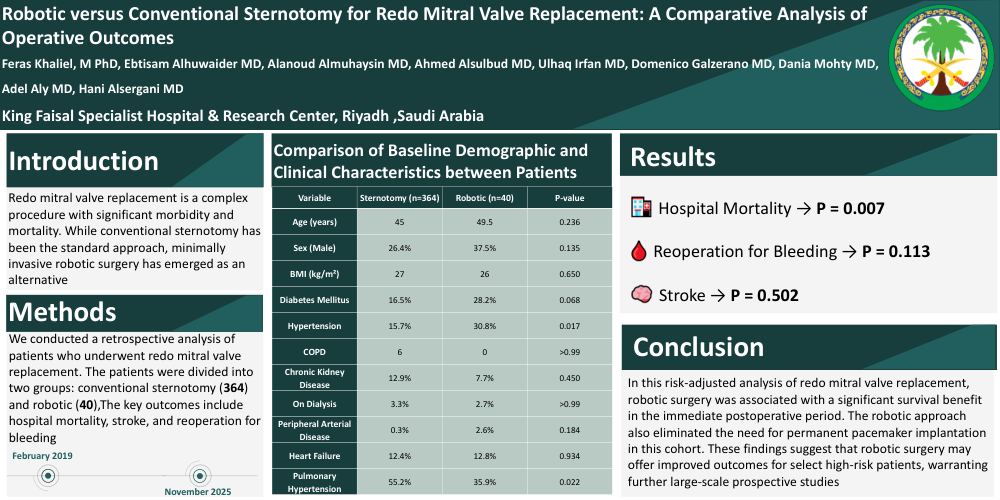
Background: Redo mitral valve replacement is a complex procedure with significant morbidity and mortality. While conventional sternotomy has been the standard approach, minimally invasive robotic surgery has emerged as an alternative. This study aims to compare the postoperative outcomes of patients undergoing redo mitral valve replacement via robotic surgery versus traditional sternotomy.
Methods: We conducted a retrospective analysis of patients who underwent redo mitral valve replacement between February 2019 and November 2025. Patients were divided into two groups: conventional sternotomy (n=364) and robotic (n=40). To account for baseline differences, we used g-computation with regression adjustment to estimate the average treatment effect (ATE) of the surgical approach on key outcomes, including hospital mortality, stroke, and reoperation for bleeding.
Results:
After adjusting for baseline patient characteristics, the average treatment effect of robotic surgery was evaluated for several key postoperative outcomes. A significant reduction in hospital mortality was observed in the robotic surgery group compared to the conventional sternotomy group (β = -0.09, 95% CI: -0.15 to -0.02, p = 0.007).
No statistically significant difference was found in the incidence of postoperative stroke between the two surgical approaches (β = 0.03, 95% CI: -0.06 to 0.13, p = 0.502). Similarly, the risk of reoperation for bleeding did not differ significantly between the robotic and sternotomy groups after covariate adjustment (β = 0.07, 95% CI: -0.02 to 0.16, p = 0.113). Furthermore, there was no significant difference in the occurrence of new-onset atrial fibrillation (β = 0.001, 95% CI: -0.142 to 0.144, p = 0.99). Long-term survival was similar between the groups (log-rank p=0.120).
Conclusion: In this risk-adjusted analysis of redo mitral valve replacement, robotic surgery was associated with a significant survival benefit in the immediate postoperative period. The robotic approach also eliminated the need for permanent pacemaker implantation in this cohort. These findings suggest that robotic surgery may offer improved outcomes for select high-risk patients, warranting further large-scale prospective studies.