301 posters, 50 videos, 13 topics, 13 sessions, 739 authors, 192 institutions
ePostersLive by SciGen Technologies S.A. All rights reserved.
ISMICS 2026 Annual Meeting
10 - 13 June, 2026 | Miami, Florida

D24
Precision Matters: Ct-based Measurement For Optimal Sutureless Valve Implantation
Poster Presenter
Authors
Jonah Schwarz, Parvis Massoudy, Christian Mogilansky, Robert Balan
Affiliations
Part of Topic
Valve � Surgical Valves
Introduction
Accurate annular sizing is a key determinant of procedural success in sutureless aortic valve replacement. Incorrect valve sizing may lead to complications such as paravalvular regurgitation, device malposition, elevated transvalvular gradients, and suboptimal hemodynamic performance [1,2,5].
Computed tomography (CT)-based annular assessment has emerged as a reliable modality for preoperative planning, enabling detailed anatomical evaluation and more precise prosthesis selection. [3,4]. This approach is particularly relevant in minimally invasive and robotic-assisted procedures, where the use of conventional valve sizers may be technically challenging and where accurate preoperative planning may help reduce procedural complexity and operative time.
The Perceval Plus valve is currently the only conventional sutureless aortic valve with an established CT-based sizing strategy where CT-derived annular measurements, including average annular diameter and perimeter-derived diameter are utilised to guide Perceval Plus valve selection.
Objective: Evaluating the feasibility and utility of computed tomography (CT)-derived annular measurements, for guiding Perceval Plus valve sizing in aortic valve replacement, particularly in minimally invasive and robotic-assisted procedures compared to intraoperative sizing.
Methods
Cohort selection: A total of 47 consecutive patients undergoing Perceval Plus aortic valve implantation between June 2024 and April 2026 were retrospectively analyzed. All patients underwent preoperative contrast-enhanced computed tomography (CT) imaging for annular assessment and procedural planning.
Analysis: CT-derived annular measurements, including average annular diameter and perimeter-derived diameter were analysed preoperative and compared to the intraoperative measured and selected Size. Early postoperative outcomes and procedural characteristics were evaluated to assess the clinical applicability and predictive value of CT-guided sizing for Perceval Plus implantation. Continuous variables were summarized as mean ± standard deviation (SD), while categorical variables were reported as absolute numbers and percentages. Given the descriptive, single-cohort study design, no comparative hypothesis testing or p-value calculations were performed.
Results
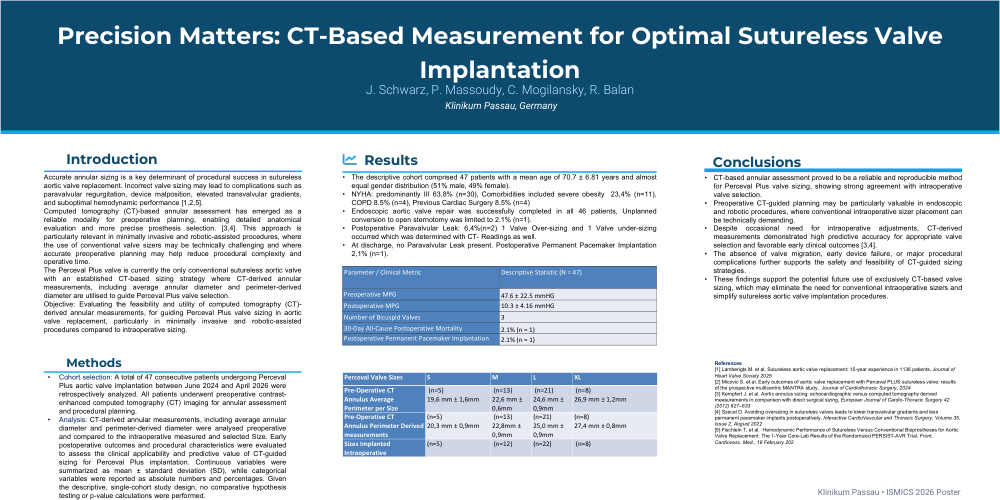
The descriptive cohort comprised 47 patients with a mean age of 70.7 ± 6.81 years and almost equal gender distribution (51% male, 49% female).
NYHA: predominantly III 63,8% (n=30), Comorbidities included severe obesity 23,4% (n=11), COPD 8.5% (n=4) and Previous Cardiac Surgery 8,5% (n=4).
Endoscopic aortic valve repair was successfully completed in all 46 patients, Unplanned conversion to open sternotomy was limited to 2.1% (n=1).
Postoperative Paravalvular Leak: 6,4%(n=2) 1 Valve Over-sizing and 1 Valve under-sizing occurred which was determined with CT- Readings as well.
At discharge, no Paravalvular Leak present. Postoperative Permanent Pacemaker Implantation 2,1% (n=1)
Conclusion
CT-based annular assessment proved to be a reliable and reproducible method for Perceval Plus valve sizing, showing strong agreement with intraoperative valve selection.
Preoperative CT-guided planning may be particularly valuable in endoscopic and robotic procedures, where conventional intraoperative sizer placement can be technically demanding.
Despite occasional need for intraoperative adjustments, CT-derived measurements demonstrated high predictive accuracy for appropriate valve selection and favorable early clinical outcomes [3,4].
The absence of valve migration, early device failure, or major procedural complications further supports the safety and feasibility of CT-guided sizing strategies.
These findings support the potential future use of exclusively CT-based valve sizing, which may eliminate the need for conventional intraoperative sizers and simplify sutureless aortic valve implantation procedures.
References
[1] Lamberigts M. et al. Sutureless aortic valve replacement: 15-year experience in 1136 patients, Journal of Heart Valve Society 2025
[2] Micovic S. et al. Early outcomes of aortic valve replacement with Perceval PLUS sutureless valve: results of the prospective multicentric MANTRA study, Journal of Cardiothoracic Surgery, 2024
[3] Kempfert J. et al. Aortic annulus sizing: echocardiographic versus computed tomography derived measurements in comparison with direct surgical sizing, European Journal of Cardio-Thoracic Surgery 42 (2012) 627–633
[4] Szecel D. Avoiding oversizing in sutureless valves leads to lower transvalvular gradients and less permanent pacemaker implants postoperatively, Interactive CardioVascular and Thoracic Surgery, Volume 35, Issue 2, August 2022
[5] Fischlein T, et al. Hemodynamic Performance of Sutureless Versus Conventional Bioprostheses for Aortic Valve Replacement: The 1-Year Core-Lab Results of the Randomized PERSIST-AVR Trial, Front. Cardiovasc. Med., 18 February 202