301 posters, 50 videos, 13 topics, 13 sessions, 739 authors, 192 institutions
ePostersLive by SciGen Technologies S.A. All rights reserved.
ISMICS 2026 Annual Meeting
10 - 13 June, 2026 | Miami, Florida

D23
The Age-adjusted Charlson Comorbidity Index Predicts Early Recovery After Robotic Mitral Valve Repair
Poster Presenter
Authors
Kei Kobayashi, Andrea Amabile, Guo Yizhan, Xander Jacquemyn, Ariana Jackson, Jeffrey Ding, Irsa Hasan, Danny Chu, David West, David Kaczorowski, Johannes Bonatti
Affiliations
Part of Topic
Valve � Surgical Valves
The Age-Adjusted Charlson Comorbidity Index In Robotic Mitral Valve Repair
Kei Kobayashi, Andrea Amabile, Yizhan Guo, Xander Jacquemyn, Ariana Jackson, Jeffrey Ding, Irsa Hasan, Danny Chu, David West, David Kaczorowski, Johannes Bonatti
Objective:
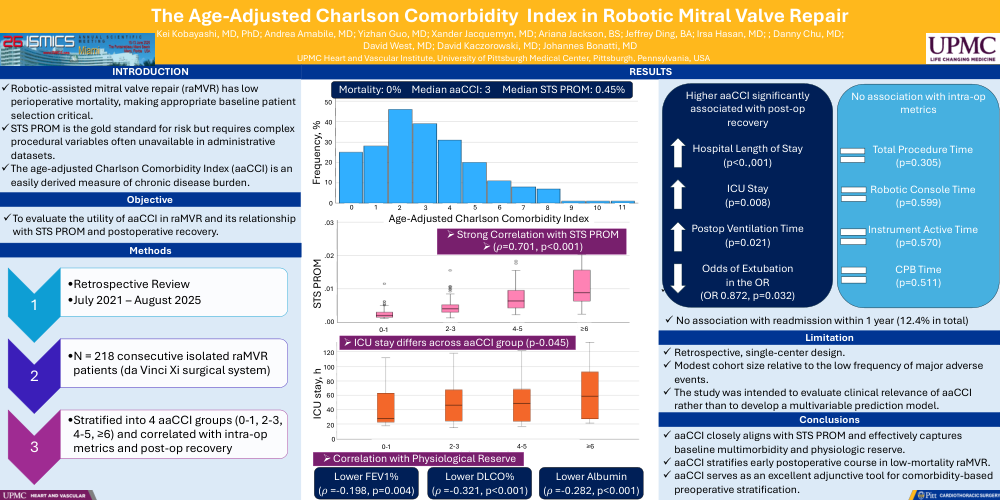
The age-adjusted Charlson Comorbidity Index (aaCCI) is an established measure of comorbidity burden, but its utility in robotic-assisted mitral valve repair (raMVR) is unknown. We evaluated its relationship with postoperative recovery and Society of Thoracic Surgeons Predicted Risk of Mortality (STS PROM).
Methods:
We retrospectively reviewed 218 consecutive patients who underwent raMVR between 2021-2025. The predictive values of the aaCCI and STS PROM were compared. Correlation analysis, univariable linear and logistic regression analyses were used to assess associations between aaCCI and pre-, intra-, and post-operative outcomes.
Results:
Median age was 62 years (interquartile range [IQR], 53.8-69.0). Median aaCCI was 3 (IQR, 2-4; range 0-11), and median STS PROM was 0.45% (IQR, 0.28%-0.74%). aaCCI strongly correlated with STS PROM (ρ=0.701, p<0.001), but it was not associated with intraoperative duration or automated performance metrics. In contrast, higher aaCCI was associated with longer ventilation time (ρ=0.157, p=0.021), ICU stay (ρ=0.181, p=0.008), and hospital length of stay (ρ=0.314, p<0.001). Extubation in the operating room was achieved in 117 patients (53.7%), and 1-year readmission occurred in 27 (12.4%). There was no mortality. In univariable analysis, aaCCI was associated with longer hospital length of stay (B 0.482, 95%CI 0.251-0.714, p<0.001) and lower odds of extubation in the operating room (odds ratio 0.872, 95%CI 0.769-0.988, p=0.032).
Conclusions:
In raMVR, aaCCI aligns closely with STS PROM and is associated with early postoperative recovery measures/variables rather than intraoperative technical metrics. aaCCI may serve as a practical adjunct for perioperative risk stratification in robotic mitral repair.