301 posters, 50 videos, 13 topics, 13 sessions, 734 authors, 193 institutions
ePostersLive by SciGen Technologies S.A. All rights reserved.
ISMICS 2026 Annual Meeting
10 - 13 June, 2026 | Miami, Florida

P139
Large Aortic Annulus In Tavr With Newer Generation Valves: An Entropy-balanced Comparison Of Balloon-expandable Versus Self-expanding Devices
Poster Presenter
Part of Topic
Valve - Transcatheter Therapies
Large Aortic Annulus in TAVR with Newer Generation Valves: An Entropy-Balanced Comparison of Balloon-Expandable Versus Self-Expanding Devices
Massimo Baudo1, Serge Sicouri1, Dimitrios E. Magouliotis1, Fadi Hage2, Scott M. Goldman2, Eric M. Gnall2, Khalid Ridwan2, William A. Gray1,2, Basel Ramlawi1,2
1.Department of Cardiac Surgery Research, Lankenau Institute for Medical Research, Main Line Health, Wynnewood, PA, USA
2.Department of Cardiac Surgery, Lankenau Heart Institute, Main Line Health, Wynnewood, PA, USA
Background
TAVR is increasingly offered to lower-risk and anatomically complex patients, making device-specific performance in underrepresented subgroups increasingly relevant. Large aortic annuli pose distinct technical challenges: BEV risk incomplete annular conformability, while SEV depend on radial force and frame adaptation for sealing. Early comparative data from the CHOICE trial showed significantly higher moderate-to-severe PVL with older-generation SEV versus BEV in large annuli, a gap that narrowed substantially with next-generation platforms. Despite these advances, device-specific outcomes in large annuli with contemporary valves remain incompletely characterized, making these device-specific outcomes clinically relevant.
Methods
We retrospectively analyzed consecutive patients undergoing TAVR between January 2018 and December 2023. A large annulus was defined as a CT-derived annular area >575 mm² and/or perimeter >85 mm. Emergency procedures, endocarditis, active or prior cancer, immunocompromised status, redo aortic interventions, predominant aortic regurgitation, and bicuspid valves were excluded.
Entropy balancing was applied to achieve comparable baseline characteristics between BEV and SEV groups. Weighted categorical variables were expressed as sums of weights. Comparisons were performed using survey-adjusted statistical tests: design-adjusted t-tests for continuous variables, Rao–Scott chi-squared tests for categorical variables, and rank-based methods for non-parametric comparisons. Survival was assessed using weighted Kaplan–Meier analysis.
Results
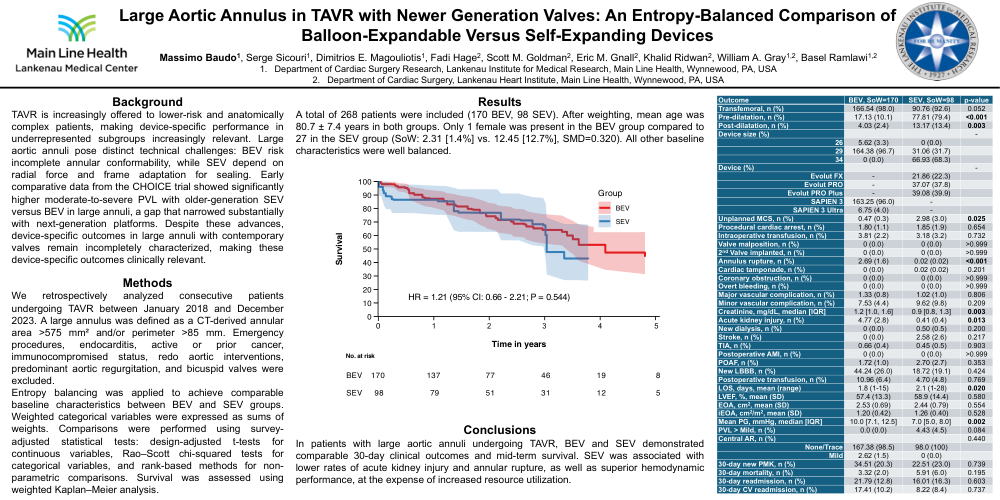
A total of 268 patients were included (170 BEV, 98 SEV). After weighting, mean age was 80.7 ± 7.4 years in both groups. Only 1 female was present in the BEV group compared to 27 in the SEV group (SoW: 2.31 [1.4%] vs. 12.45 [12.7%], SMD=0.320). All other baseline characteristics were well balanced.
Conclusions
In patients with large aortic annuli undergoing TAVR, BEV and SEV demonstrated comparable 30-day clinical outcomes and mid-term survival. SEV was associated with lower rates of acute kidney injury and annular rupture, as well as superior hemodynamic performance, at the expense of increased resource utilization.