301 posters, 50 videos, 13 topics, 13 sessions, 739 authors, 192 institutions
ePostersLive by SciGen Technologies S.A. All rights reserved.
ISMICS 2026 Annual Meeting
10 - 13 June, 2026 | Miami, Florida

P133
Minimally Invasive Trans-axillary Aortic Valve Replacement: Early Outcomes And Program Adoption In A Contemporary Series
Poster Presenter
Part of Topic
Valve � Surgical Valves
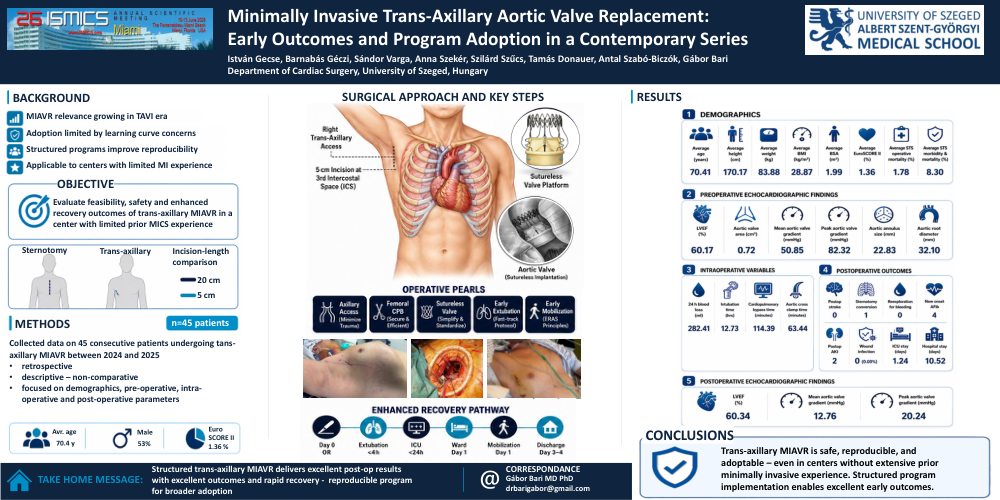
Minimally Invasive Trans-Axillary Aortic Valve Replacement: Early Outcomes and Program Adoption in a Contemporary Series
Objective:
Minimally invasive aortic valve replacement (MIAVR) plays an increasingly important role in the contemporary era of transcatheter therapies. However, concerns regarding technical complexity and institutional learning curves may limit its adoption, particularly in centers with limited prior minimally invasive cardiac surgery experience. This study aimed to evaluate the feasibility, safety, and early recovery outcomes of trans-axillary MIAVR performed within a structured enhanced recovery pathway, while highlighting its reproducibility as an adoptable programmatic strategy.
Methods:
A consecutive series of 45 adult patients underwent MIAVR via a right trans-axillary approach using a standardized 5-cm incision in the anterior axillary line at the third or fourth intercostal space. Cardiopulmonary bypass was established through femoral cannulation. A self-expanding sutureless aortic valve prosthesis was implanted to reduce procedural complexity. Perioperative management followed an enhanced recovery pathway emphasizing transfusion minimization, early mobilization, and expedited extubation. The program was intentionally structured for implementation in a center without extensive prior experience in minimally invasive valve surgery.
Results:
Procedural success was achieved in all patients. Median cardiopulmonary bypass and aortic cross-clamp times were 114.39 and 63.44 minutes, respectively. There were 0% in-hospital mortality and 0% stroke rates. Conversion to sternotomy occurred in one case. Postoperative ventilation time was 12.73 hours, and median intensive care unit length of stay was 1.24 days. The approach was associated with low transfusion requirements and favorable early recovery profiles consistent with enhanced recovery principles.
Conclusions:
Trans-axillary MIAVR using a simplified implantation strategy is a safe and effective approach with favorable early outcomes. Importantly, this technique demonstrates high procedural reproducibility and can be successfully adopted within a structured program, even in centers with limited prior minimally invasive cardiac surgery experience. These findings support the broader implementation of standardized MIAVR pathways to expand access to minimally invasive surgical valve therapies.