301 posters, 50 videos, 13 topics, 13 sessions, 739 authors, 192 institutions
ePostersLive by SciGen Technologies S.A. All rights reserved.
ISMICS 2026 Annual Meeting
10 - 13 June, 2026 | Miami, Florida

P119
Cost And Outcomes Comparison Of Mini-thoracotomy Versus Sternotomy In Isolated Mitral Valve Replacement
Poster Presenter
Authors
Alexandra Murillo Solera, Oscar Holmvard, Anjali E. Khanna, Cristina J. Crippen, Tyler J. Loftus, Thomas M. Beaver
Affiliations
Department of Surgery, Division of Cardiovascular Surgery, University of Florida, Gainesville, Florida, Department of Surgery, University of Florida, Gainesville, Florida
Part of Topic
Valve � Surgical Valves
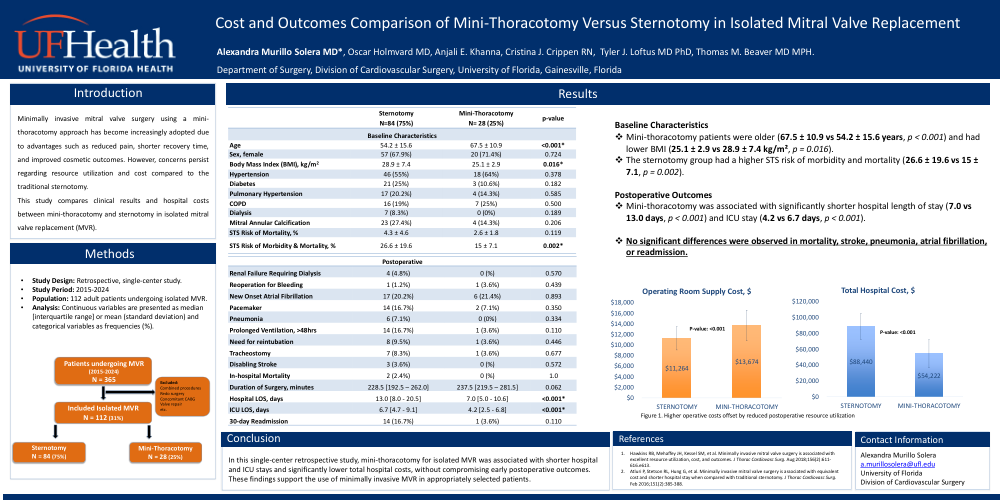
Objective: Minimally invasive mitral valve surgery using a mini-thoracotomy approach has become increasingly adopted due to advantages such as reduced pain, shorter recovery time, and improved cosmetic outcomes. However, concerns persist regarding resource utilization and cost compared to the traditional sternotomy. This study compares clinical results and hospital costs between mini-thoracotomy and sternotomy in isolated mitral valve replacement (MVR).
Methods: We retrospectively reviewed 112 patients who underwent MVR between 2015 and 2024 at a single institution. Patients were categorized by surgical approach: sternotomy (n=84) and mini-thoracotomy (n=28). Only isolated MVR cases with first-time sternotomy were included to ensure a low-risk, homogeneous cohort. Continuous variables are reported as mean standard deviation or median (interquartile range [IQR]), and categorical variables as percentage or frequency.
Results: Patients in the mini-thoracotomy group were older (67.5 ± 10.9 vs. 54.2 ± 15.6 years, p < 0.001) and had lower BMI (25.1 ± 2.9 vs. 28.9 ± 7.4, p = 0.016). Other baseline characteristics were similar between groups. Mini-thoracotomy was associated with significantly shorter hospital length of stay (7.0 [5.0 - 10.6] vs. 13.0 [8.0 - 20.5] days, p < 0.001) and ICU stay (4.2 [2.5 - 6.8] vs. 6.7 [4.7 - 9.1] days, p < 0.001). Total hospital cost was significantly lower in the mini-thoracotomy group (54,222 ± 17,673 vs. 88,440 ± 61,146 p < 0.001), despite higher operating room supply costs (13,674 ± 2,838 vs. 11,264 ± 2,198 p < 0.001). There were no significant differences in major complications, including in-hospital mortality (0 (0%) vs 2 (2.4%) p = 1.0) and disabling stroke (0 (0%) vs 3 (3.6%) p = 0.572). Patient characteristics are summarized in Table 1.
Conclusions: In this single-center retrospective study, mini-thoracotomy for isolated MVR was associated with shorter hospital and ICU stays and significantly lower total hospital costs, without compromising early postoperative outcomes. These findings support the use of minimally invasive MVR in appropriately selected patients.