301 posters, 50 videos, 13 topics, 13 sessions, 739 authors, 192 institutions
ePostersLive by SciGen Technologies S.A. All rights reserved.
ISMICS 2026 Annual Meeting
10 - 13 June, 2026 | Miami, Florida

P113
500 Mini-thoracotomy Aortic Valve Replacements: Propensity-matched Comparison With Mini-j-incision Sternotomy And Full Sternotomy
Poster Presenter
Authors
Mona Kakavand, Filip Stembal, Kristina Krzelj, Edward G. Soltesz, Faisal G. Bakaeen, Patrick Vargo, Jeevanantham Rajeswaran, Eric E. Roselli, Eugene H. Blackstone, A. Marc Gillinov, Lars G. Svensson, Marijan Koprivanac
Affiliations
Department of Thoracic and Cardiovascular Surgery, Cleveland Clinic, Cleveland, Ohio, US, Department of Quantitative Health Sciences, Cleveland Clinic, Cleveland, Ohio, US, Department of Thoracic and Cardiovascular Surgery; Department of Qualitative Health Sciences, Cleveland Clinic, Cleveland, Ohio
Part of Topic
Valve � Surgical Valves
500 Mini-thoracotomy Aortic Valve Replacements: Propensity-Matched Comparison with J-incision Sternotomy and Full Sternotomy
Mona Kakavand, MD,1 Filip Stembal, MD1, Kristina Krzelj, MD1, Edward G. Soltesz, MD, MPH,1 Faisal Bakaeen, MD,1 Patrick Vargo, MD,1 Jeevanantham Rajeswaran, PhD,2 Eric E. Roselli, MD,1 Eugene H. Blackstone, MD,1, 2 A.Marc Gillinov, MD,1 Lars G. Svensson, MD, PhD,1 Marijan Koprivanac, MD, MS1
1 Department of Thoracic and Cardiovascular Surgery
2 Department of Quantitative Health Sciences
Cleveland Clinic
Cleveland, Ohio, US
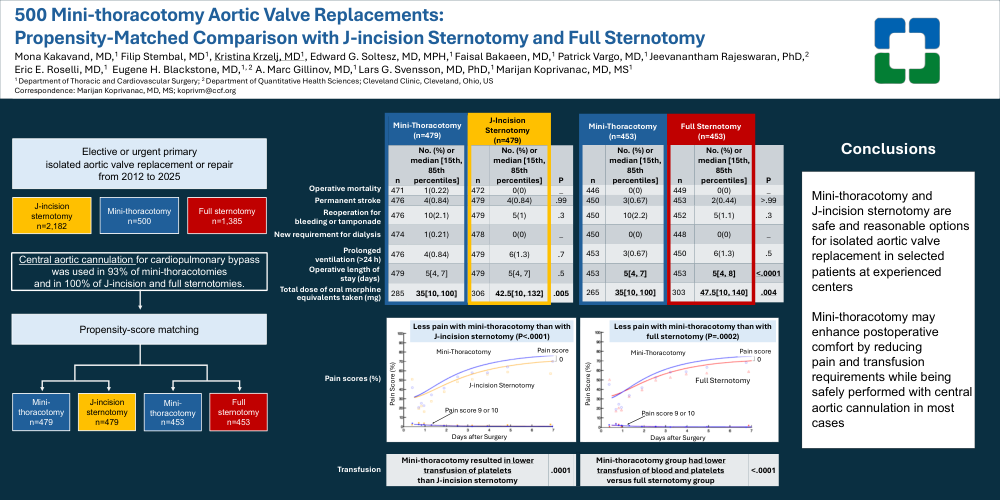
Objective: To compare in-hospital outcomes of aortic valve replacement (AVR) via mini-thoracotomy vs. J-incision sternotomy and full sternotomy for aortic valve stenosis at a single center using propensity score matching.
Methods: From 1/2012-12/2025, 4,067 patients underwent primary isolated AVR via mini-thoracotomy (n=500, including early program cases), J-incision sternotomy (n=2,182) and full sternotomy (n=1,385). Central aortic cannulation for cardiopulmonary bypass was used in 93% of mini-thoracotomies and in 100% of J-incision and full sternotomies. Two saturated propensity models were established using 41 preoperative variables: J-incision sternotomy vs. mini-thoracotomy and full sternotomy vs. mini-thoracotomy. Propensity matching yielded 479 and 453 well-matched pairs, respectively. Administered opioid doses were converted to oral morphine dose equivalents. Patients in mini-thoracotomy group received intercostal nerve blockade at surgeon’s discretion.
Results: Before matching, operative mortality was lower than expected (Society of Thoracic Surgeons Score) across all approaches: 0.21% (mini-thoracotomy), 0.30% (J-incision), and 0.23% (full sternotomy) vs. expected rates of 1.1%, 1.4%, and 1.8%, respectively. Complication rates were similar across groups. After matching, operative mortality remained low: 0.22% vs. 0% for mini-thoracotomy vs. J-incision, and 0% vs. 0% for mini-thoracotomy vs. full sternotomy. The mini-thoracotomy group received fewer platelet transfusions, while J-incision group had shorter cardiopulmonary bypass time; operative length of stay was similar in both approaches. Compared with mini-thoracotomy group, the full sternotomy group required more blood product transfusions, had longer cardiopulmonary bypass time, and longer operative length of stay. Postoperative pain scores and total opioid requirements were significantly lower in the mini-thoracotomy group compared with both other approaches. The risk of reoperation for bleeding was higher after mini-thoracotomy, but not statistically significant.
Conclusions: Mini-thoracotomy and J-incision sternotomy can be a reasonable option for isolated AVR in appropriately selected patients, particularly in high-volume centers with experienced teams. In such settings, mini-thoracotomy may offer enhanced postoperative comfort by providing less pain and lower blood products transfusion rate while maintaining in-hospital outcomes comparable to J-incision and full sternotomy. Mini-thoracotomy can be performed safely with central aortic cannulation in most cases, similarly to J-incision and full sternotomy, avoiding complications associated with femoral arterial cannulation related to aortoiliac/femoral vascular disease.