301 posters, 50 videos, 13 topics, 13 sessions, 739 authors, 192 institutions
ePostersLive by SciGen Technologies S.A. All rights reserved.
ISMICS 2026 Annual Meeting
10 - 13 June, 2026 | Miami, Florida

P111
Asymptomatic Mitral Valve Repair Achieves Survival Comparable To The General Population: Supporting A Proactive Approach?
Part of Topic
Valve � Surgical Valves
Asymptomatic Mitral Valve Repair Achieves Survival Comparable to the General Population: Supporting a Proactive Approach?
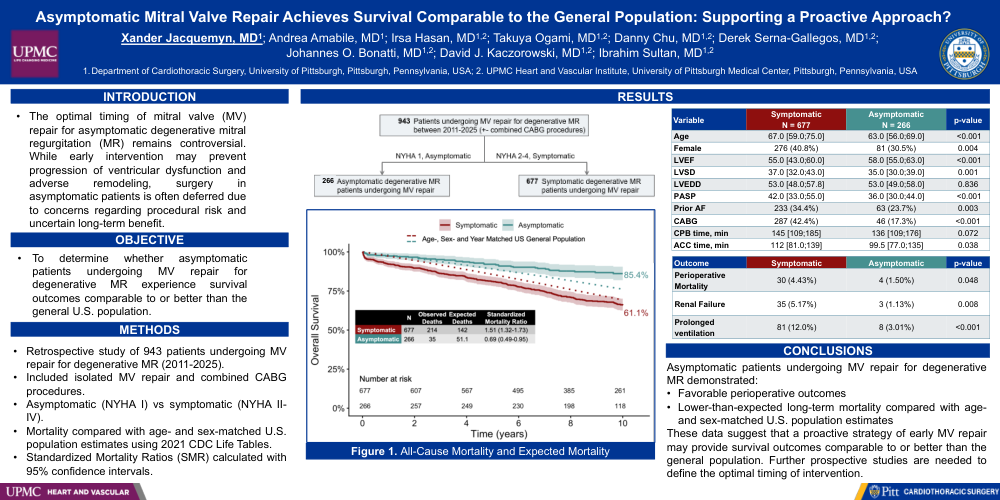
Objective: The optimal timing of mitral valve (MV) repair for asymptomatic degenerative mitral regurgitation (MR) remains debated. We aimed to examine survival of asymptomatic patients after MV repair compared with expected mortality based on age- and sex-matched U.S. population to guide intervention timing.
Methods:We retrospectively analyzed 943 patients who underwent MV repair for degenerative MR between 2011 and 2025, including isolated and combined CABG procedures. Patients were classified as asymptomatic (NYHA I) or symptomatic (NYHA II-IV). Observed mortality was compared with expected mortality derived from 2021 CDC U.S. Life Tables, generating standardized mortality ratios (SMR) with 95% confidence intervals.
Results:Of 943 patients, 266 (28%) were asymptomatic. Asymptomatic patients were younger (63 [56-69] vs 67 [59-75] years, p<0.001), had higher left ventricular ejection fraction (58 [55-63]% vs 55 [43-60]%, p<0.001), lower pulmonary artery systolic pressures. Robotic procedures were more frequent in asymptomatic patients (24% vs 11%, p<0.001). Perioperative mortality was lower in asymptomatic patients (1.5% vs 4.4%, p=0.048), as were rates of renal failure (1.1% vs 5.2%, p=0.008) and prolonged ventilation (3.0% vs 12%, p<0.001). SMR analysis suggested lower-than-expected mortality in asymptomatic patients (SMR 0.69, 95% CI 0.49-0.95) and higher-than-expected mortality in symptomatic patients (SMR 1.51, 95% CI 1.32-1.73).
Conclusions:Asymptomatic patients undergoing MV repair for degenerative MR demonstrate favorable perioperative outcomes and lower-than-expected long-term mortality compared with age- and sex-matched U.S. population estimates. These data suggest that early intervention may be associated with survival outcomes at least comparable to the general population and highlight the potential value of a more proactive treatment approach. Further prospective studies are needed to confirm these findings and guide optimal timing of repair.