301 posters, 50 videos, 13 topics, 13 sessions, 739 authors, 192 institutions
ePostersLive by SciGen Technologies S.A. All rights reserved.
ISMICS 2026 Annual Meeting
10 - 13 June, 2026 | Miami, Florida

P9
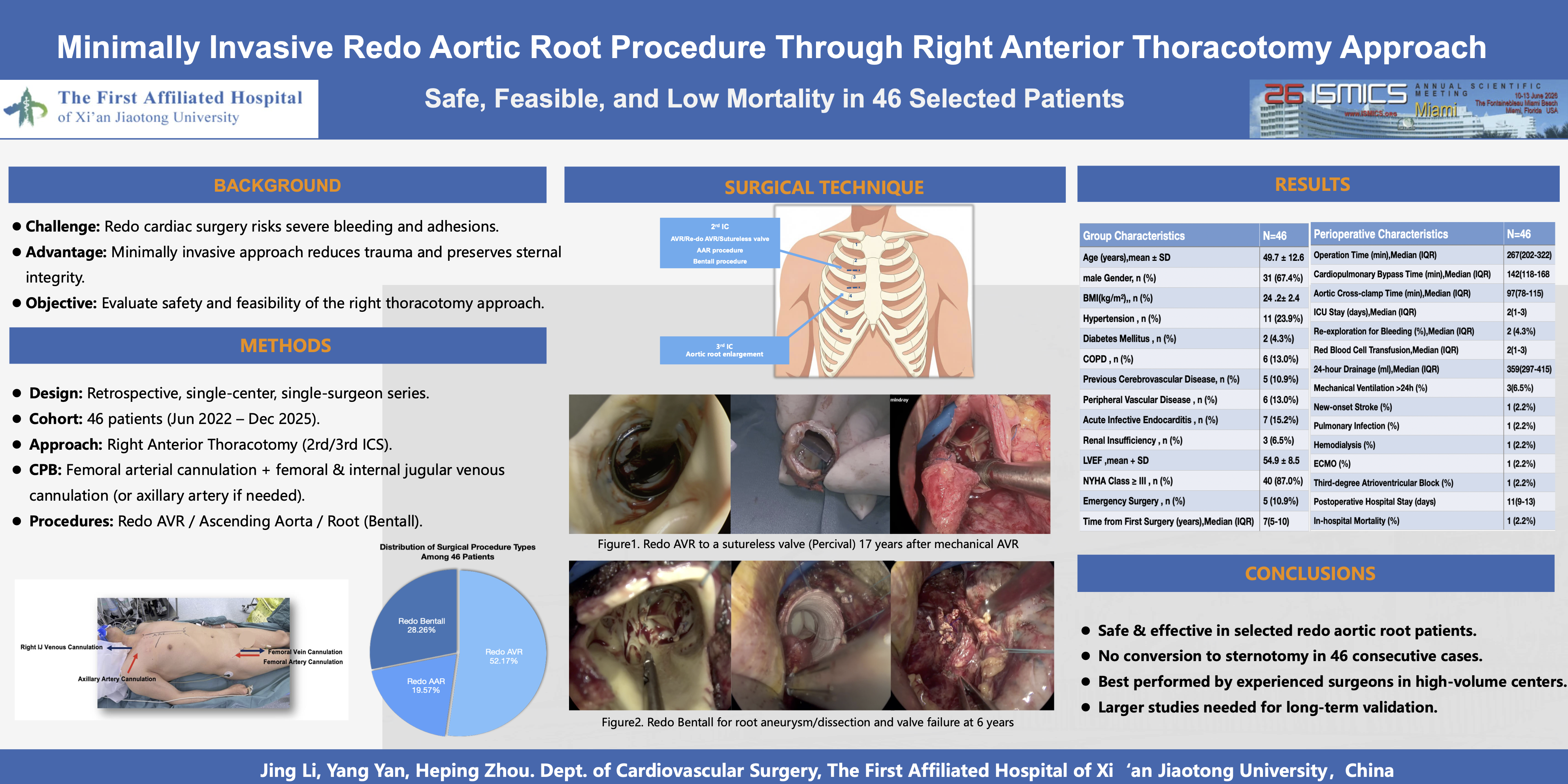
Minimally Invasive Redo Aortic Root Procedure Through Right Anterior Thoracotomy Approach
Part of Topic
Aortic and Endovascular Therapies
Minimally Invasive Redo Aortic Root Procedure Through Right Anterior Thoracotomy Approach
Jing Li, Yang Yan, Heping Zhou. Department of Cardiovascular Surgery, The First Affiliated Hospital of Xi'an Jiaotong University
BACKGROUND:This study aimed to evaluate the early clinical outcomes and summarize the surgical experience of reoperative aortic valve
replacement, ascending aorta replacement, and aortic root replacement performed via a right intercostal minimally invasive approach.
METHODS:Between June 2022 and December 2025, a retrospective analysis was conducted on 46 patients with prior cardiac surgery who
underwent reoperation via a right intercostal minimally invasive approach at the Department of Cardiovascular Surgery, First Affiliated
Hospital of Xi’an Jiaotong University. The cohort comprised 24 patients undergoing redo aortic valve replacement, 9 undergoing redo
ascending aorta replacement, and 13 undergoing redo aortic root replacement (Bentall procedure). Peripheral cannulation via the femoral
artery and vein was utilized in all cases, with adjunctive axillary artery cannulation when indicated. All procedures were performed by a single,
experienced senior cardiac surgical team.
RESULTS: All 46 patients successfully underwent surgery without conversion to median sternotomy. The median cardiopulmonary
bypass time was 142 minutes (IQR, 118–168 minutes), and the median aortic cross-clamp time was 97 minutes (IQR, 78–115 minutes). The 30-
day postoperative mortality rate was 2.1% (1/46). Postoperative complications included re-thoracotomy for bleeding (n=2), acute renal failure
(n=1), stroke (n=1), pulmonary infection (n=1), and third-degree atrioventricular block (n=1). The median postoperative red blood cell
transfusion was 2 units (IQR, 1–3 units). Among surviving patients, there were no in-hospital deaths. The median ventilation time was 10.5
hours (IQR, 8.2–14.7 hours), the median ICU stay was 2 days (IQR, 1–3 days), and the median hospital length of stay was 11 days (IQR, 9–13
days). During a median follow-up of 6.2 months (IQR, 3.8–8.5 months), all discharged patients remained alive without major adverse events.
CONCLUSIONS:The right intercostal minimally invasive approach is a safe and feasible option for selected patients requiring reoperation on
the aortic valve, ascending aorta, or aortic root, demonstrating satisfactory early outcomes. Given the technical complexity of reoperative
cardiac surgery, this approach should be reserved for experienced surgeons in high-volume centers. Careful patient selection is paramount for
success. Larger prospective studies are warranted to validate these findings.