293 posters, 56 videos, 24 topics, 13 sessions, 658 authors, 215 institutions
ePostersLive by SciGen Technologies S.A. All rights reserved.
ISMICS 2025 Annual Meeting
28 - 31 May, 2025 | Istanbul, Turkey

P87
Intravascular Ultrasound To Assess Coronary Obstruction During Transcatheter Aortic Valve Replacement
Part of Topic
TAVI
INTRAVASCULAR ULTRASOUND TO ASSESS CORONARY OBSTRUCTION DURING TRANSCATHETER AORTIC VALVE REPLACEMENT
AIMS
Coronary obstruction (CO) is a rare and yet life-threatening complication of transcatheter aortic valve replacement (TAVR). We currently have at our disposal two techniques to prevent CO: the chimney stent technique and the bioprosthetic or native aortic scallop intentional laceration (BASILICA), both effective and with comparable periprocedural and 1-year outcomes. Nonetheless, assessing coronary artery obstruction during TAVR in the absence of hemodynamic compromise and relying only on angiographic findings can be tricky. In this study, we present our experience with intravascular ultrasound (IVUS) to objectify coronary obstruction during TAVR in patients at high risk.
METHODS AND RESULTS
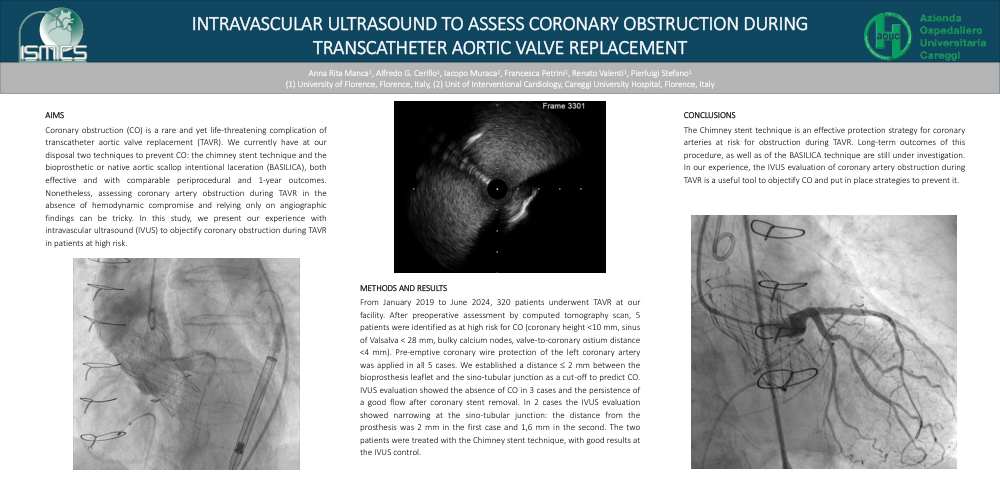
From January 2019 to June 2024, 320 patients underwent TAVR at our facility. After preoperative assessment by computed tomography scan, 5 patients were identified as at high risk for CO (coronary height <10 mm, sinus of Valsalva < 28 mm, bulky calcium nodes, valve-to-coronary ostium distance <4 mm). Pre-emptive coronary wire protection of the left coronary artery was applied in all 5 cases. We established a distance £ 2 mm between the bioprosthesis leaflet and the sino-tubular junction as a cut-off to predict CO. IVUS evaluation showed the absence of CO in 3 cases and the persistence of a good flow after coronary stent removal. In 2 cases the IVUS evaluation showed narrowing at the sino-tubular junction: the distance from the prosthesis was 2 mm in the first case and 1,6 mm in the second. The two patients were treated with the Chimney stent technique, with good results at the IVUS control.
CONCLUSIONS
The Chimney stent technique is an effective protection strategy for coronary arteries at risk for obstruction during TAVR. Long-term outcomes of this procedure, as well as of the BASILICA technique are still under investigation. In our experience, the IVUS evaluation of coronary artery obstruction during TAVR is a useful tool to objectify CO and put in place strategies to prevent it.