293 posters, 56 videos, 24 topics, 13 sessions, 658 authors, 215 institutions
ePostersLive by SciGen Technologies S.A. All rights reserved.
ISMICS 2025 Annual Meeting
28 - 31 May, 2025 | Istanbul, Turkey

P79
Should We Abandon The Transapical Approach?
Part of Topic
TAVI
Video
Transfemoral access is the preferred approach for transcatheter aortic valve implantation (TAVI) due to its minimally invasive nature. However, in the presence of significant peripheral vascular disease or thoraco-abdominal aortic pathology (aneurysm or dissection), what alternatives are available for high-risk patients?
We present two cases where peripheral access was not feasible, and a transapical approach was chosen.
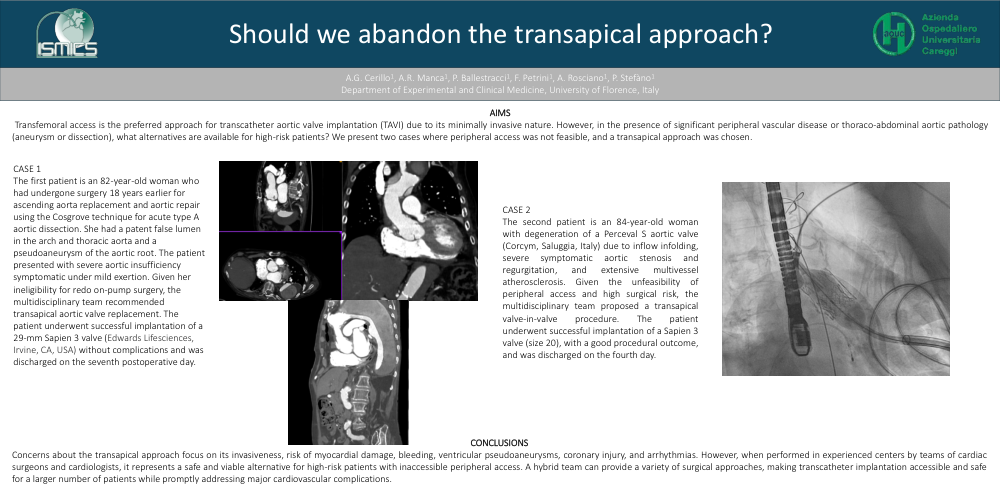
The first patient is an 82-year-old woman who had undergone surgery 18 years earlier for ascending aorta replacement and aortic repair using the Cosgrove technique for acute type A aortic dissection. She had a patent false lumen in the arch and thoracic aorta and a pseudoaneurysm of the aortic root. The patient presented with severe aortic insufficiency symptomatic under mild exertion. Given her ineligibility for redo on-pump surgery, the multidisciplinary team recommended transapical aortic valve replacement. The patient underwent successful implantation of a 29-mm Sapien 3 valve (Edwards Lifesciences, Irvine, CA, USA) without complications and was discharged on the seventh postoperative day.
The second patient is an 84-year-old woman with degeneration of a Perceval S aortic valve (Corcym, Saluggia, Italy) due to inflow infolding, severe symptomatic aortic stenosis and regurgitation, and extensive multivessel atherosclerosis. Given the unfeasibility of peripheral access and high surgical risk, the multidisciplinary team proposed a transapical valve-in-valve procedure. The patient underwent successful implantation of a Sapien 3 valve (size 20), with a good procedural outcome, and was discharged on the fourth day.
Concerns about the transapical approach focus on its invasiveness, risk of myocardial damage, bleeding, ventricular pseudoaneurysms, coronary injury, and arrhythmias. However, when performed in experienced centers by teams of cardiac surgeons and cardiologists, it represents a safe and viable alternative for high-risk patients with inaccessible peripheral access.
A hybrid team can provide a variety of surgical approaches, making transcatheter implantation accessible and safe for a larger number of patients while promptly addressing major cardiovascular complications.