293 posters, 56 videos, 24 topics, 13 sessions, 658 authors, 215 institutions
ePostersLive by SciGen Technologies S.A. All rights reserved.
ISMICS 2025 Annual Meeting
28 - 31 May, 2025 | Istanbul, Turkey

P86
Clampless Repair Technique For Suprasternal Transcatheter Aortic Valve Replacement
Poster Presenter
Part of Topic
TAVI
Background: In patients undergoing transcatheter aortic valve replacement (TAVR), those with unsuitable femoral arteries are considered for an alternative approach. Suprasternal transcarotid access is a commonly used alternative approach. We have developed a clampless technique to avoid vascular occlusion and primary repair of the carotid artery after valve deployment.
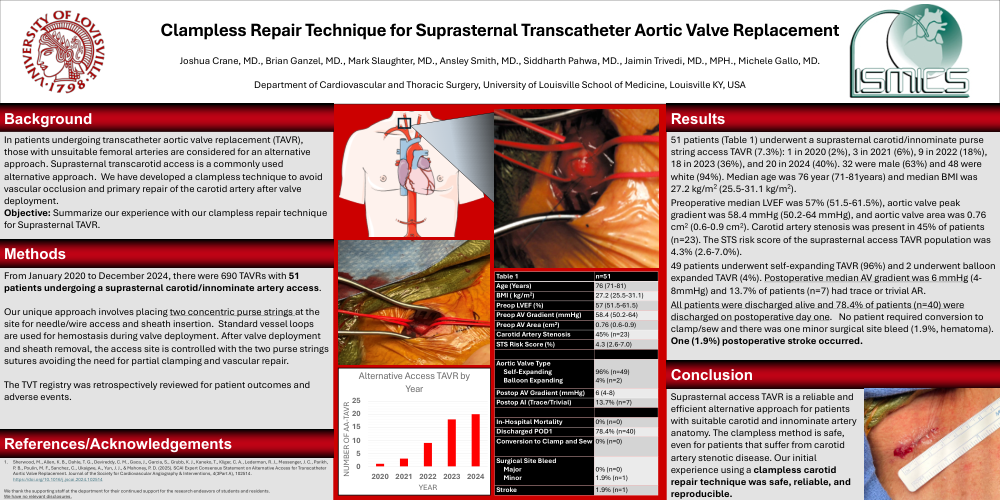
Methods:From January 2020 to December 2024, there were 690 TAVRs with 51 patients undergoing a suprasternal carotid/innominate artery access. Our unique approach involves placing two concentric purse strings at the site for needle/wire access and sheath insertion. Standard vessel loops are used for hemostasis during valve deployment. After valve deployment and sheath removal, the access site is controlled with the two purse strings sutures avoiding the need for partial clamping and vascular repair. The TVT registry was retrospectively reviewed for patient outcomes and adverse events.
Results: 51 patients underwent a suprasternal carotid/innominate purse string access TAVR (7.3%): 1 in 2020 (2%), 3 in 2021 (6%), 9 in 2022 (18%), 18 in 2023 (36%), and 20 in 2024 (40%). 32 were male (63%) and 48 were white (94%). Median age was 76 year (71-81years) and median BMI was 27.2 kg/m2 (25.5-31.1 kg/m2). Preoperative median LVEF was 57% (51.5-61.5%), aortic valve peak gradient was 58.4 mmHg (50.2-64 mmHg), and aortic valve area was 0.76 cm2 (0.6-0.9 cm2). Carotid artery stenosis was present in 45% of patients (n=23). The STS risk score of the suprasternal access TAVR population was 4.3% (2.6-7.0%). 49 patients underwent self-expanding TAVR (96%) and 2 underwent balloon expanded TAVR (4%). Postoperative median AV gradient was 6 mmHg (4-8mmHg) and 13.7% of patients (n=7) had trace or trivial AR. All patients were discharged alive and 78.4% of patients (n=40) were discharged on postoperative day one. No patient required conversion to clamp/sew and there was one minor surgical site bleed (1.9%, hematoma). One (1.9%) postoperative stroke occurred.
Conclusion: Suprasternal access TAVR is a reliable and efficient alternative approach for patients with suitable carotid and innominate artery anatomy. Our initial experience using a clampless carotid repair technique was safe, reliable, and reproducible.