293 posters, 56 videos, 24 topics, 13 sessions, 658 authors, 215 institutions
ePostersLive by SciGen Technologies S.A. All rights reserved.
ISMICS 2025 Annual Meeting
28 - 31 May, 2025 | Istanbul, Turkey

P77
Sex-specific Outcomes And Predictors Of Repair Failure In Minimally Invasive Mitral Valve Surgery
Poster Presenter
Authors
Affiliations
Part of Topic
Mitral Valves
Background
Sex differences in mitral valve disease
outcomes are increasingly reported, but few studies have examined
differences in operative outcomes between men and women undergoing
minimally invasive mitral valve surgery. This study aimed to analyse
sex-specific differences and risk factors for mitral valve repair or
failure in endoscopic mitral valve surgery for degenerative disease.
Methods
From July 2015 to March 2023, 512 consecutive patients (345
male, 167 female) with degenerative mitral valve disease underwent
endoscopic non-rib spreading minimally invasive mitral valve surgery.
All procedures were performed by surgeons proficient in minimally
invasive techniques, with preoperative imaging guidance and standardised
surgical approach.
Results
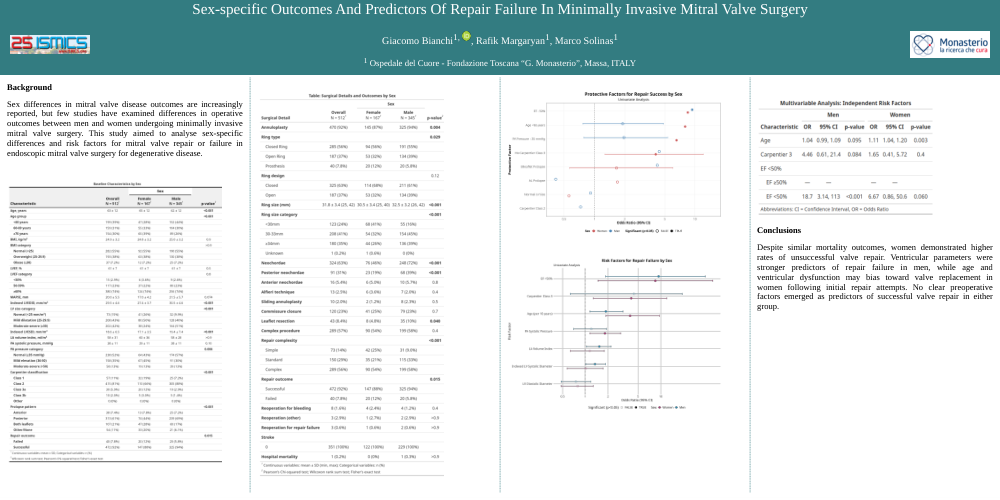
Women were significantly older (67 [59-74]
vs 62 [53-70] years, p<0.001) and had different anatomical characteristics compared to men, including smaller indexed left ventricular dimensions and less posterior leaflet prolapse, higher rates of annular dilatation (19% vs 7.2%, p<0.001) and leaflet tethering (12% vs 2.9%, p<0.001). Men more frequently presented with Carpentier type 2
disease (88% vs 66%, p<0.001) and posterior leaflet prolapse (69% vs
44%, p<0.001). Overall repair success rate was 92%, but while 30-day mortality was similar between groups (0 vs 1, p=0.9), women had a higher failure to repair rate (12% vs 5.8%,
p=0.015). In univariate analysis, sex-specific factors emerged: for men, reduced ejection fraction (<50%) was a significant risk factor for failure (OR 18.7, p<0.001), while normal left ventricular size and Carpentier Class 2 pathology were protective. For women, age (OR 1.11 per year, p=0.003) was the primary risk factor, while ejection fraction ≥50% was strongly protective (OR 14.7, p<0.001). Multivariable analysis confirmed reduced ejection fraction as an independent risk factor in men (OR 18.7, p<0.001), while age remained significant in women (OR 1.11, p=0.003).
Conclusions
Despite similar mortality outcomes, women demonstrated higher rates of
unsuccessful valve repair. Ventricular parameters were stronger
predictors of repair failure in men, while age and ventricular
dysfunction may bias toward valve replacement in women following initial
repair attempts. No clear preoperative factors emerged as predictors of
successful valve repair in either group.