293 posters, 56 videos, 24 topics, 13 sessions, 658 authors, 215 institutions
ePostersLive by SciGen Technologies S.A. All rights reserved.
ISMICS 2025 Annual Meeting
28 - 31 May, 2025 | Istanbul, Turkey

P69
Does Body Mass Index Impact Outcomes In Patients Undergoing Minimally Invasive Mitral Valve Surgery?
Poster Presenter
Authors
Part of Topic
Mitral Valves
Background
Obesity is a major risk factor for cardiovascular disease and increases complications after cardiac surgery, expecially wound healing. Right minithoracotomy has emerged as a favored approach for mitral valve surgery for its numerous benefits, including the reduced incidence of wound dehiscence. This study investigates the impact of Body Mass Index (BMI) on patient outcomes following this approach
Methods
Between January 2010 and December 2024, 1773 adult patients underwent minimally invasive mitral valve surgery. They were categorized into three groups: normal weight (BMI < 25, n=942), overweight (BMI 25- 30, n=661), and obese (BMI > 30, n=170)
Results
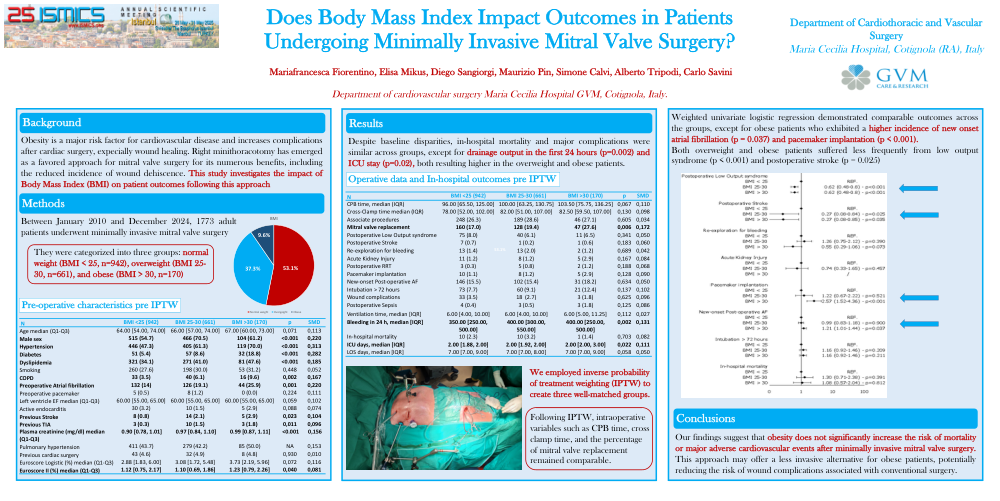
Despite baseline disparities, in-hospital mortality and major complications were similar across groups, except for drainage output in the first 24 hours (p=0.002) and ICU stay (p=0.02), both resulting higher in the overweight and obese patients. We employed inverse probability of treatment weighting (IPTW) to create three well-matched groups. BMI Normal weight Overgeight Obese 53.1% 9.6% 37.3% 53.1% Following IPTW, intraoperative variables such as CPB time, cross clamp time, and the percentage of mitral valve replacement remained comparable. Weighted univariate logistic regression demonstrated comparable outcomes across the groups, except for obese patients who exhibited a higher incidence of new onset atrial fibrillation (p = 0.037) and pacemaker implantation (p < 0.001). Both overweight and obese patients suffered less frequently from low output syndrome (p < 0.001) and postoperative stroke (p = 0.025).
Conclusions
Our findings suggest that obesity does not significantly increase the risk of mortality or major adverse cardiovascular events after minimally invasive mitral valve surgery. This approach may offer a less invasive alternative for obese patients, potentially reducing the risk of wound complications associated with conventional surgery