293 posters, 56 videos, 24 topics, 13 sessions, 658 authors, 215 institutions
ePostersLive by SciGen Technologies S.A. All rights reserved.
ISMICS 2025 Annual Meeting
28 - 31 May, 2025 | Istanbul, Turkey

P75
Body Mass Index Impact On Minimally Invasive Mitral Valve Surgery: Report From A Multicenter Registry
Poster Presenter
Authors
Affiliations
Part of Topic
Mitral Valves
Title: Body mass index impact on minimally invasive mitral valve surgery: report from a multicenter registry
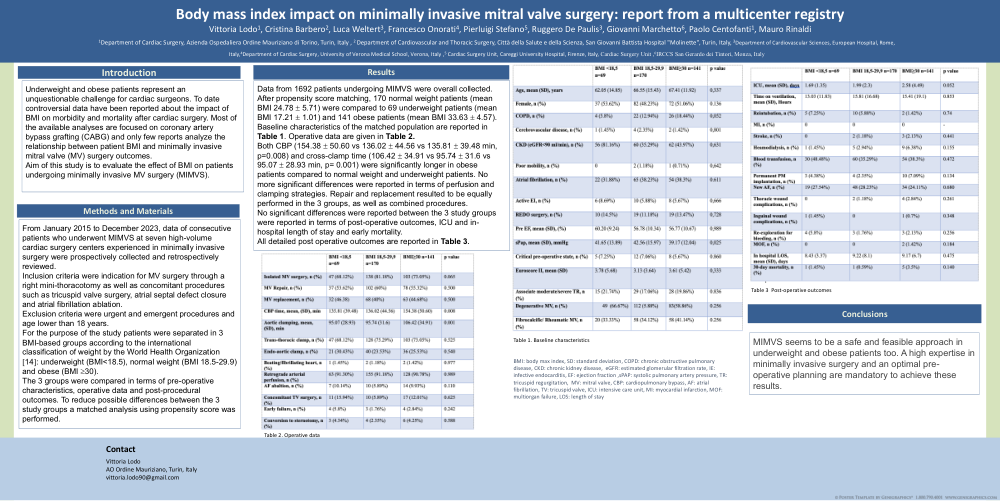
Introduction: underweight and obese patients represent an unquestionable challenge for cardiac surgeons. To date controversial data have been reported about the impact of BMI on morbidity and mortality after cardiac surgery. Most of the available analyses are focused on coronary artery bypass grafting (CABG) and only few reports analyze the relationship between patient BMI and minimally invasive mitral valve (MV) surgery outcomes.Aim of this study is to evaluate the effect of BMI on patients undergoing minimally invasive MV surgery (MIMVS).
Method and material: from January 2015 to December 2023, data of consecutive patients who underwent MIMVS at seven high-volume cardiac surgery centers experienced in minimally invasive surgery were prospectively collected and retrospectively reviewed.Inclusion criteria were indication for MV surgery through a right mini-thoracotomy as well as concomitant procedures such as tricuspid valve surgery, atrial septal defect closure and atrial fibrillation ablation.xclusion criteria were urgent and emergent procedures and age lower than 18 years. For the purpose of the study patients were separated in 3 BMI-based groups according to the international classification of weight by the World Health Organization [14]: underweight (BMI<18.5), normal weight (BMI 18.5-29.9) and obese (BMI ³30).The 3 groups were compared in terms of pre-operative characteristics, operative data and post-procedural outcomes. To reduce possible differences between the 3 study groups a matched analysis using propensity score was performed.
Results: data from 1692 patients undergoing MIMVS were overall collected. After propensity score matching, 170 normal weight patients (mean BMI 24.78 ± 5.71) were compared to 69 underweight patients (mean BMI 17.21 ± 1.01) and 141 obese patients (mean BMI 33.63 ± 4.57). Baseline characteristics of the matched population are reported in Table 1. Operative data are given in Table 2.Both CBP (154.38 ± 50.60 vs 136.02 ± 44.56 vs 135.81 ± 39.48 min, p=0.008) and cross-clamp time (106.42 ± 34.91 vs 95.74 ± 31.6 vs 95.07 ± 28.93 min, p= 0.001) were significantly longer in obese patients compared to normal weight and underweight patients. No more significant differences were reported in terms of perfusion and clamping strategies. Repair and replacement resulted to be equally performed in the 3 groups, as well as combined procedures.No significant differences were reported between the 3 study groups were reported in terms of post-operative outcomes, ICU and in-hospital length of stay and early mortality. All detailed post operative outcomes are reported in Table 3.
Conclusions: MIMVS seems to be a safe and feasible approach in underweight and obese patients too. A high expertise in minimally invasive surgery and an optimal pre-operative planning are mandatory to achieve these results.