293 posters, 56 videos, 24 topics, 13 sessions, 658 authors, 215 institutions
ePostersLive by SciGen Technologies S.A. All rights reserved.
ISMICS 2025 Annual Meeting
28 - 31 May, 2025 | Istanbul, Turkey

P74
Mv Repair: The Trailing Edge Technique
Poster Presenter
Authors
Rosa Giusti, Rafik Margaryan, Giacomo Bianchi, Marco Solinas
Affiliations
null,
Part of Topic
Mitral Valves
Background
In the pool of current mitral valve repair techniques, valve reconstruction with polytetrafluoroethylene sutures isassociated with high repair rates and excellent durability, but is dependenton careful implantation technique. When considering the manner in which freehand neo-chordae are performed, this is often associatedwith subjectivity and variabilitybetween surgeons, and this can lead to different results.
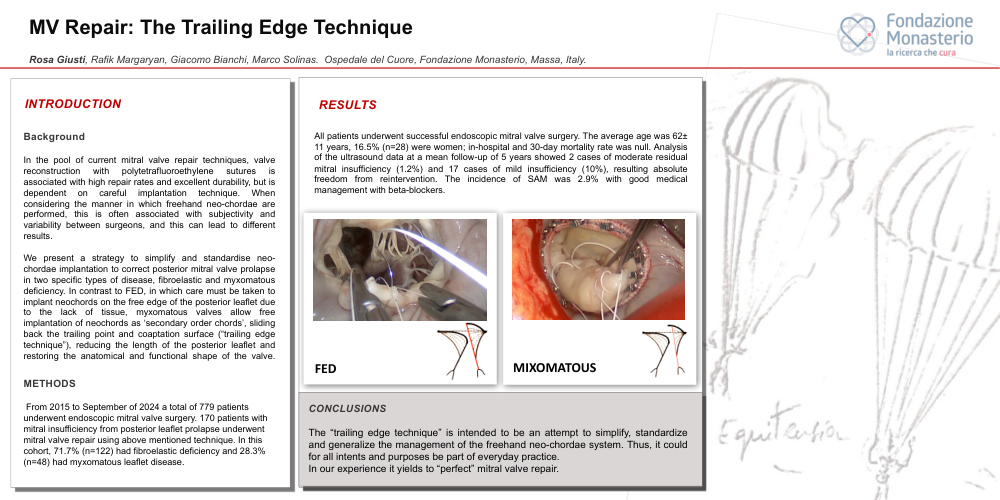
We present a strategy to simplifyand standardise neo-chordaeimplantation to correct posteriormitral valve prolapse in two specifictypes of disease, fibroelastic and myxomatous deficiency. In contrastto FED, in which care must be takento implant neochords on the free edge of the posterior leaflet due to the lack of tissue, myxomatousvalves allow free implantation of neochords as ‘secondary order chords’, sliding back the trailingpoint and coaptation surface(“trailing edge technique”), reducingthe length of the posterior leaflet and restoring the anatomical and functional shape of the valve.
METHODS
From 2015 to September of 2024 a total of 779 patients underwentendoscopic mitral valve surgery. 170 patients with mitral insufficiency from posterior leaflet prolapse underwentmitral valve repair using abovementioned technique. In this cohort, 71.7% (n=122) had fibroelasticdeficiency and 28.3% (n=48) hadmyxomatous leaflet disease.
RESULTS
All patients underwent successfulendoscopic mitral valve surgery. The average age was 62± 11 years, 16.5% (n=28) were women; in-hospital and 30-day mortality rate was null. Analysis of the ultrasounddata at a mean follow-up of 5 yearsshowed 2 cases of moderate residual mitral insufficiency (1.2%) and 17 cases of mild insufficiency(10%), resulting absolute freedomfrom reintervention. The incidence of SAM was 2.9% with good medicalmanagement with beta-blockers.
CONCLUSIONS
The “trailing edge technique” isintended to be an attempt to simplify, standardize and generalize the management of the freehand neo-chordaesystem. Thus, it could for allintents and purposes be part of everyday practice. In our experience it yields to “perfect” mitral valve repair.