293 posters, 56 videos, 24 topics, 13 sessions, 658 authors, 215 institutions
ePostersLive by SciGen Technologies S.A. All rights reserved.
ISMICS 2025 Annual Meeting
28 - 31 May, 2025 | Istanbul, Turkey

P67
Mid-term Outcomes Of Minimally Invasive Aortic Valve Repair With Annuloplasty Ring Device
Poster Presenter
Part of Topic
Aortic Valves
Video
Introduction
Aortic valve replacement (AVR) has traditionally been the treatment of choice for patients with AR. Several contemporary studies have shown that both bioprosthetic and mechanical valves are associated with excess mortality when implanted in young and middle-aged adults as to prosthesis thrombosis, endocarditis constant risk of valve degeneration. 1-2
Over the past 20 years, aortic valve repair (AVr) has become an interesting alternative to AVR in patients with AR. AVr uses native tissues to restore aortic valve function showing similar survival to the matched general population, avoiding the risk of prosthetic valve complications. A lot of surgeons analysed the correlation between the degree of preoperative aortic regurgitation and size of anulus showing that dilated aortic annulus represents a major risk factor for failure of AVR, indicating the need to treat annulus at the time of aortic valve or root repair3-4.Despite this evidence, AVR is today preferred because of eligibility criteria to AVr, recurrency of AR, limited data exist regarding long-term follow-up and valve-related events. 5
The existing AVr techniques, do not completely stabilize functional aortic anulus, for these reasons in 2012 J. Scott Rankin et all, showed the first results in vivo implantation of intra-annular aortic valve with three dimensional Hemispherical Aortic Annuloplasty Ring Technology (HAART).
The study aim to analyze the results of our first series of minimally invasive Avr with annuloplasty ring device HAART.
Methods
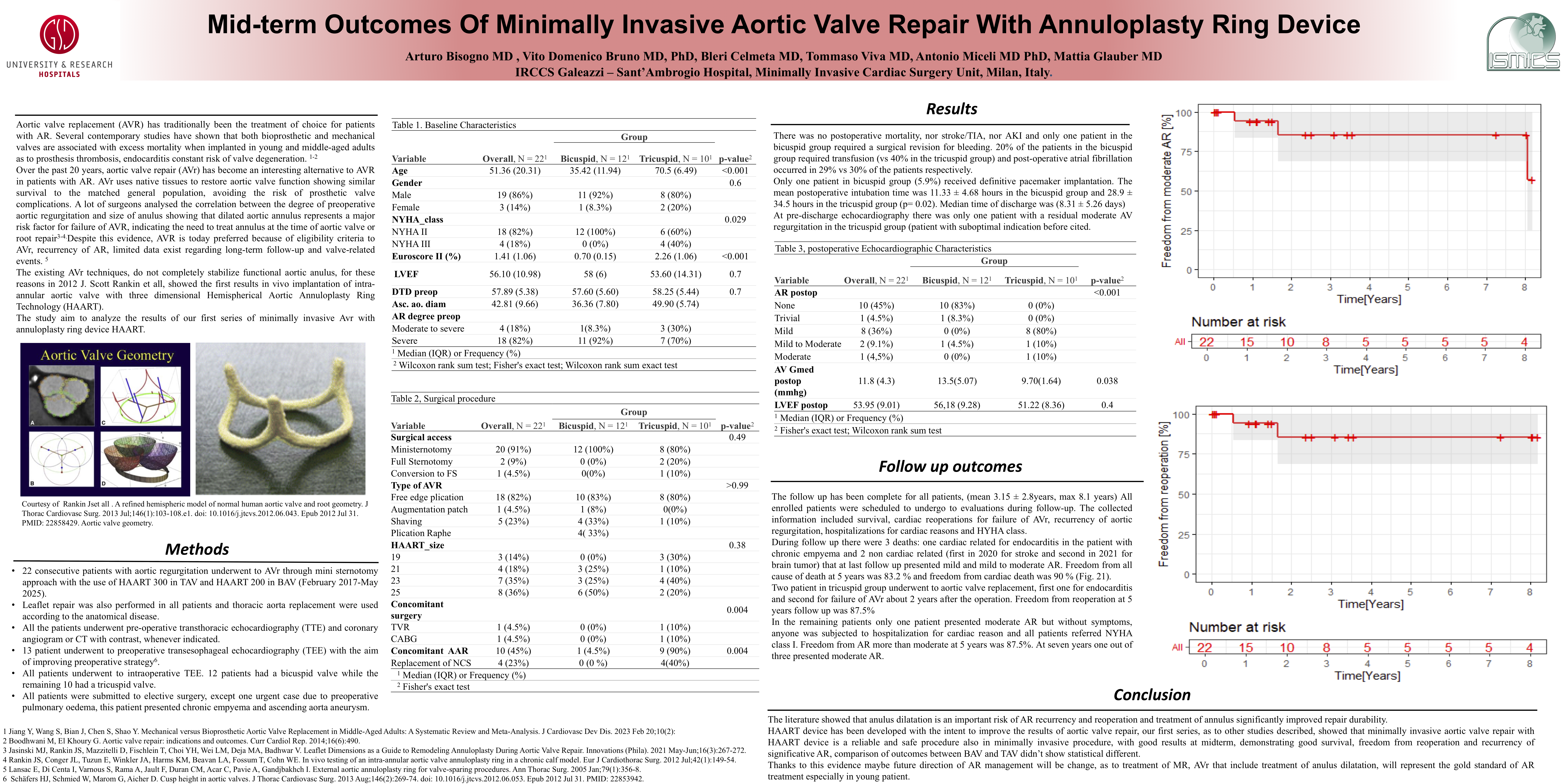
From February 2017 to May 2025, 22 consecutive patients with aortic regurgitation. All patients underwent to AVr through mini sternotomy approach with the use of HAART 300 in TAV and HAART 200 in BAV. Additional leaflet repair was performed in all patients and thoracic aorta replacement were used according to the anatomical disease. All the patients underwent pre-operative transthoracic echocardiography (TTE) and coronary angiogram or CT with contrast, whenever indicated. During the patient enrolment, since 2022 we changed preoperative setting, and we submitted last 13 patient to preoperative transesophageal echocardiography (TEE) with the aim of improving preoperative strategy as described in licterature. All patients underwent to intraoperative TEE. 12 patients had a bicuspid valve while the remaining 10 had a tricuspid valve. All patients were submitted to elective surgery, except one urgent case due to preoperative pulmonary oedema, this patient presented chronic empyema and ascending aorta aneurysm; despite suboptimal indication to AVr to reduce the high risk of infective endocarditis we performed AVr,
Results
There was no postoperative mortality, nor stroke/TIA, nor AKI and only one patient in the bicuspid group required a surgical revision for bleeding. 20% of the patients in the bicuspid group required transfusion (vs 40% in the tricuspid group) and post-operative atrial fibrillation occurred in 29% vs 30% of the patients respectively.
Only one patient in bicuspid group (5.9%) received definitive pacemaker implantation. The mean postoperative intubation time was 11.33 ± 4.68 hours in the bicuspid group and 28.9 ± 34.5 hours in the tricuspid group (p= 0.02). Median time of discharge was (8.31 ± 5.26 days)
At pre-discharge echocardiography there was only one patient with a residual moderate AV regurgitation in the tricuspid group (patient with suboptimal indication before cited.
Follow up outcomes
The follow up has been complete for all patients, (mean 3.15 ± 2.8years, max 8.1 years) All enrolled patients were scheduled to undergo to evaluations during follow-up. The collected information included survival, cardiac reoperations for failure of AVr, recurrency of aortic regurgitation, hospitalizations for cardiac reasons and HYHA class.
During follow up there were 3 deaths: one cardiac related for endocarditis in the patient with chronic empyema and 2 non cardiac related (first in 2020 for stroke and second in 2021 for brain tumor) that at last follow up presented mild and mild to moderate AR. Freedom from all cause of death at 5 years was 83.2 % and freedom from cardiac death was 90 % (Fig. 21).
Two patient in tricuspid group underwent to aortic valve replacement, first one for endocarditis and second for failure of AVr about 2 years after the operation. Freedom from reoperation at 5 years follow up was 87.5%
In the remaining patients only one patient presented moderate AR but without symptoms, anyone was subjected to hospitalization for cardiac reason and all patients referred NYHA class I. Freedom from AR more than moderate at 5 years was 87.5%. At seven years one out of three presented moderate AR.
Conclusion
The literature showed that anulus dilatation is an important risk of AR recurrency and reoperation and treatment of annulus significantly improved repair durability.
HAART device has been developed with the intent to improve the results of aortic valve repair, our first series, as to other studies described, showed that minimally invasive aortic valve repair with HAART device is a reliable and safe procedure also in minimally invasive procedure, with good results at midterm, demonstrating good survival, freedom from reoperation and recurrency of significative AR, comparison of outcomes between BAV and TAV didn’t show statistical different.
Thanks to this evidence maybe future direction of AR management will be change, as to treatment of MR, AVr that include treatment of anulus dilatation, will represent the gold standard of AR treatment especially in young patient.