293 posters, 56 videos, 24 topics, 13 sessions, 658 authors, 215 institutions
ePostersLive by SciGen Technologies S.A. All rights reserved.
ISMICS 2025 Annual Meeting
28 - 31 May, 2025 | Istanbul, Turkey

P65
Minimally Invasive And Conventional Surgical Treatment Of Cardiac Mixomas. A 14 Years Experience Of A National Reference Center
Poster Presenter
Authors
Affiliations
Part of Topic
Aortic Valves
MINIMALLY INVASIVE AND CONVENTIONAL SURGICAL TREATMENT OF CARDIAC MYXOMAS. A 14 YEAR EXPERIENCE OF A NATIONAL REFERENCE CENTER
Julio Moron Castro MD1, Josué Sisniegas Razón MD1, Rios Ortega Josias MD1, Yemmy Perez Valverde MD1, Cristian Aguilar Carranza MD2
- EsSalud, National Cardiovascular Institute (INCOR), Cardiovascular Surgery department, Lima - Perú.
- EsSalud, National Cardiovascular Institute (INCOR), Diagnostic Department, Lima - Perú.
ABSTRACT
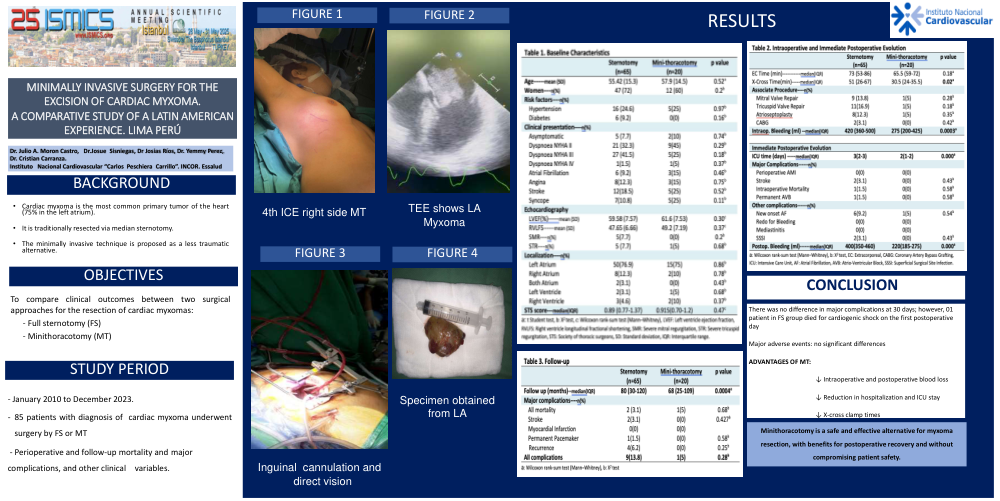
BACKGROUND: Cardiac myxomas have a low incidence and silent clinical presentation. Traditionally, the approach to this pathology through median sternotomy has been the gold standard, however, in the last decade, minimally invasive surgery has become an attractive alternative. In the present study we present the surgical outcomes of minimally invasive surgery approach through right anterolateral mini - thoracotomy and the median sternotomy approach.
METHODS: From January 2010 to December 2023, 85 patients with histopathological diagnosis of cardiac myxoma were treated surgically by right mini-thoracotomy approach or median sternotomy in our hospital. Data was collected from the clinical records. The perioperative results and follow up period were collected and compared between both approaches.
RESULTS: A total of 85 patients were included in the study, 16 were men and 59 were women with a median age of 56.6 ± 15 year. The most frequent clinical presentation was progressive dyspnoea (n= 64, 75.3%) followed by stroke debut (20%). The most frequent location of myxoma was the left atrium (n = 65, 76.4%), followed by the right atrium (n = 10, 11.76%). All patients had a low STS risk score distributed in 65 cases (78.1%) by median sternotomy and 20 cases (23.5%) by mini-thoracotomy. There was no statistical significance between both groups in terms of extracorporeal circulation time but there was a tendency of less aortic clamping time. There was statistical significance in ICU length of stay (IQR media of 3 days (2-3) for stertotomy vs. 2 days (1-2) for mini-thoracotomy (p<0.0001). Patients with anterolateral minitoracotomía had less intraoperative and postoperative bleeding than those who underwent median sternotomy (p<0.0001 for both outcomes). There was no perioperative mortality. Three cases of recurrence occurred during follow-up period.
CONCLUSIONS: Surgical treatment of cardiac myxoma is safe and curative in most cases. The minimally invasive approach offers less intraoperative and postoperative bleeding compared to median sternotomy, as well as fewer days of stay in the ICU, offering a reliable approach with faster recovery and aesthetic scar.
KEYWORDS: Minimally invasive surgery, cardiac myxoma,