293 posters, 56 videos, 24 topics, 13 sessions, 658 authors, 215 institutions
ePostersLive by SciGen Technologies S.A. All rights reserved.
ISMICS 2025 Annual Meeting
28 - 31 May, 2025 | Istanbul, Turkey

P66
Anatomical Predictors Responsible For Endoscopic Aortic Plan Deviation: Feature Analysis And Stratification
Poster Presenter
Authors
Rosa Giusti, Rafik Margaryan, Francesca Chiaramonti, Giacomo Bianchi, Marco Solinas
Affiliations
null,
Part of Topic
Aortic Valves
Background
Endoscopic cardic surgery is gaining interest in isolated aortic valve surgery. However, it remains little or not stadatized due to its difficult planning and execution and large anatomical variability
Our purpose
The aim of this study is to identify the anatomical predictors that determine variations in the surgical approach by analyzing preoperative imaging.
Methods
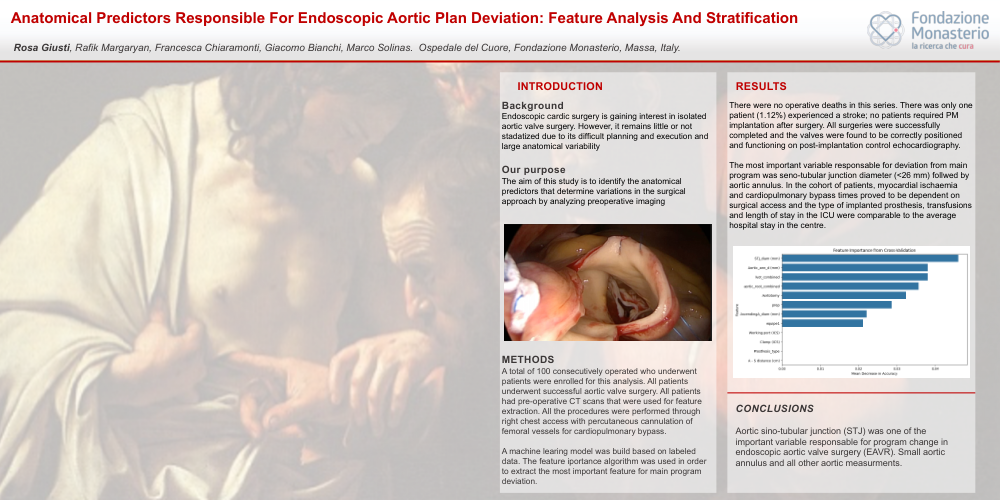
A total of 100 consecutively operated who underwent patients were enrolled for this analysis. All patients underwent successful aortic valve surgery. All patients had pre-operative CT scans that were used for feature extraction. All the procedures were performed through right chest access with percutaneous cannulation of femoral vessels for cardiopulmonary bypass. A machine learing model was build based on labeled data. The feature iportance algorithm was used in order to extract the most important feature for main program deviation.
Results
There were no operative deaths in this series. There was only one patient (1.12%) experienced a stroke; no patients required PM implantation after surgery. All surgeries were successfully completed and the valves were found to be correctly positioned and functioning on post-implantation control echocardiography. The most important variable responsable for deviation from main program was seno-tubular junction diameter (<26 mm) follwed by aortic annulus. In the cohort of patients, myocardial ischaemia and cardiopulmonary bypass times proved to be dependent on surgical access and the type of implanted prosthesis, transfusions and length of stay in the ICU were comparable to the average hospital stay in the centre.
CONCLUSIONS
Aortic sino-tubular junction (STJ) was one of the important variable responsable for program change in endoscopic aortic valve surgery (EAVR). Small aortic annulus and all other aortic measurments.